Wednesday, June 30, 2010

What is a Border Ruffian?

If you are a fan of sports you know that neighboring states often have rivalries that date from history, but most of those rivalries began on the playing fields, not on the killing fields. One exception to the norm is Kansas and Missouri. Of the many names that Kansans have called Missourians - and believe me their labels are numerous - the title of Border Ruffian has achieved a level of infamy that few others can claim. Of course, this particular reference to the term "Border Ruffian" dates back to Kansans attempt at statehood in the mid 1850s and brings to mind a lawless Missourian determined to add Kansas to the Union as a slave state.

Recently while reading War to the Knife: Bleeding Kansas, 1854-1861, by Thomas Goodrich, I ran across a reference to Border Ruffians left by a New Englander, Reverend William Clark, who was a recent emigrant to Kansas. Naturally, the abolitionist the Clark was biased in his opinion of Missourians, but I found his remarks humorous. He stated, "Should my friends wish to know my present views on peace, I would say Peace principles are the best for all classes of men, but as to the wild beasts of Missouri, who walk upright, wear men's clothes, vote [fraudulently] for the people of Kansas, and hang around steam boats - nothing but Colt's revolvers have any influence with them..."

Another free-soiler added this detailed description of Border Ruffians: "Imagine a man standing in a pair of long boots, covered with dust and mud and drawn over his trousers, the latter made of course, fancy-colored cloth, well soiled; the handle of a large bowie-knife projecting from one or both boot-tops; a leathern belt buckled around his waist, on each side of which is fastened a large revolver; a red or blue shirt, with a heart, anchor, eagle or some other favorite device braided on the breast or back, over which is swung a rifle or carbine; a sword dangling by his side, and a chicken, goose or turkey feather sticking in the top; hair uncut and uncombed, covering his neck and shoulders; an unshaven face and unwashed hands. Imagine a picture of humanity, who can swear any given number of oaths in any specified time, drink any quantity of bad whiskey without getting drunk, and boast of having stolen a half dozen horses and killed one or more abolitionists, and you will have a pretty fair conception of a border ruffian..."

As you can see from the t-shirt above, the love between these two states continues to this day. And, whereas Kansans forefathers might have called the Missourians "Scum," "white-trash," "rif-raf," and "pukes;" and Missourians called Kansans "Blue-bellies," "hirelings," "mud-sills," and "pest-house paupers" during the Bleeding Kansas years, one could only hope for such civil language today at a Kansas-Missouri football or basketball game.

Tuesday, June 29, 2010

Random Shots from Harpers Ferry


After spending a few hours doing research in the park's archives last week I took some time to look around Harpers Ferry and snap some shots. Being somewhat familiar with the site I was able to make my way around without having to spend too much time searching for things. The archive and library is on the third floor of the park's John Brown Museum, which sits directly across the street from the fire engine house, or "John Brown's Fort," as it later came to be called.

The museum has a number of excellent exhibits on different aspects of Brown's life. One of the artifacts that stood out during my visit was one of the broad swords that was reportedly used by Brown's sons and his men to kill five proslavery settlers at Pottawatomie Creek, Kansas. Unfortunately I wasn't able to get a good clear photo of the sword to share.

Another neat exhibit was the one pictured above that described some of Brown's weapons, including his famous pikes and Sharps carbines. The two Sharps that are shown here were authenticated as belonging to raider Aaron Stevens (top) and Brown himself (bottom) by Virginia Governor Wise. Both were captured when the engine house was finally stormed and taken by the Marines.


The fire engine house has been moved a number of times since its most famous occupant took up shelter there. It was taken to Chicago in 1891 for exhibition and after proving to be an unpopular attraction was brought back to the Harpers Ferry area, some three miles from its original location, and reconstructed in 1895. In 1903 it was moved to Storer College at Harpers Ferry. It remained there until 1968, when it was moved to its present location in the Lower Town Historic District, some 150 feet from its original location.

The fire engine house...an inside look.


The monument pictured above marks the location where the fire engine house originally stood during the 1859 raid. To the right of the light blue-trimmed building behind the monument in this photo is Hog Alley, where raider Dangerfield Newby was shot through the neck and killed.


The Heyward Shepherd monument is pictured above. It is to the free man of color, who as fate would have it, turned out to be the first victim of the raid. Its interpretation is interesting, in that from what I can tell, Shepherd was just trying to get away when he was shot in the back.


The John Brown Wax Museum is not to be confused with the National Park's John Brown Museum. The wax museum, which as its sign says, highlight's the "Controversial career of John Brown from Youth to the Gallows, in Life Size Figures and Tableaux" is on High Street just off of the park's property. Of course, I had to go in. It cost $7.00 to go through the "museum," so I reluctantly paid my fee. It appeared to me that the exhibit had been updated since it opened, which looked to have been some time around the centennial of the raid. I think it took all of about 10 minutes to walk through all of the different displays of Brown's life. Some of the tableaux's had "push-button" recorded messages that lasted about 30 seconds or so and didn't give much valuable information. One of the exhibits showed the death of baggage master Heyward Shepherd, but he was labeled Shepherd Hayward. I wondered if that had ever been pointed out to them or not.


The photo above, of course, is a shot of Brown climbing the steps of the gallows to be hanged. I can't say that I would recommend a visit to the John Brown Wax Museum, especially for the $7.00 admission fee, but if you want to see what probably passed for a great exhibit when it opened, stop in the next time you are in Harper's Ferry. By the way, you exit a different way than you enter. I think that was probably planned to cut down on visitor complaints.


I didn't eat here, but I couldn't pass up a picture.
Harpers Ferry is one of those National Parks where almost everyone can find something to like. Some visitors will enjoy the town's architecture and living history; others will like the history of John Brown's raid; still others will just wonder at the beauty of the rivers and mountains...and then, there are those like me, that like it all.
P.S. The park's bookstore has a fantastic selection!

Thursday, June 24, 2010

Random Shots from Charles Town and the Kennedy Farm


While in the Washington D.C. area this past week I journeyed up I-270 to Frederick, Maryland and then headed west on 340 to Harpers Ferry to do some research. I was attempting to find out more information on Benjamin Mills, who was the Master Armorer at the time of John Brown's raid. Mills also happened to be a Kentuckian and one of Brown's hostages. But, before going to do my research at the park's archives, I drove on a few miles more to Charles Town, West Virginia.

Although I had been to Harpers Ferry a number of times before, until this trip I had never taken the extra time to go on into Charles Town. Other than the beautiful and huge historic house for sale that I passed as I entered the town, the first sight that caught my eye was the old Jefferson County Courthouse (pictured above).


The courthouse was originally built in 1808 on a lot donated by Charles Washington, (George's brother) the town's name sake. In 1836 that courthouse was replaced by a larger structure which is included in the present building.

Unfortunately, I was there too early and before they opened and didn't get to see inside, but apparently, according to the sign, "visitors are welcome."


Of course, the reason I visited the courthouse was because it is where John Brown was tried and convicted for treason for his role in the Harpers Ferry raid. The building maintains most of its historical integrity, and it doesn't take too much imagination to think what the scene must have been like outside the courthouse during the duration of the trial.

Interestingly, the Jefferson County Courthouse served as the venue for another and later high-profile court case. In 1922 miners were tried there for their role in the "Battle of Blair Mountain," which had occurred on the West Virginia/Kentucky border and pitted striking miners against the state of West Virginia as well as federal troops.


Naturally, while in town, I wanted to find the location where Brown was hanged. Following the directions on a town wayside map I proceeded about four blocks or so from the courthouse and found the historical marker pictured above. A house has been built adjacent to the location, but an iron fence and large yard gives one the understanding that the hanging happened "within these grounds." A huge swarm of pesky gnats were out in full force at the hanging sight so I didn't stay too long.


After visiting Harpers Ferry, (which I will describe in a future post) I asked for directions to the Kennedy Farm from the visitor center attendant. She quickly provided a one page sheet with information on the history of the site and direction on how to get there. What looked like a simple drive out there proved to be quite the adventure.

The Kennedy Farm is where Brown and his men gathered in the months and weeks leading up to the raid. Brown had sent one of his men, John Cook, on to Harpers Ferry about a year in advance of the raid to scout the area and gather information. Cook lived in the town and even married a local woman during his stay. In July 1859 Brown and his sons Oliver and Owen along with raider Jeremiah Anderson arrived in the area. Using the alias of Isaac Smith, Brown rented the Kennedy farmhouse on the Maryland side of the Potomac River, about seven miles from Harpers Ferry.

Brown told locals that asked that he was in the area to do some mining; so the wagons that brought additional men, weapons, and ammunition were not as suspicious. In addition, he had his daughter Annie, and daughter-in-law Martha (Oliver's wife) come to the Kennedy Farm from upstate New York to keep house and make it appear more like a settled home to the passing neighbors.

In the weeks before the raid more men would arrive including free blacks John Copeland and Lewis Leary from Oberlin, Ohio. Brown consulted with the well-informed Cook about the make up of the town and the local slave population. On September 30 Brown sent Annie and Martha back to New York, and on October 16, after a passionate prayer, Brown said, "Men get on your arms; we will proceed to the Ferry."


The house (pictured below) has been carefully restored to appear as it did in 1859. It is not open to the public except for advanced scheduled tours and has a chain link fence around the grounds, so I was not able to get a real close look at it.

If Brown was looking for an out of the way place, but one that was not too far from his planned attack, then the Kennedy Farm was the perfect location. I didn't think I would ever get there. The road is winding and hilly enough to the twenty-first century automobile traveler. I can only imagine what it must have been like for the nineteen century horse and wagon traveler. There is no real good way to get there in the present day. You have to travel way out of your way to even get to the road that takes you there since there is no automobile bridge across the Potomac from Harper Ferry. I chalked it up to adventure and pretended that I was on one of the curvy roads of my native East Tennessee. But, in the end it was worth the drive, and although I wish I could have seen inside the house, I doubt they get the visitation that would permit it to be open without an appointment.

Monday, June 21, 2010

Random Shots from Washington D.C.


Looking through the photographs on my digital camera this evening I noticed that I had a number of various images that probably would not make for a single complete posting, but that I thought were interesting and wanted to share.

The image above is a silver goblet that was presented to South Carolina Representative Preston Brooks by his Edgefield District constituents for his caning of Massachusetts Senator Charles Sumner in 1856 and is on display at the new U.S. Capitol Visitor Center. I had read that people all across the South sent Brooks canes to replace the one that he broke on Sumner, but the expense of a silver cup must have been significant at that time.


The National Museum of American History's ongoing exhibit "The Price of Freedom: Americans at War" is an amazing array of artifacts from the French and Indian War through our present conflicts. I thought the parts of the exhibit that covered the Mexican War and the Civil War were especially well done. The above case included a John Brown pike and Sharp's rifle. Another part of the exhibit also displayed a cannon from "Bleeding Kansas," a box of "Beecher's Bibles," a sporting Sharps rifle that was presented to Brown from an admirer, and a Maynard pistol that Brown's party had brought to Harpers Ferry.


This image of John Brown was on display at the National Portrait Gallery. This is the second time I had been to this museum, but I saw a number of things this time that I had apparently missed on my first visit. At present, they are exhibiting a number of Civil War portraits. It is a don't miss stop if you make it to D.C.


The G.A.R. monument on Pennsylvania Avenue was dedicated in 1909 and is listed on the National Register of Historic Places.


This unique version of the preamble to the Constitution was at the American Art Museum which shares its building with the National Portrait Gallery.


The National Archives and Records Administration is now exhibiting "Discovering the Civil War: Part 1-Beginnings" until September. I was really impressed with the choice of documents that this exhibit is displaying. It gives a number of different perspectives on the causes of the war and why people chose to fought for their particular side. I found that I spent a significant amount of time using the interactive display on the personal connections that a number of the people in the war shared.


The General Winfield Scott Hancock monument at 7th and Pennsylvania and near the National Archives building was dedicated in 1896.


The African American Civil War Memorial is located on historic U Street. The monument was sculpted by Kentuckian Ed Hamilton and was completed in 1997. The memorial is now managed by the National Park Service.


The monument also honors the black sailors that served in the Union Navy.


This image shows the reverse of the monument.


Behind the monument is a listing of over 209,000 soldiers from each USCT regiment, as well as sailors, that served in the Civil War.


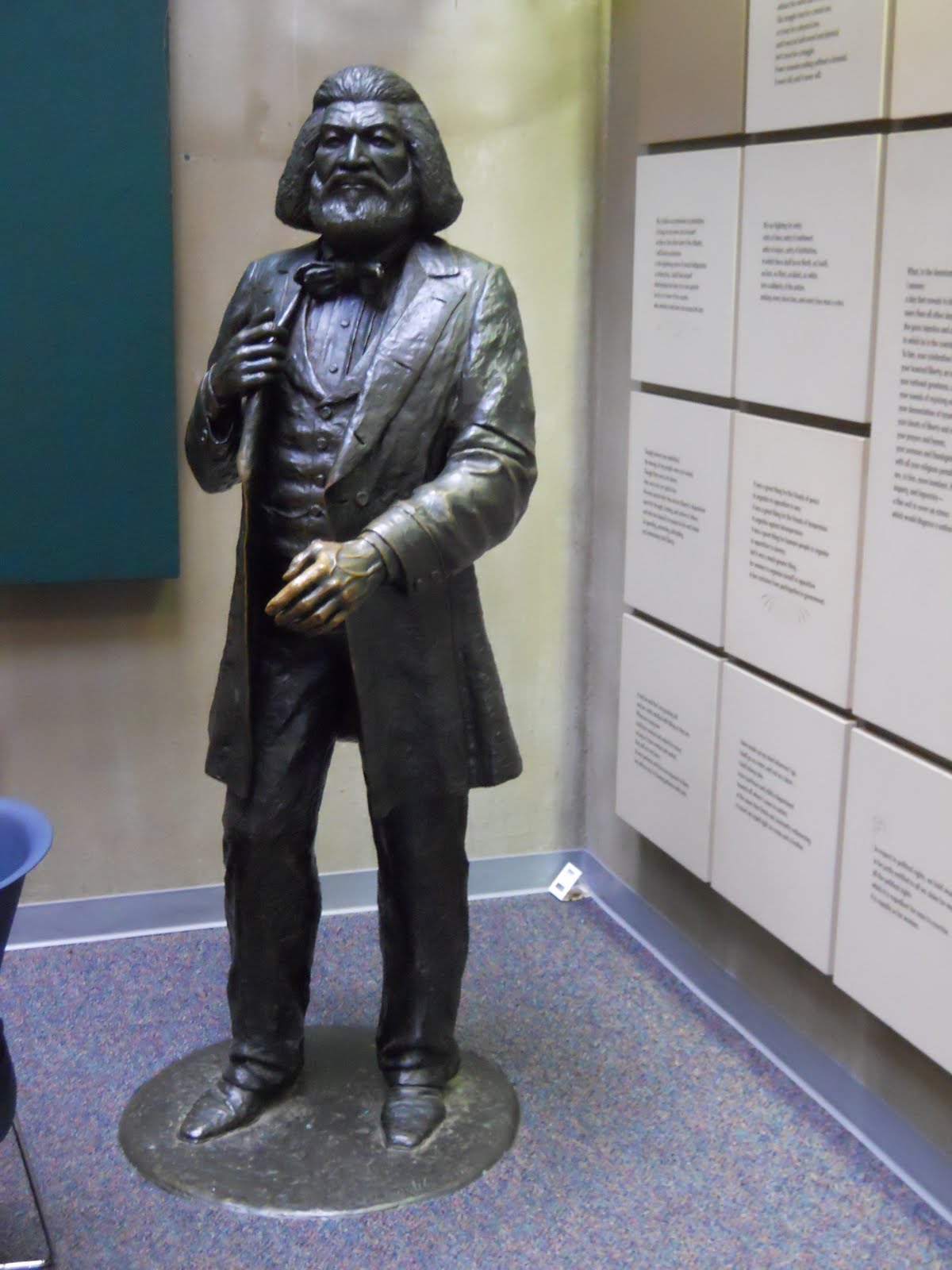
A statue of Frederick Douglass at the Visitor Center of the Frederick Douglass National Historic Site.

Saturday, June 19, 2010

A Visit to Augustus Saint-Gaudens' Memorial to Robert Gould Shaw and the Massachusetts Fifty-fourth Regiment at the National Gallery of Art


There was a time not so long ago that I would not have taken the time to visit the National Gallery of Art (even though it's free), but I have seemingly grown to appreciate art more and more over the past few years. At a conference back in December I had heard that a version of the Robert Gould Shaw and 54th Massachusetts Regiment Memorial was there on display, so while I was in D.C., I thought I'd go for a look see.

It is not enough to say that the work is impressive. This bas-relief sculpture was the work of Irish-born Augustus Saint-Gaudens. The original sculpture was cast in bronze and dedicated on May 31, 1897, and was placed on the Boston Common. At the time the bronze version was being unveiled, Saint-Gaudens was creating a plaster version; the one currently on display at the National Gallery of Art. There were very few actual differences in the two versions.


In 1902 the plaster version was purchased by the Buffalo Academy of Fine Arts and displayed until 1919 when it was covered by a wall. In 1949 the sculpture was donated to Saint-Gaudens National Historic Site in New Hampshire where it was displayed starting in 1959, exposed to the elements. In 1997 it was brought to the National Gallery of Art. After a thorough conservation that included removing old restoration work and filling in damaged plaster the sculpture was coated with a protective resin and placed on display.


The details in the sculpture are striking. From the soldiers' rifles, to their bedrolls and canteens, you can see the care that Saint-Gaudens took in his work. One of the most striking parts of the sculpture is the allegorical figure floating above Shaw and the troops. She carries an olive branch, a symbol of peace, and poppies, symbolic of death, sleep, and remembrance. The label explains that the figure serves "as mediator between the real an the ideal, between the present and the past, between action and remembrance. Her ethereal presence makes the earthly palpability of the soldiers all the more startling and keenly felt." One detail that Saint-Gaudens didn't get right was the date of the assault the 54th made on Battery Wagner. His sculpture has July 23, 1863 inscribed at the base but the attack actually occurred on July 18.

Although Saint-Gaudens produced a number of Civil War monuments before his death in 1907, the Shaw Memorial is probably his most moving public monument. It is indeed a fitting tribute to the brave men that it honors.

Friday, June 18, 2010

A Visit to the Frederick Douglass National Historic Site "Cedar Hill"

After a busy five days at the National History Day contest in College Park, Maryland it was nice to have a break and get to do some sightseeing and try out my new digital camera. When the awards ceremony concluded on Thursday I took the Metro train down to Anacostia to visit the Frederick Douglass National Historic Site in southeast D.C.

If you have been to D.C. you might know that the Potomac and Anacostia Rivers kind of form the base southwestern and southeastern boundaries of the city from Virginia on the Potomac side to Maryland on the Anacostia side. The Frederick Douglass House, "Cedar Hill" is poised on what I was told was the second highest point in the area.

After being dropped off by the bus on W Street I walked less than a block to the site's Visitor Center which is seemingly carved into the side of Cedar Hill. I was surprised and pleased to find that not only was admission to the Visitor Center free, the tour of the house was as well. Inside the center there were some small exhibits on the life of Douglass and a wall of famous and significant quotes. There was also a small gift shop with a good selection of books on Douglass and African American history.

The Visitor Center shows a film that lasts about 20 minutes or so and provides a very brief but good overview of Douglass' full and productive 77 years. Although the film was probably made in the late 70s or early 80s, and is certainly dated in its production, it does give the visitor a good sense of the man and all that he accomplished.


I was told my tour would begin at 3 PM and to meet on the front steps of the house. I made the walk up the hill a little early to get some pictures of the house and to get a feel of the environment. When I visit historic sites I like to try to do just that; get in the "feel" of the place. The view from the front steps was amazing. Although the scenery had changed drastically since the days of Douglass, one can imagine the peaceful feeling that such a setting provided. The high placement of the house also provided a nice breeze that I am sure Douglass appreciated as much as I did.

Our tour guide, Ebony Davis, provided a wonderful tour of the house. The house that Douglass would come to call Cedar Hill had been built in the late 1850s. Douglass moved there with his wife Anna in 1877, when he was nearly 60 years old. As we went through the house room by room I really got a sense of Douglass and what he liked. Ms. Davis informed us that about 70 percent of the furnishings currently in the house are original Douglass family pieces. Seeing things like his beloved violin, leather rocking chair, his library work desk and hundreds of books, all show how far this man had come from his days as a Maryland slave.

Douglass seemed to have enjoyed having images and reminders of those that had worked in the abolitionist and equal rights causes. I saw pictures of Wendell Phillips, Blanche K. Bruce, John Brown, Charles Sumner, and Garrit Smith, among a host of others scattered on the walls throughout the house. I also noticed a framed picture of the the steamboat "Planter" that Charleston, South Carolina slave Robert Smalls piloted out to the blockading Union forces during the Civil War.


Ms. Davis pointed out the wealth that Douglass accumulated during his later years by his speaking engagements. During these years he became known as the "Sage of Anacostia," and was sought out by many younger men for his keen insight and advice. She also explained that he always took special care to be dressed well; image was important to Douglass.

In 1882 his wife Anna passed away. He would not allow anyone to enter her room in the years after her death, even when he remarried 18 months after. His marriage to Helen Pitts, a white woman, was controversial not only in D.C. society, but also in his own immediate family. Douglass basically explained to his family that he didn't see color, only the person the person he loved when he looked at Helen, and if they didn't like it, that was too bad.

Frederick Douglass passed away on February 20, 1895 after attending a women's rights rally. Douglass had championed equal rights for women for almost his entire career as an orator. His second wife Helen preserved Cedar Hill as a memorial to her husband. In 1900 she organized the Frederick Douglass Memorial and Historical Association, and in 1916 it combined with the National Association of Colored Women's Clubs. In 1962 the home was deeded to the National Park Service who currently cares for the house and grounds.


If you want to learn more about Frederick Douglass the man, I don't think there is a better place to do that than "Cedar Hill." It is easily accessible by the Metro train and bus services and the friendly NPS staff ensures that your visit will be both educational and enjoyable.

Friday, June 11, 2010

On the Road to D.C...and Other Adventures

Bright and early tomorrow morning I will be on my way to Washington D.C. with a couple of colleagues for the National History Day competition. Actually, the contest is being held in College Park, Maryland at the University of Maryland, but it's just a short Metro ride from D.C. While we are there we have set up some photo opportunities with some of our Kentucky legislators at the Capitol building and plan on taking in a few sights of the city.

Luckily for me, after the contest is over on Thursday, I get to take a few days of vacation to do some research and visit some other historic sights. I am hoping to get to see the Frederick Douglass House and the Lincoln Cottage at the Soldier's Home, as well as spend some time in Old Alexandria during the following weekend. On Monday I hope to hit the Library of Congress to do some research, and then on Tuesday I have made an appointment to visit Harpers Ferry National Historic Park's research library. Its always a treat to get to Harpers Ferry, but to get the opportunity to do some research is especially exciting as I am sure that I will find some excellent material. While at Harpers Ferry I am going to try to make it to the John Brown Wax Museum (never been) and over to Charlestown (now West Virginia), and also visit the Kennedy Farm in nearby Maryland, where Brown and his men gathered in the weeks before the raid.

I will be taking my laptop and I hope to post every couple days or so about my adventures. For me, the most difficult part of the trip is the wait to get started. Let's go!!!

Tuesday, June 8, 2010

Frankfort's Colored Soldiers Civil War Monument

It has been said in jest that Kentucky didn't secede until after the Civil War. There is no better proof for that comment than the great disparity in the number of Union and Confederate monuments within the Commonwealth's borders. Kentucky never left the Union and sent over twice as many men to fight for the Blue than the Gray, but if post-war monuments had equalled war-time military victories then we might be paying our taxes to Richmond and not Washington.

One of few monuments to the Union in Kentucky, and the only one to Kentucky African American Civil War soldiers, is in the capital city of Frankfort, in Greenhill Cemetery. This ten-foot limestone pillar as it says on the front, was erected on July 4, 1924, by the "Women's Relief Corps No. 8 GAR" (Grand Army of the Republic. The monument was dedicated, "In Memory of the Colored Soldiers Franklin County, Kentucky Who Fought in the Civil War 1861-1865." On the other three sides of the monument there are 142 soldiers' names.

Around 25,000 Kentucky African American soldiers served in the war; almost one-third of the total Union soldiers from the state. More probably would have served if they had been allowed to enlist before March 1864. Almost half of these soldiers were recruited and trained at Camp Nelson in Jessamine County, and a large number of those soldiers saw combat at Saltville, Virginia, the 1864 Nashville Campaign, and the Petersburg/Richmond Campaign.

The day before the monument was dedicated the Frankfort State Journal ran the following short article:
"Colored Soldiers Monument to be Unveiled- The monument, which has been erected to the memory of the Colored Soldiers of the Civil War from Frankfort and Franklin County, will be unveiled at Green Hill Cemetery tomorrow afternoon at four o'clock. Short and appropriate exercises are to be held. This monument has been erected at the cost of several hundred dollars under the direction of the Colored Women's Relief Corps, and each soldier's name has been cut on the stone. Contributions are being made to the fund by patriotic and public spirited citizens of both races."

Saturday, June 5, 2010

Henry Clay Pate Strikes Again

Researching in the University of Kentucky Special Collections at the Margret I. King Library a couple of weeks ago I ran across a pamphlet that was in very bad condition and that I didn't know existed. In all of my reading on John Brown I had never come across a reference to it that I can recall.

Anyone doing research on John Brown has probably come across the name Henry Clay Pate (see June 15, and December 30, 2009 posts). Brown and Pate had some run-ins in the "Bleeding Kansas" years, and Pate, a native Virginian, visited the incarcerated Brown while he was in jail at Charlestown, Virginia awaiting his hanging.

Anyway, this pamphlet was printed in 1859, so it had to have been produced in the few weeks following Brown's execution on December 2. It was printed in New York "by the author." The title is, John Brown as Viewed by H. Clay Pate; a very brief title for a mid-nineteenth century publication of this type - the titles to these things usually run into almost paragraph length.

Other than the usual rhetoric you might expect from a person in Pate's position, and with past experiences with Brown, there was nothing that really caught my eye, except for Pate's biographical narrative on Brown. There were some things that he got right, but for the most part it was totally off the mark.

This section of the pamphlet is labeled, "The Antecedents of John Brown," and I will provide the entire quote:

It will be a gratification to the friends of Horace [Greeley] and Frederick [Douglass] for them to know all about him whose champion they are, and whose advocates they have been. We will first look at the old hero as a Kentucky jail bird. The Evansville (Indiana) Enquirer informs us that John Brown passed two years in Frankfort [state penitentiary] at hard labor, "having been concerned in running off slaves, and was caught in the act." After his term was out, "he went North, avowed himself a martyr to the anti-slavery cause, and became the idol of the Republicans." It seems that old Brown made his headquarters at Henderson, Kentucky, pretending to be a "pedlar," instead of a "miner," as at Harper's Ferry. This was about 1852 or '53. Then Enquirer adds: "Old 'Pedlar' Brown, on one of his excursions, stayed over night at a house about six miles from Evansville, where the editor of this paper happened also to be a guest. The subject of slavery was discussed between them, and in the conversation, Brown stated he had lived in Portage county, Ohio. This, also, it seems, was formerly the home of old "Ossawatomie." He also said that he had a family of sons whom he had dedicated to eternal hostility to slavery. Old 'Ossawatomie' lost two sons at Harper's Ferry, carrying out their eternal hostility." And lost them, the editor might have added, in carrying out the country's "emancipation from the slave power in blood."

I am very curious to know where the editor of the Evansville Enquirer got his information. To my knowledge, John Brown never set foot in the state of Kentucky, and other than this one, there is certainly no solid historic record that he served two years in the state penitentiary. Pate mentions that Brown's activity in Kentucky was in "1852 or '53." At that time John Brown was tied up attending numerous court cases in Ohio, Pennsylvania, New York and Massachusetts concerning suits with his unsuccessful operation of the wool firm Perkins and Brown. He certainly wasn't in Kentucky making little rocks out of big rocks. And, although he did have ties to Portage County, Ohio, (Franklin Mills) and did have a flock of sons that were committed to abolition, that information could have easily been gleaned from the numerous newspaper accounts in the wake of the Harpers Ferry raid.

Obviously, by writing the pamphlet Pate was attempting to make Brown look as dispicable as possible. He certainly had his motives to denigrate Brown; one of the most important being his honor. Brown had captured Pate in Kansas and Pate had published cards and newspaper articles defending himself and giving his side to that story. It just goes to show; retaliation in the media is not something the twenty-first century invented.

Thursday, June 3, 2010

Personality Spotlight: John Anthony Copeland, Jr.

A few months back I found a letter in the Kentucky Gov. Beriah Magoffin Executive Papers that a Lawrence Thatcher had tried to forward to John Brown via another operative. The letter was apparently dropped by said operative and eventually forwarded to Virginia Gov. Wise. Wise in turn forwarded it to Tennessee Governor Isham Harris and Gov. Magoffin due to the contents.

The letter was dated October 3, 1859, just a couple weeks before the Harpers Ferry raid and was marked from Memphis, Tennessee. Thatcher reported to Brown that he had been on a tour through Tennessee and Arkansas and was "now on my way to Kentucky." While in Memphis Thatcher met with a man named Palmer who promised Thatcher that he could raise an army of slaves for an uprising. Thatcher was impressed with Palmer's genuineness and gave a favorable report to Brown of his earnestness. At the end of the letter Thatcher stated that, "I leave Memphis tomorrow by way of Clarksville [Tennessee] for the Mammoth Cave, where I wish to be for a number of days before anything comes off there."

What did Thatcher mean by "before anything comes off there?" Was an insurrection planned for Mammoth Cave? It certainly seems it would have made a good place for such an action. There was a significant slave population in the area, and with so many visitors form across the nation coming to see the amazing wonder of the cave, it would be easy to keep strangers incognito.

I didn't put a whole lot of thought into this possible "Kentucky conspiracy" until I read more about one of Brown's Harpers Ferry raiders: John Anthony Copeland, Jr. In an examination by Federal Marshalls for his participation in the raid, Copeland explained that Kentucky also had been a planned target.

In an article under the headline "Startling Developments," published in the Frankfort Yeoman (as well as a number of other Kentucky newspapers) on October 29, 1859. The article stated that, "He has given the names of the parties at Oberlin who induced him to go to Harper's Ferry, who furnished money for his expenses, &c. He also states that a movement of a similar character was contemplated in Kentucky about the same time." Another source of the actual questioning was, "Have you any knowledge of an attempt to raise an insurrection in any other State or region of our country?" Copeland answered, "I understood that there was an intention to attempt a movement of that kind in Kentucky about the same time." Was this the "thing to come off there" that Thatcher had referenced in his letter to Brown? Maybe, it certainly sounds like it since it was to occur "about the same time" as the Harpers Ferry raid, but we may never know for sure.

John Anthony Copeland, Jr. was born in Raleigh, North Carolina to a free mixed-race father and a free mother in 1834. Copeland's father was emancipated in 1819 and they left North Carolina as a family in 1843. They first settled in Cincinnati then moved to Oberlin, Ohio. Copeland Jr. had helped his father in his carpentry business in his youth, but had apparently received a good enough education to enter Oberlin College for the 1854-55 session.

Copeland's exposure to anti-slavery activity at Oberlin no doubt influenced his decision to join the Oberlin Anti-Slavery Society. In 1858 Copeland was one of 37 men that was arrested for their role in the John Price rescue, also known as the Oberlin-Wellington Rescue (see my June 23, 2009 post). In 1859 Copeland was recruited to join Brown's Harpers Ferry venture by his uncle Lewis Sheridan Leary, who was later shot and killed during the raid.

Copeland was captured after things started turning bad for the raiders. He attempted to cross the Shenandoah River to escape when he was pursued by James A. Holt, a townsman. Copeland and Holt both attempted to shoot each other, but their wet weapons didn't discharge. Copeland threw down his gun and became a captive in the middle of the river. Copeland probably would have been lynched right on the back of the river if it were not for townsman Dr. John D. Starry, who exclaimed, that only cowards would "want to kill a man when disarmed and a prisoner."

In his trial Copeland was found guilty and was sentenced to be hanged on December 16. On his last day of life the 25 year old wrote to his parents. "Why should you sorrow?" he asked. "Why should your hearts be racked with grief? Have I not everything to gain and nothing to lose by the change? I fully believe that not only myself but also all three of my poor comrades who are to ascend the same scaffold- (a scaffold already made sacred to the cause of freedom, by the death of that great champion of human freedom, Capt. John Brown) are prepared to meet our God."

Speaking of Copeland and his stoic nature in facing his death, the Virginia prosecuting attorney said Copeland, "behaved himself with as much firmness as any of them, and with far more dignity. If it has been possible to recommend a pardon for any of them it would have been this man Copeland as I regretted as much if not more, at seeing him executed than any other of the party."

Copeland's body, along with that of fugitive slave raider Shields Green and Brown's son Watson, were taken to the Winchester Medical School where they were used as dissecting cadavers. Watson Brown's body was eventually recovered and reinterred with his father in New York state, but Copeland and Green's remains were never reclaimed. In 1865 the African American citizens of Oberlin erected a monument to Copeland, Green and Leary. Although only Copeland and Leary had ties to Oberlin, the community chose to honor the three together.

Sunday, May 30, 2010

The Kentucky Military Institute and John Brown's Raid

When I began my research project on Kentuckians' reactions to John Brown's raid, I wondered if there were any connections (however remote) between the Kentucky Military Institute and the state's responses to the raid. I suppose this came to mind due to the noted role that the Virginia Military Institute played in Brown's execution. The Virginia cadets were used as guards at that event on December 2, 1859 in Charlestown, Virginia, and were accompanied by Professor and Major Thomas Jonathan Jackson, later to be known as "Stonewall." In addition, Virginian and arch-secessionist, Edmund Ruffin, borrowed an overcoat from the cadets in order to observe the hanging in person, as civilians were not supposed to be in attendance.

I was pleased to recently find that my hunches were correct; indeed KMI did have connections in response to the raid. In the Friday, January 20, 1860 edition of the Lexington Kentucky Statesman newspaper an article ran under the title of "Citizen Soldiery." In the immediate aftermath of Harpers Ferry, Kentucky newspaper editors vehemently called for a reorganization of the state's militia system, which was also later demanded by Governor Magoffin. A new state militia system, the Kentucky State Guard, finally took effect by order of the state legislature in March 1860. But, in the weeks after Brown's execution the demand was still being made to secure the safety of Kentucky's citizens.
In the "Citizen Soldiery" article the Kentucky Statesman editor called attention to a recent submission to the Frankfort Yeoman newspaper that praised KMI, which was located near the capital city. The editor explained that, there was an "importance of establishing our State militia upon a war footing, defensive if not offensive." He went on to state that, "Ours is a border State, and whenever the conflict comes, we must stand the brunt of the battle....Geography has assigned Kentucky her position, and her people will accept it in no craven spirit; and our legislators should not leave it to a late posterity to reproach them with being unfaithful guardians upon our watch-towers."
The editor then closed with his recommendation and full endorsement of KMI, especially in the then present tying times. He stated, "We recommend this Military Institute to the patronage of the citizens of Kentucky; for their sons may require the sword as well as they scythe; and they will find, unless some good Providence give a different direction upon this mad time, that those men will be most useful to their State who have made more proficiency in tactics than in the quieter paths of the classics." (Emphasis in original.)


The Kentucky Military Institute was founded in 1845 by Robert T.P. Allen, a former West Point graduate, veteran of the Seminole War, and professor at Transylvania University, and was chartered in 1847. The institute was located just six miles south of Frankfort and drew students largely from the Ohio River valley and the Southern states. The school produced scores of soldiers for both the Union and Confederacy during the Civil War. In 1894 the school moved to Mt. Sterling, Kentucky, and then in 1896 moved to Lyndon, in Jefferson County, Kentucky. In 1906 the Institute began the interesting (and I'm sure popular) practice of moving its winter session to Florida, and apparently and strangely, it kept up the practice until it closed its doors in 1971.
Military institutes were extremely popular choices for Southern parents in the antebellum years. Almost every Southern state could count one or more private or state supported military schools. In his book, The Militant South, historian John Hope Franklin explained their appeal to antebellum Southerners. A military style education, "provided the type of experience that made for stronger, healthier men," plus it encouraged a high level of scholarship, reinforced Southern values, and properly prepared the pupils for their futures as Southern men .(pg. 139)
As my research continues, I hope to find more interesting connections between KMI and John Brown's raid.

Tuesday, May 25, 2010

The Wilderness Battlefield on the National Trust's Top Eleven Endangered Sites

A few posts back I mentioned that the Civil War Preservation Trust (CWPT) had released its top ten endangered battlefields. Well, just on their heels came the National Trust for Historic Preservation's list of the top eleven endangered historic sites in the United States.

It was both pleasing and disturbing to see that the National Trust also included the Wilderness Battlefield to their list. It was pleasing in that the threat there is being made known to an even larger audience than solely battlefield preservationists, but it is disturbing in that this hallowed ground is in such danger as to make both lists.

Along with the Wilderness, the other sites on the top eleven in danger are a diverse group. Hinchcliffe Stadium in Patterson, New Jersey is only one of three Negro League baseball stadiums still in existence. Once the home of the New York Black Yankees, this now dilapidated stadium once used to host some of baseball's best players. Also included on the list is Black Mountain in eastern Kentucky. The towns of Benham and Lynch were booming coal towns in the first half of the twentieth century, but now the towns face threats from the mineral that first brought them into existence. Surface and deep coal mining projects endanger the historic feel of these areas, which have worked so hard to reinvent themselves into a special heritage tourism area.

The most unusual "site" listed is not actually in one single location. The National Trust made it a point to explain that deep cuts to states' budgets have caused many state historic sites and state-owned parks to forfeit much of the wonderful work and programming they provide to their citizens. They report that almost 3o states have experienced budget cuts to their state parks and historic sites and that as many as 400 parks and sites could be closed due to those cuts. At issue is not only the present availability of the parks and sites, but also the significant damage that could occur due to abandonment and or lack of maintenance.

Now is the time to act. Write your representatives, both state and national, and tell them how important these sites are to you and all citizens. Visit these sites. Your tourism dollars can mean whether a site stays open or if it disappears in a flurry of development or possibly closes for good.

To learn more about the National Trust for Historic Preservation's Top Eleven Endangered sites click on the following link:
http://www.preservationnation.org/issues/11-most-endangered/

Sunday, May 23, 2010

327 Acres at Perryville is CWPT's Latest Charge

I always enjoy getting mail from the CWPT. They do a great job of keeping us members well informed of preservation opportunities all across the nation. Not only do they provide wonderful explanations of what happened on the historic grounds they trying to save, they also include a detailed map that shows troop movements over that ground as well as areas of that battlefield they have already helped preserve.

Their latest effort is to save 327 acres at Perryville, Kentucky. Perryville is significant to me because as an 11 year-old, it was the first battlefield I ever visited. I can remember taking dozens of pictures on that visit and spending most of my time looking at everything twice. At that time I didn't know when I would get the opportunity to come back so I wanted to make the most of it. Fortunately, since then, I have been back to Perryville a number of times. I am always amazed by how natural it feels there. There aren't the huge number of stone monuments like at a Gettysburg or Antietam and I have heard it said many times that if it was possible to bring back the soldiers that fought there, they would not have a difficult time recognizing where they were. In my humble opinion, that is probably the best compliment that a battlefield can be given.

The Battle of Perryville was fought on October 8, 1862 as the Union troops under Don Carlos Buell clashed with Confederates of Braxton Bragg's army along the banks of Doctor's Fork, a tributary of the Chaplin River. While the Confederates maintained determined attacks against the Federal left flank, the Union troops defensively held on until nightfall, when Bragg determined to withdraw.

That day's worth of fighting would prove to be the most significant battle in Kentucky during the Civil War and would produce nearly 7,500 casualties. The cost in life and suffering was high, not only for the soldiers, but also for the Perryville community, which turned into a vast hospital immediately after the battle.

The CWPT is making this preservation effort easy for us. With a match in funds being offered that provides each acre for only $517, this deal is a steal.

To learn more about the Battle of Perryville and contribute to this worthy cause please check out the CWPT's Perryville page at:
http://www.civilwar.org/battlefields/perryville.html

Friday, May 21, 2010

Yeeah, West Virginia!!!

Since moving to Kentucky, I have noticed that they have a little self-deprecating joke here. Depending on the issue (education, joblessness, poverty rate, or such) it is often exclaimed, "Thank God for West Virginia...(or maybe Mississippi), meaning that at least Kentucky is not last in something. This year the reference has been expressed with extra disdain since the Mountaineers beat the Wildcats in the NCAA basketball tournament. Although I don't have anything against West Virginia personally, I must admit I certainly don't enjoy driving through it on I-64. It seems every time I make the trip to Virginia from Kentucky, or to Kentucky from Virginia, I get another chip in my windshield from a piece of gravel some huge truck kicked up while driving in the "Mountaineer" state. But, finally, I have found something that affords me the opportunity to heap praise on the state that seceded from a state that seceded (follow that?).

I have found the West Virginia Memory Project from the West Virginia Division of Culture and History that features the collections of the West Virginia Archives and History. More specifically, I have found the John Brown/Boyd B. Stutler Collection Database website for the West Virginia Memory Project.

Anyone doing research on John Brown has probably come across the name Boyd B. Stutler. Stutler was the man! If you think I am fascinated by John Brown, you'll think this man was a John Brown nut! Stutler (1889-1970) was a WWI veteran, a newspaper man, and long time editor of the American Legion Magazine. For over half his life, Sutler was dedicated to collecting anything related to John Brown and of Brown's efforts at Harpers Ferry. Stutler was mainly a collector, but he did contract to write a biography of Brown in the 1950s. Unfortunately, the work was never completed. He did write "The Hanging of John Brown" for American Heritage, which appeared in the February 1955 issue. Although he did not prove to be a prolific writer, he did not jealously guard his collection, but rather, he made it readily available to those scholars working on John Brown projects. When Stutler passed away his collection went to the state of West Virginia and is now housed in The West Virginia Division of Culture and History in Charleston.

This "searchable" online collection has already proven to be valuable to me in my research. I had been searching for a few month for Kentuckian Cassius M. Clay's speech in Frankfort on January 10, 1860 without luck. This source appeared to be important to me because I had found references to it in period newspapers that mentioned Clay's reactions to Brown's Harpers Ferry raid, and that the same day Clay made his speech, a pike and the noose used to hang Brown were passed around Frankfort as propaganda tools by the Democrats. Well, I found the speech in printed form on the Stutler collection website and confirmed those references. Tremendous! Without this valuable research tool I would have had to search longer or made an unexpected trip to Charleston, West Virginia to get my hands on it. In addition, I also found another Clay speech, this one made in Covington, Kentucky, that also referenced Brown a number of times, as well as part of the testimony of John A . Copeland, a free black raider, who mentioned that he was aware of another insurrection planned for Kentucky. Huge find! And, it all would not have been possible without the state of West Virginia making it available to researchers like me. I think Mr. Stutler would be proud that his collection is being made so easily accessible to the public through this wonderful website.

To take a look and browse around for awhile use the following link:
http://www.wvculture.org/hiStory/wvmemory/imlsintro.html

Tuesday, May 18, 2010

"In Defense of Academic History Writing"

Last week at work friend and colleague Stuart Sanders shared an article with me that I would in turn like to share with you. The article, "In Defense of Academic History Writing," was written by the acclaimed early American historian Gordon Wood and appeared in Perspectives on History.

I won't attempt to summarize the relatively short article, rather I will leave it to you to read and make the decision whether you agree or disagree. I will say that I heartily agree with Wood's assessment. Personally, I thoroughly enjoy reading academic, or as he calls it, "analytic" history. The research and thus gained understanding of the past that academic historians have provided over the past 60 years or so is amazing. Their contributions to history, whether widely read or not, have advanced the field and our knowledge.

The article can be accessed via the following link:
http://www.historians.org/Perspectives/issues/2010/1004/1004art1.cfm

Monday, May 17, 2010

So, What Exactly is Gutta Percha?

We are quickly approaching an important anniversary in American history. In a few short days (May 22) it will be 154 years (that's 1856 if you don't want to do the math) since South Carolina Congressman Preston Brooks beat Massachusetts Senator Charles Sumner on the floor of the U.S. Senate. When I read about the incident a few years ago I found that Brooks has used a gutta percha cane for his assault weapon (not pictured here).

When I read that, the first question to myself was, what the heck is gutta percha? I had never heard of it before. Well, apparently it was quite the new product discovery of the mid-nineteenth century.

Gutta percha is a hard rubber much like many of our plastic products today. It came from the gutta percha plant/tree (pictured below) of Southeast Asia. Although indigenous peoples in the region had used the product for centuries, Europeans in the 1840s found that extracting the sap from the plant by boiling it and then allowing it to dry in the sun produced a latex that could used in for many different products. One of the positives that made gutta percha highly desirable was the fact that it could be easily moulded and did not shrink when it cooled.
Gutta percha back then, like plastic today, was used for just about everything that you can think of. It was used to insulate submarine telegraph cable, and to make molded jewelry and intricate furniture. It found favor with pipe manufacturers for durable pipe stems, and even was used in the mass production of golf balls.

Gutta percha was used readily well into the twentieth century for things as diverse as pistol grips and tooth fillings.

Thursday, May 13, 2010

CWPT Releases 2010 Most Endangered

In their ongoing crusade to save as many acres of Civil War battlefield land as possible, the Civil War Preservation Trust annually names their top ten most endangered grounds.

This year's list features some of the best known, and also some of the least known battlefields in America. Among the famous sites are lands that saw enormous casualties, such as Gettyburg, where a gambling casino is attempting to spoil the battlefield environment, and the Wilderness, where the Super Wal-mart fight continues. In Richmond, Kentucky a new highway interchange threatens the tremendous efforts and accomplishments underway there. At Pickett's Mill, Georgia, state budget cuts have limited the availability of the park to the public, reduced the staff, and left needed projects undone.

Lesser known sites, such as Camp Allegheny, West Virgina, where a project to place a number of forty-story high wind turbines would destroy the pristine environment and historic atmosphere; and Thoroughfare Gap, Virginia, where a proposal to build a huge cell telephone tower would likewise ruin the historic feel of the area, are both significant threats.

For more information on the other sites and how you can help contribute to fight the development of these Civil War battlefields, please visit: www.civilwar.org/history-under-siege/

Wednesday, May 12, 2010

Think You're Having a Bad Hair Day?

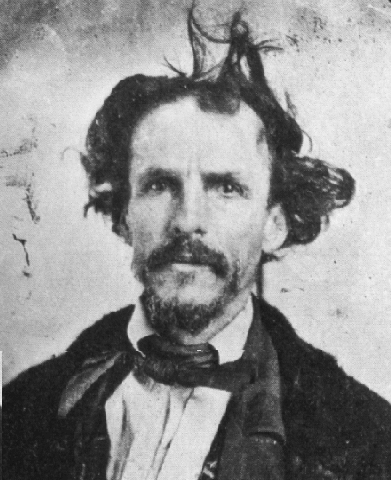
I remember in junior high that if you came to school with your hair a mess everyone would ask you, "Have you heard of this new invention?....It's called a comb!" And, heaven forbid that you show up for your school pictures with the "bed head." As a matter of fact, I remember that the school photography company gave out free combs so you could look well-groomed. Well, apparently for some nineteenth-century men, the "smooth do" was a matter of little concern when it was time to have their likeness made. For my examples I have provided three individuals...and these are not some unknown yahoos...even though they looked like it when these images were made.

First, we have Kansas senator James Lane (pictured above). Lane was born in Lawrenceburg, Indiana and served as Hoosier U.S. congressman before he moved to Kansas in the 1850s. Lane was as fierce as a free-state proponent in Kansas as this image makes him out to be. During the Civil War he raised a brigade of Kansans and was commissioned a general. I don't know what Lane (or the photographer) was thinking when this image was taken. That's a pretty bad look. Maybe he didn't care, and maybe the photographer thought he would have a little fun at Lane's expense by not advising him to find a comb. He certainly doesn't have the excuse that they weren't invented yet.

Next we have "Honest Abe." As I understand it Lincoln was about 47 years old when this image was taken, so that would put this in the mid-1850s. Certainly he had not attained the fame that would come in a few short years, but he was a well known and well paid Illinois attorney that should have had a positive image to uphold. In this picture, Lincoln looks like he either came straight to the photographer from his pillow, or after a hard-fought wrestling match.

Lastly, we have stern-looking John C. Calhoun from South Carolina. Along with Henry Clay and Daniel Webster, Calhoun was regarded as one of the most important statesmen in the nineteenth-century. Although he died over a decade before the Civil War, Calhoun is often credited with laying the foundation for eventual Southern secession. He fiercely defended Southern interests such as slavery and free trade and longed to be president. Calhoun had a head of hair that any man his age would envy, but true to his fiery nature he never seems to have been able to control it. Even when he pulled it straight back from his forehead it appeared Medusa-like.
So, the next time you find it difficult to tame your mane, don't feel so bad. You can easily claim to be in good company....if you have a time machine.