Wednesday, August 31, 2011

Cherokee Nation Expels Descendants of Tribe's Black Slaves

I received an emailed article from a colleague at work today that was very interesting. The article explained that recently the Cherokee Supreme Court (they are a sovereign people) ruled that only Cherokees of blood descent are allowed to be members of the tribe and thus benefit financially from the profits they earn from their casino businesses. That means that descendants of former Cherokee slaves who had long been considered official members of the tribe are now not.

Not too many people know that the Cherokees, among many other southern Indian tribes such as the Creeks, Chickasaws and Choctaws held African American slaves. Many of these tribes had become so-called "civilized" to white ways in the early 19th century and that included agricultural slaveholding. When most of these Indians were removed to west of the Mississippi River in the 1830s, they took their slaves with them.

I really want to know more about this topic and there appears to be several good books out there about it. One is pictured here: Ties that Bind: The Story of and Afro-Cherokee Family in Slavery and Freedom, by Tiya Miles. Others include African Cherokees in Indian Territory: From Chattel to Citizens, by Celia E. Naylor, and The House on Diamond Hill: A Cherokee Plantation Story, by also by Tiya Miles.

To me the relationship between these two groups is fascinating. Here are two of the most oppressed peoples in American history and yet one group was willing to hold the other as slave. I guess it goes to show something that should not surprise any of us; that is that sometimes people are motivated more by economics than by common circumstances.

Here is a link to the article:

Tuesday, August 30, 2011

Time's 100 All-time Best Nonfiction Books

Jumping around a little bit ago on the internet I ran across a list of the 100 top nonfiction books printed in English since 1923 and chosen by Time magazine. Why it says "all-time" and only includes books since 1923 is unexplained. The books were not ranked in any order, but they were separated by different genres such as "War," "Social History," "Sports," etc.

I was pleased to see that there were a number of books that I have in my library or that I have read over the years. Black Boy by Richard Wright is a classic, although I prefer the fiction Native Son. Manchild in the Promised Land by Claude Brown and Notes on a Native Son by James Baldwin made the list, as did Why We Can't Wait by Dr. Martin Luther King Jr. I remember reading that for my American Studies class as a junior in high school. The Autobiography of Malcolm X by Alex Haley is also on the list. If you have never read that one, make plans to as soon as you can. You won't be disappointed. Another one that stands out is Bury My Heart at Wounded Knee, by Dee Brown. Bury My Heart should be required reading for every American.

I wasn't shocked to see a Civil War book listed, but I was a little surprised that it was Shelby Foote's trilogy, Civil War: A Narrative. I figured that if there was a Civil War book on the list it would be James McPherson's Battle Cry of Freedom. Shelby Foote was an excellent writer...a narrative writer, so comparing him to the more scholarly McPherson is probably a little unfair. Both are good, just different.

If you are interested in checking out the list, here's the link:

Thursday, August 25, 2011

1850 Kentucky Bill of Rights


While doing some poking around online researching for a work project I found the Bill of Rights for the 1850 Kentucky Constitution.

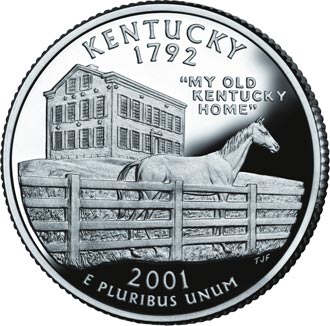
Like other states, Kentucky has gone through its fair share of constitutions. The commonwealth's first one came in 1792, when the bluegrass state became the #15 state in the Union. It was rewritten in 1799, again in 1850 and then lastly in 1891.

Article 13 of the 1850 constitution is the document's Bill of Rights, of which there are 30 sections. But, it was the first four sections that really caught my attention.

The Bill of Rights begins: "That the general, great, and essential principles of liberty and free government may be recognized and established, WE DECLARE-" Nothing earth shattering there...sounds very American.

"1. That all freemen, when they form a social compact, are equal, and that no man, or set of men, are entitled to exclusive, separate public emoluments or privileges from the community, but in consideration of public services." At least it says "freemen" are equal. I wonder what free men of color in Kentucky in the 1850s would have thought about that statement.

"2. That absolute, arbitrary power over the lives, liberty, and property of freemen exists nowhere in a Republic, not even in the largest majority." In other words. you can't take our property away from us, even if you are in the majority.

"3. The right of property is before and higher than any constitutional sanction; and the right of an owner of a slave to such slave, and its increase, is the same, and as inviolable as the right of the owner of any property whatever." Property is preeminent! Is it clear when we say property that we mean slaves are our property?

"4. That all power is inherent in the people, and all free governments are founded on their authority , and instituted for their peace, safety, happiness, security, and the protection of property. For the advancement of these ends, they have, at all times, and inalienable and indefeasible right to alter, reform, or abolish their government, in such manner as they think proper." If that is not a statement of states rights I don't know what is. John C. Calhoun couldn't have made a stronger statement. However, Kentucky never thought it proper to alter, reform or abolish their government when their property was threatened fourteen years later, during the Civil War.

Wednesday, August 17, 2011

Civil Rights Bus Tour - Day 5, July 15, 2011


Our last day of touring was an amazing day in Memphis, Tennessee. Our first stop was another site that was not on our original itinerary, but I'm glad it was added. Mason Temple is the location of the Church of God in Christ's world headquarters and the location that Dr. King gave his last public speech on April 3, 1968.


It was here that Dr. King gave his "Mountaintop" speech. In the speech King seemingly prophesied his death. "I've been to the mountaintop...I've looked over and I've seen the promised land. I may not get there with you...." Absolutely haunting! The next day he was killed on the hotel balcony where he was staying.


A historic photo of King at Mason Temple on April 3, 1968.


One of my favorite stops was to the Stax Museum of American Soul Music. Stax recording studios was started in an old movie theater. Stax was named for a white brother and sister team, Jim Stewart and Estelle Axton, who began the studio. It would become the recording home of such musical stars as Issac Hayes, Otis Redding, the Staple Singers, Wilson Pickett, Booker T. and the MGs, and Sam and Dave.


The original music studio was torn down, but the museum and a youth music academy now keep the Stax story alive. Stax was an integrated label from the beginning and the music it produced almost magically seemed to break down racial barriers.


The Ike and Tina Turner exhibit.


The iconic Soul Train. The museum featured a huge screen that showed clips of the famed TV show with a dance floor in front that made you feel like you were a personal guest of show host Don Cornelius.


The Isaac Hayes exhibit. I was loving the gold platform shoes.


Isaac Hays's macked out Caddy.


Lunch was at Rendezvous, a Memphis landmark. The BBQ was excellent and the atmosphere even better.


Our last stop of the day was to the Lorraine Motel, which now serves as the National Civil Rights Museum. The museum has an impressive gallery that holistically covers the movement.

A wreath hangs on the balcony outside of Room 306 where Dr. King was killed.


The museum also owns the former boarding house across the street that was rented and used by convicted killer James Earl Ray.


Many people overlook why Dr. King was in Memphis when he was killed. He was there supporting the city's sanitation workers during a strike for better working conditions. On March 28, a demonstration had turned violent when looters broke windows of stores along the march route. Over 280 people were arrested and one man was killed.


One of the moving forces in Memphis that supported the sanitation workers was Rev. Samuel Kyles. In the picture above Rev. Kyles collects money in symbolic garbage cans at Mason Temple.

Dr. King was on the way to Rev. Kyles's home for supper when he was shot on the balcony of the Lorraine Motel. Rev. Kyles was beside Dr. King when the bullet struck.


While at the museum we were fortunate to get to meet and hear Rev. Kyles (center) recount spending the last minutes of Dr. King's life by his side.

Friday, July 29, 2011

Civil Rights Bus Tour - Day 4, July 14, 2011

Our first stop on day four was to Selma, Alabama. Selma, like Montgomery to the east, is on the Alabama River and based its economy on cotton for decades. We first visited the National Voting Rights Museum, which recently moved to its current location. The museum is a good example of how a local community is taking control and preserving its history without waiting for funds or outside help. Their aim is to honor the "foot soldiers" of the movement; those that didn't necessarily gain notoriety but stood up for their rights and what was right.


The museum has an amazing set of photos of the three marches that were planned to go from Selma to Montgomery. On February 18, 1965 Jimmie Lee Jackson was killed by an Alabama state trooper while trying to protect his mother during a voting rights protest. The first march was led by Hosea Williams and attempted on March 7, 1965 in protest of Jackson's death. The marchers were met by Sheriff Jim Clark's deputized citizens and when the marchers stopped to talk to the police they started being shoved and beaten. Seventeen of the marchers were hospitalized and the day went down in history as "Bloody Sunday."

The second march was organized by Dr. King and took place on March 9, 1965. 2500 people participated but it was stopped by a federal court order. King didn't want to disobey the federal order since he knew that federal authorities were his only possible protection.

On March 16, a federal judge ruled in the protesters favor and the third march went off on March 21. The marches made it to the steps of the state capitol in Montgomery on March 25. That night Viola Liuzzo, a white woman from Detroit who came to Alabama to help the voting rights effort was shot by members of the Ku Klux Klan while driving African American marchers back to Selma.

In the above photo Sheriff Clark's police patrol outside of Brown Chapel African Methodist Episcopal Church, which we next visited.

Brown Chapel AME Church is a unique place, as it can make the rare claim of having both Dr. King and Malcolm X speak there during the movement. Malcolm X spoke there on February 4, 1965, only weeks before he was killed in New York City on February 21, 1965. Brown Chapel is situated in a neat kept housing project neighborhood.


A monument to Dr. King, James Reeb, Jimmie Lee Jackson and Viola Liuzzo at Brown Chapel.


Our group on the historic steps of Brown Chapel


At the National Voting Rights Museum was a political election card for Sheriff Jim Clark (pictured above) with nightstick and cattle prod. It included a poem of sorts that stated:

Jim Clark Says
"NEVER"
Never be afraid to do what's right
Always be willing to stand and fight
Never be overcome by Socialism
For the next thing that follows is Communism
Never be overcome by Federal Control
Stand for States Rights true and bold
Never let true justice be forgotten or
Overrun in our Dixie Land of Cotton
Never be afraid of the Leftist Block
Stand true and firm like Gibralter's rock
Never dim the glow of bright true light
Always lead us through the restless night.


Making the walk across the bridge was a moving experience for me; much like being on a Civil War battlefield.

This historic photo shows marchers crossing over the Edmund Pettus Bridge.


A historic photo of "Bloody Sunday." The bridge can be seen in the background with clouds of tear gas.


Near the site of "Bloody Sunday" three monuments have been placed to honor some of those that fought for voting rights: Hosea Williams, John Lewis, Amelia Boyton Robinson and Marie Foster.


I couldn't resist snapping a picture of a genuine Alabama cane brake. This one was across Highway 80 from Essie's Place, where we ate a wonderful down home lunch.

Much of the rest of the day was spent traveling through west Alabama and into east Mississippi. We went through tornado ravaged Tuscaloosa. The damage was beyond belief where the twister touched down.


We finally found our way to Oxford, Mississippi, home of the University of Mississippi (Ole Miss) and William Faulkner. The courthouse square is your ideal southern setting. There are at least three bookstores in the numerous businesses around the courthouse so obviously I was in heaven. After having supper at City Grocery we headed on to Memphis.


This plaque on the Lafayette County, Mississippi Courthouse is a great Faulkner quote...a sentence that runs on forever.


A southern courthouse square would not be complete without the ubiquitous Confederate monument.

Tuesday, July 26, 2011

Civil Rights Bus Tour - Day 3, July 13, 2011


We arrived in steamy Montgomery, the capital city of Alabama, on Tuesday evening. We had amazing accommodations at the Renaissance Hotel in downtown Montgomery that made our two night stay very comfortable. My room window provided a great view of the Alabama River (above). The Alabama River is one big reason Montgomery grew in the 1820s and 1830s and became the capital of the state in the 1840s. Cotton grown in the interior of the state was often brought to Montgomery where it was traded and transported down this waterway to Mobile (Cotton City), which was probably only second to New Orleans as a port of export for the fluffy fiber that fed the state's economy.


The first stop in our site-packed Wednesday was not originally on our agenda, but our lead scholar, Dr. Gerald Smith suggested adding it due its great historical significance to the city and the Civil Rights Movement.

Holt Street Baptist Church was where the Montgomery Bus Boycott was organized and where a young Dr. King was chosen as the leader of the Montgomery Improvement Association. On December 5, 1955, Dr. King made his debut in the movement. That night the church was filled to overflowing as he addressed the crown with a short speech in what was originally intended to be a one day boycott. It ended up lasting 381 days.


Today Holt Street Baptist Church is empty and is quickly decaying. The congregation has moved into a different and more commodious location, but fortunately, does have intentions on preserving this historic landmark.


Our second stop was a view of the King parsonage on South Jackson St. It was here on January 31, 1956, that a bomb exploded that did not injury King's wife Coretta and young daughter Yolanda. Montgomery blacks rallied to the house and vowed revenge, but King advised to continue in their pursuit of a nonviolent strategy. The house was damaged again over a year later when a another bomb was planted near the front porch. Again, fortunately, no one was physically harmed.


Our next stop, the Civil Rights Memorial, commemorates 40 men and women who died advocating for civil rights between the years 1954 and 1968. The memorial, pictured above, was designed by Mya Lin, who also designed the Vietnam Memorial in Washington, D.C. The 40 names are carved on a beautiful black granite table as water constantly flows over them. The symbolism is fascinating. On the wall behind the memorial is carved words from one of Dr. King's speeches, "Until justice rolls down like water and righteousness like a mighty stream."


Of course a Civil Rights tour of Montgomery would not be complete without a visit to Dr. King's church, Dexter Avenue Baptist. The significance of the black churches in the Civil Rights Movement can not be overlooked was fully evident in our week long tour. As one black man during the Jim Crow Era said, "He turns to it [church] not only for his spiritual wants, but looks toward it as the center of his civilization. Here he learns the price of cotton or the date of the next circus; here is given the latest fashion plates or the announcement for candidates for justice of the peace."


After a lunch on our own we next reconvened at the Alabama state capitol building for a tour. The temperature was pushing 100 degrees at this point in the day, so I was happy to be in the air conditioned building. Our guide, an African American gentlemen who participated in the famous march from Selma to Montgomery as a young man mentioned that we were in the perfect place when I told him we had teachers that were studying "From Civil War to Civil Rights." He also explained that in his opinion there would never be a monument to the famous march on the capitol grounds because then governor George Wallace didn't allow the marchers to touch the capitol property. As the historic picture above shows the marchers made it right up to the capitol steps.


On the grounds are several tributes to the Confederacy. A huge monument to southern soldiers was erected on the grounds as well as the above monument to Jefferson Davis. Montgomery is often called the "Cradle of the Confederacy" as it was here that the Confederate government was formed, Jefferson Davis was inaugurated as its president, and this building served as the first capital of the Confederacy, before it was moved to Richmond, Virginia in May of 1861.


This star marks the location on the steps of the capitol building where Jefferson Davis was inaugurated on February 18, 1861.


In the above photo our tour guide tells us why the Alabama state capitol building is the most historically significant state capitol building in the United States. I think he has a good argument!


After our visit to the capitol, we went a few blocks back west to the Montgomery Greyhound Bus Station. Now, thanks to the efforts of the Alabama Historical Commission, this building is restored and protected to interpret the significant events of May 20, 1961 when the Freedom Riders attempted to integrate the public facility. Here the black and white riders were mobbed after their police protection disappeared and they were left to the mercy of their attackers who saw them as being "outside agitators."


A historic photo of Freedom Riders waiting to restart their trip.


It was at the Montgomery fountain square where seamstress Rosa Parks worked in a department store called Montgomery Fair, and outside of which, on December 1, 1955, she got on the bus and went into history. Parks, who had previously studied civil disobedience at the Highlander School in Tennessee, became the test case that civil rights lawyers were looking for. After Parks was warned to give her seat to a white person she refused and when warned that she would be arrested if she didn't move, she said, "You may do so."


A historic photo of 42 year old Rosa Parks being booked in Montgomery for refusing to give up her seat on the bus.


Parks's police finger prints are on display at the Rosa Parks Museum. It was at the museum's present location that the bus stopped and where Parks was arrested. The museum features the story of how the African American community of Montgomery worked to bring about social change. Men and women of all walks of life contributed, and even though the museum features the name of one person, it really honors all the "unsung heroes."

The Rosa Parks Museum also features a children's wing, which offers a magic time traveling bus where one goes back into time to learn where the word Jim Crow originated, as well as meet historic figures such as Homer Plessy, Harriet Tubman, Henry "Box" Brown, among others.