Tuesday, February 15, 2022

Fallen but not Forgotten - Pvt. Henderson Taborn, Co. A, 5th USCI

During the mid-nineteenth century, Oberlin, Ohio, known as a “hotbed of abolitionism,” and even referred to as “the town that started the Civil War,” became a magnet of relocation for both self-emancipated and free people of color seeking a greater sense of liberty, autonomy, and equality. Oberlin College, founded in the early 1830s, and soon thereafter dedicated to providing a co-educational and interracial educational experience, produced a generation of abolitionist-minded Black and White graduates by the eve of the Civil War.

Famous—or infamous, depending on one’s period perspective—for the successful rescue of John Price, a self-emancipated man from Kentucky in 1858, and the adopted home of African American John Brown Harpers Ferry raiders, John Anthony Copeland and Lewis Leary, activist-abolitionism was a way of life for many Oberlin residents by the time of the Civil War.

The integrated Oberlin-Wellington Rescuers in 1858. Image in the public domain 


As was the case with Copeland and Leary, Henderson Taborn emigrated to Oberlin from North Carolina. And like Copeland and Leary, Taborn was born a free man of color. Despite being free, people of color still existed as basically second-class residents with precious few rights in the slaveholding states. Taborn, and many others, left upper-South states like North Carolina, seeking better immediate opportunities and a more hopeful future for their descendants. For many, Oberlin proved to be their promised land.

Henderson Taborn began life about 1823 in Orange County, North Carolina. Before relocating to Ohio he lived in the towns of Chapel Hill and Hillsborough where he honed his skills as a cabinet maker. Records show Taborn married Minerva Mayho on April 25, 1850, in Orange County. The couple’s union produced three children in North Carolina: Sally Ann, George, and Henderson, Jr. According to one source, the growing family moved to Oberlin toward the end of 1860 or early in 1861, just as the clouds of civil war began to gather. The Taborns welcomed two more additions to the family circle after moving to Ohio, sons Samuel and Thomas.

Marriage Certificate for Henderson Taborn & Minerva Mayho, 1850. Image courtesy of Ancestry.com


Most of Oberlin’s early war White enlistees viewed the conflict from an emancipationist perspective, in addition to the stated purpose of maintaining the Union. Town men such as Giles Waldo Shurtleff joined regiments such as the 7th Ohio Volunteer Infantry and battled to end slavery’s stain on the United States before emancipation was an officially stated war aim. A number of Oberlin’s Black men jumped at the opportunity to join the 54th Massachusetts Infantry and left for training in the spring of 1863, but Henderson Taborn was not among them.

In the fall of 1863, when the opportunity arose for Ohio to raise its own regiment of African American troops, Henderson Taborn did not enlisted in what became the 5th United States Colored Infantry. At about 40 years of age, and with a wife and five children to provide for, perhaps Taborn thought soldiering was a calling for Oberlin’s younger Black men. Maybe he also understood that African Americans had obtained few benefits from previous military service to the United States. Maybe he was disheartened by the unequal pay Black soldiers received or the lack opportunity for advancement beyond the non-commissioned officer level. By the beginning of 1864, Ohio started recruiting another USCT regiment, the 27th USCI, but again, Taborn was not among its rank and file.

However, on September 1, 1864, Henderson Taborn enlisted in the 5th USCI in Wooster, Ohio. Nothing in his complied military service record indicates that he was drafted or was serving as a substitute for someone else. Perhaps Taborn heard or read about of the performance of fellow Oberlin men who fought in the 5th USCI on June 15, 1864 at Petersburg, or neighbor men who struggled bravely in the 27th USCI at the Battle of the Crater on July 30, 1864. Maybe those reports prompted him to offer his service to do his part to end slavery, show that Black men could be as brave as White men, and to help the United States—now officially dedicated to emancipation—defeat the slaveholding Confederacy. Taborn did not tell us why, so we do not exactly know. All we know is that he enlisted.

Taborn’s enlistment records state he enlisted on September 1, 1864, was 41 years old, five feet eight inches tall, and a cabinet maker by trade. The enlisting officer noted his complexion as “black.” Nothing in Taborn’s records indicate what transportation the army used to get him to the fighting front in Virginia in such a short period. He may have traveled partly by train to Washington D.C., and from there by boat or ship down the Potomac to the Chesapeake Bay and then up the James River to the 5th USCI’s camp.

It is clear that Taborn received little if any significant training for what he would soon face. Travel time from Wooster, Ohio, to the war’s front in central Virginia took a least a week, if not two. Taborn probably had little opportunity to make acquaintance with his comrades, learn to cook his hardtack and salt pork, boil coffee army style, or even get his brogans and new uniform broken in before the 5th USCI received its next combat assignment. 

On the morning of September 29, 1864, less than a month after enlisting, Taborn and the 5th formed a second wave of an assault by the Army of the James’ Third Division of the XVIII Corps, against the Confederate earthworks along the New Market Road defended by the famous Texas Brigade. After witnessing the terrific casualty rate the first attack wave (4th and 6th USCI) encountered, the 5th USCI received orders to lead another attack, followed in column by the 36th and 38th USCIs. The 5th USCI took advantage of holes in the two lines of abatis that the first attack created, but the firepower of the Confederates was initially too much to bear and the attack stalled. Suffering terrific casualties among the officers and enlisted men, many of the non-commissioned officers took over their companies and got their momentum going again, surging forward, and with the weight of the 36th and 38th USCIs, drove the rebel defenders out of their entrenched position.

Among those in the 5th USCI recognized for their feats of heroism were first sergeants Robert Pinn, Milton Holland, James Bronson, and Powhatan Beaty, who all received the Medal of Honor for their courage under fire. Oberlin’s Lt. Col. Giles Waldo Shurtleff, now commanding the 5th USCI and wounded twice in the attack, remembered during the battle that some of the Confederates yelled derisively to the USCTs, “’Come on you smoked Yankees, we want your guns.’” While the second attack bogged down, Shurtleff recalled, “the most murderous fire that I witnessed during the war, opened upon us.” Already wounded once, Shurtleff gave the soldiers the command to “’Forward double quick’ and they went over the abbatis with a shout, and carried the works, the enemy retreating as soon as the obstructions were passed.”

First Sgt. Milton Holland was one of four 5th USCI soldiers who received the Medal of Honor for courageous actions at the Battle of New Market Heights


Scattered on the ground before the enemy earthworks, the casualties of the 5th USCI—who lost about half their men—included newly minted soldier Pvt. Henderson Taborn. It is unknown at what point in the attack life left his body, but Lt. Col. Shurtleff, and Lt. James Marsh, who was quartermaster for the 5th USCI, provided affidavits for the pension claim of Taborn’s wife, Minerva, that they heard about Taborn’s death on the battlefield from two of Taborn’s comrades captured during the attack and who were later paroled and eventually returned to the regiment. These two unnamed enlisted men saw Taborn lying dead on the battlefield.   

Pvt. Henderson Taborn likely received a burial on the field of battle. Whether Taborn was later removed to a National Cemetery as an unidentified soldier or missed during the interment process, is unknown. Although he was a United States Colored Troops soldier for less than a month that does not in any way detract from the sacrifice he willingly made with his life to his country and for the advancement of human rights. We remember Pvt. Taborn and praise his courage and determination despite the many dangers surrounding him during the Battle of New Market Heights. May he and his comrades never be forgotten!

Thursday, January 27, 2022

Occupations Held by Petersburg's Free People of Color

Waiter in Hotel 

House Servant

Seamstress 

Fireman (railroad) 

Laborer 

Train Hand

Tobacco Stemmer 

Brick Layer 

Washerwoman 

Sawyer 

Fruit Seller

Nurse 

Tobacco Twister 

Drayman 

Porter 

Waiter 

Cupper and Leecher 

Barber 

Barber Apprentice 

Armstead Wilson

Cook 

Huckster 

Butcher 

Cartman 

Waterman 

Tobacco Prizer 

Shoemaker 

Fisherman 

Ditcher 

Sailor 

Blacksmith 

Brick Moulder 

Plasterer 

Carpenter 

Car Hand (railroad) 

Hackman 

Livery Keeper 

Musician 

Whitewasher 

Upholsterer 

Fishmonger 

Cooper 

Caulker 

Gardener 

Waggoner 

Wheelwright 

Miller 

Well Digger 

House Maid 

Stone Mason 

Painter 

Midwife 

Engineer 

Baptist Preacher

Finisher 

Carriage Driver 

Driver Furniture Wagon 

Factory Hand 

Ostler (Hostler) 


Monday, January 17, 2022

Fallen, but not Forgotten: Pvt. James Chaney, Co. I, 1st USCI

Historians estimate that perhaps as many as twenty percent of Civil War soldiers enlisted under the age of 18. While enlisting officials were not supposed to accept anyone under army regulation age, in effort to fill companies and regiments, they sometimes made exceptions to the rule. Many of these youths served in support roles: musicians, hospital assistants, and couriers, among other duties, yet thousands of youngsters saw combat as arms bearing soldiers, too.

One underage soldier, James Chaney, enlisted in Co. I, 1st United States Colored Infantry, at only 16 years of age. Being so young, Chaney did not have much opportunity to leave a significant amount of documentation that recorded his brief life. Cheney, apparently born free around 1847, in Baltimore, Maryland, appears in the 1850 federal census in that city’s 18th Ward as a four year old. Residing in the household of his mother, Elizabeth “Eliza” Chaney (25 years of age), and his brothers, Isaac (6), Lewis (2), and George (3 months), were also Arlenthia Cheney (18), who was perhaps Eliza’s sister; Benjamin Thomas (18) and John W. Thomas (12). Everyone is described as “mulatto,” and only Benjamin Thomas has an occupation, “laborer,” listed. Having so many youthful individuals in the household, with so little work experience, and thus few chances to build earning power, probably meant times were financially tight for the Chaneys and Thomases.

A decade later, perhaps due to family economic needs, James, Isaac, and Lewis appear residing in a 16th Ward Baltimore hotel owned by William Dorbacker. The three Chaney boys, along with John and William Nelson, all listed as “black,” and noted as “servants,” are the only African Americans residing at the hotel. Full-service hotels of the period readily employed both free and enslaved men, women, and children to clean rooms, do laundry, serve as bell hops and barbers, cook meals, and wait on tables. Free blacks sometimes received wages, tips, and room and board as their compensation. 

It was likely that the experience James Chaney gained while working in Dorbacker’s hotel helped bring him to Washington D.C. sometime between the summer of 1860 and his enlistment in the Union army in the summer of 1863. Records show that James worked as a waiter at Banks’s Restaurant and the National Hotel in Washington City before joining up. These records also state that James gave the “greater part of his wages to his mother” so she could buy food, clothes, and pay her rent. Apparently Elizabeth Chaney suffered from bad health that left her unable to work consistently and caused her “spasms . . . so severe as to render her . . . unable for five or six days to perform labor or any sort.” Thus, Elizabeth Chaney “depended upon him for the greater part of her support.” James Cheney was a model son.


National Hotel in Washington D.C. Courtesy of the Library of Congress.

One wonders what James Chaney’s primary motivation was to enlist on June 28, 1863. Did he tire of his monotonous waiter duties and long to experience the supposed adventure that came with a soldier’s life? Did he think he could earn more money in the army to help support his mother? Was he more mature in his world views than we typically credit to 16-year olds and thus wish to see slavery eradicated and to prove that men of color could be just as courageous and worthy of citizenship as white men? Obviously, being officially underage, Chaney did not have to enlist. But he did!

Enlisting the 1st USCI’s Company I at age 16, with the stated occupation of waiter, Cheney measured five feet five and a half inches tall, with a complexion described as “yellow.” Signing up on June 28, 1863, on Mason’s Island (now Theodore Roosevelt Island) in the Potomac River, Chaney’s enlistment officer was Col. William Birney, son of noted abolitionist and former Liberty Party presidential candidate James G. Birney, and older brother of Maj. Gen. David Bell Birney, who was then leading a division in the Army of the Potomac. Experienced officer Col. John Holman received the assignment to initially command the 1st USCI.


Mason's Island during the Civil War. Courtesy of the Library of Congress.

After serving initially in southeastern Virginia and northeastern North Carolina during the fall and winter of 1863-64, the 1st USCI transferred to the division of Brig. Gen. Edward Hinks in the XVIII Corps of the newly created Army of the James. It appears that James Chaney received a brief promotion to corporal around September or October 1863, but by November 4 he was reduced to the ranks for an unspecified reason. Posted at various occupied points along the James River during the spring of 1864, the 1st USCI received its first taste of combat at Wilson’s Warf (Fort Pocahontas) on May 24, 1864, where they battled Maj. Gen. Fitzhugh Lee’s Confederate cavalry, eventually driving off the rebel attackers.

The 1st USCI, now consolidated with the rest of Hinks’s Division, also battled at both Baylor’s Farm and assaulted the Dimmock Line at Petersburg on June 15, 1864, where they fought especially well. Pvt. Chaney appears to have survived these actions unscathed and in good health. Stationed part of the time in the Petersburg trenches and again at points along the James River, Chaney’s regiment gathered with the rest of the division, now under the command of Brig. Gen. Charles J. Paine, at Deep Bottom for a late September assault at New Market Heights.


Regiment identified as the 1st USCI. Courtesy of the Library of Congress.

Commanding the First Brigade of the Third Division, XVIII Corps, was Col. John Holman, who previously led the 1st USCI. His brigade included the 1st, 22nd, and 37th USCI regiments. However, in July, Chaney received orders to serve on detached duty with the Third Division, XVIII Corps sharpshooter company. Chaney’s superiors must have noticed his excellent marksmanship skills to receive this special assignment.

Service in the division sharpshooters meant Chaney would be one of the first to contact the enemy, skirmishing out ahead of the primary assaulting brigades. It is likely that Chaney received the wound that resulted in his death on the New Market Heights battlefield early in the fight. He probably was not able to witness the amazing bravery displayed by his Third Division comrades as they struggled against the determined Confederate Texas Brigade defenders for control of the New Market Road that fateful September 29, 1864, day.

Pvt. Chaney likely received a soldier’s grave on the very battlefield ground he fought over. After the war most of the United States Colored Troops soldiers killed in action at New Market Heights who could be located were reinterred at Fort Harrison National Cemetery or City Point National Cemetery. Today, Pvt. Chaney may fill an unknown soldier’s grave at one of these locations, or his remains may still rest on the battlefield. We will probably never know for sure. However, we honor this youthful soldier’s service, remember his sacrifice that helped abolish the scourge of slavery and maintained the United States of America. A life lost too early on its earthly journey will not be forgotten, but instead lives on with this humble expression of respect.    

Sunday, January 9, 2022

A Battle of New Market Heights Condolence Letter


In my ongoing research to locate records for United States Colored Troops soldiers who died in action or from their wounds received in the Battle of New Market Heights (September 29, 1864), I happened upon a condolence letter from Capt. Charles F. Eichaker, Co. G, 22nd USCI to Hannah Triford concerning the death of her husband, Corp. Obadiah Triford. The document was among those in Hannah Triford's records seeking a pension for her husband's death and held at the National Archives.

Chapin's Farm, Va, Oct. 18 '64

Mrs. Hannah Triford

Madam

The mournful duty devolves upon me to break to you the news of your husband's death; he died the death of a soldier while gallantly charging on the rebel rifle pits on our front line near Deep Bottom, Va on Sept 19 '64. He was struck by a rebel rifle bullet and died instantly without any struggle. This will indeed be sad news to you, but such is the lot of soldiers and there will be some consolidation if he and thousands of others have not laid down their lives for their country's cause in vain. May you find strength [as] you bear your personal loss.

Accept my heartfelt sympathy in your sad berevement & while tendering my assistance in the line of my official duty, I remain, madam, very respectfully,

Your  obdt Servt.

C. F. Eichaker

Capt. Co. G, 22nd USCT

Monday, January 3, 2022

Gen. Butler's Relationship with Black Troops


When it comes to Civil War generals, few have received less admiration than Benjamin Butler. And while recent reassessments that take into account his overall leadership and adaptability are starting to slowly change things toward his favor, he is still readily known by his derogatory nicknames like "Beast" and "Spoons."

Butler's early war refusal to return runaway enslaved people to their owner at Fort Monroe, and his seemingly eager incorporation of African American soldiers in his Army of the James appears to have earned him a favorable position among the USCTs under his command. 

Recently I located a couple of incidents involving Butler from an apparently objective source that probably helped further his good standing with Black soldiers. In the April 1865 edition of Fraser's Magazine for Town and Country, a British publication, the author of an essay titled "A Visit to General Butler and the Army of the James," happened to make his visit to Butler's command at the time of the Battle of New Market Heights. Behind the lines, the author and Butler encountered USCTs making their way to the rear after being wounded in the fight. He wrote:

"Soon after we began to fall in with the wounded of the coloured division which had been the first to attack 'Johnny' that morning. The General stopped by as he passed them, and inquired kindly, whether they were much hurt, praising those who had carried their rifles with them off the field. [The soldiers] replied with a smile of mixed pleasure and pride; indeed, unlike the white troops, who are apt to forget this part of discipline, they rarely fail to salute Butler with hand and smile seeming to recognize him as a friend." It says a lot about a commander, who was in the middle of a major engagement to take time out to interact with his men in such a way. Such actions were likely remembered as well by the soldiers as by the author of the article.

In addition, at the end of the article, the author made mention of another incident that shows Butler's concern for Black troops. "[Butler] showed also the greatest indignation when a medical officer was reported to him for being 'disgracefully, brutally, and insultingly drunk' when in charge of a hundred and fifty wounded. On finding that (owing to the rapid advancement of the ambulances) thirty wounded negroes had been left of nearly twenty-four hours without any medical aid, he sent for the responsible medical persons and reprimanded them severely for their neglect of the coloured men."

Finally, add to these eye-witness accounts the fact that Butler went to the trouble to have the so-called "Butler Medal" stuck in order to give to United States Colored Troops soldiers for their heroism and the evidence is fairly strong that he genuinely believed in their effectiveness as soldiers. What is even more heartening is the fact that he backed up his positive sentiment with positive actions. 


Butler image courtesy of the Library of Congress.

Friday, December 31, 2021

Top 10 Most Popular Posts of 2021


 Although 2021 lacked the usual number of posts in a given year, there were some that apparently stood out to readers. The following is a list of the ten most viewed posts in 2021.

9. (tie) Displayed the Greatest Courage:" Lt. James B. Backup, Co. I, 36th USCI  (March 16)

9. (tie) Picket Duty (March 31) 

8. Corp. James Gray, Co. E, 4th USCI (May 30)

7. Portrait of Rebel General Early (June 29) 

6. Recent Acquisitions to My Library (October 3)

5. Rufus Dawes on the Emancipation Proclamation (June 27)

4. The Negro on the Fence (April 24) 

3. The Black Regiment by George Henry Boker (April 26) 

2. Zooming in on a USCT Camp Scene (March 9) 

1. Corp. John Osborne and Late War Casualties (March 8) 


Thank you for reading!

Thursday, December 30, 2021

Good Bye to the Old, and Hello to the New


This time of year often encourages me to stop and think about they year quickly passing away, and the one coming on the horizon. Looking back, there is so much to be thankful for. I am happy that I am gainfully employed in an occupation that I am passionate about and that provides for my needs. I am fortunate to be married to a beautiful, loving, and encouraging wife, who is a true blessing to my existence. I am thankful that I have a sufficient amount of free time and resources to do things like read for pleasure, write posts for this blog, and pursue other history-related initiatives that benefits my desire for learning, and as well as that of others.

I am fortunate that I was born and live in a society where I can have and do these things. Of course, by studying history, one doesn't have to look too far back to understand that not everyone in the past had the chances that most people do today. Imagine having the above image as your primary line of sight for a long 15 or 16 hour day, five and a half or six days a week, receiving no pay, and only the most basic of food, clothing and shelter necessities met, just because you happened to be born into a certain condition of no choosing of your own.  

It sounds cliché, but take a little time to count your blessings. But, this New Year Day, take it a step further, and take action . . . whatever you determine that to be, and make some type of positive contribution. Volunteer somewhere that needs help, send a financial gift to a worthy organization, offer words of encouragement; anything to make the world we live in a little bit better.    

Happy New Year!     

Wednesday, December 29, 2021

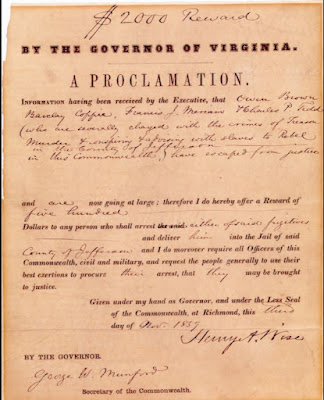
Bully Document - Reward for Four Escaped John Brown Raiders


This document, which is held by the Library of Virginia, was issued by Gov. Henry Wise to offer a reward of $500.00 each for four of John Brown's raiders who escaped from the Harpers Ferry area. 

It sought the capture of Owen Brown, Barclay Coppoc, Francis Jackson Merriam, and Charles P. Tidd. Interestingly, it does not mention Osborne Perry Anderson, a free African American man who also escaped. None of the men were ever captured or convicted. Coppoc, Merriam, and Tidd served in Union regiments during the Civil War, and Anderson helped recruit soldiers for the United States Colored Troops. 

Image courtesy of the Library of Congress.

Tuesday, December 28, 2021

National Card Playing Day


There is a seemingly endless list of "national days" throughout the calendar year. Some are quite ridiculous, while others have excellent connections to the diverse shared history and culture of the United States. 

Today, December 28, is National Card Playing Day. Now, I've never been a big card player. I don't think the way my mind works relates well to many of the skills necessary to be a good card player. But, I've been known to enjoy some games as a way to pass the time and spend time with friends. 

The importance of cards to the people of the mid-19th century is quite evident. In a day long before modern diversions like television, the radio, the internet, and thus social media, card games were a favorite activity among just about everyone, no matter race, gender, or class. That ubiquity of cards and card playing is quite evident in the letters, photographs, and other documentary evidence of the period.

Have a great National Card Playing Day!

Monday, December 27, 2021

Books I Read in 2021


In some respects 2021 proved to be more challenging than 2020. While many of COVID-19's safety restrictions eased as cases reduced, demands at work increased. The summer and fall months were particularly busy. All of this goes to say that the time I normally devote to reading and the mental energy it takes to comprehend and process those books was just not on par with past the past several years. Similarly, the number of posts on this blog dropped to one of its lowest totals over its almost 13 year existence. 

However, this year also brought a number of wonderful learning opportunities that helped me grow and network in the history field. I suppose I should be thankful for what all I've been able to accomplish this year rather than compare it to those of the past, but, that's probably just the historian in me. 

Anyway, this year I was able to complete 48 books; just less than one a week. As I've done in the past, I've highlighted those that I particularly enjoyed or found especially insightful. In addition, this year, I've separated them by the month that I completed them.

January

1. Not Even Past: The Stories We Keep Telling about the Civil War by Cody Marrs

2. The Big House after Slavery: Virginia Plantation Families and Their Postbellum Domestic Experiment by Amy Feely Morsman

3. Living By Inches: The Smells, Sounds, Tastes, and Feeling of Captivity in Civil War Prisons by Evan A. Kutzler 

4. Family Bonds: Free Blacks and Re-enslavement in Antebellum Virginia by Ted Maris-Wolf

5. We Have it Damn Hard Out Here: The Civil War Letters of Sgt. Thomas W. Smith, 6th Pennsylvania Cavalry by Eric J. Wittenburg

6. We Need Men: The Union Draft in the Civil War by James W. Geary

7. Remaking the Republic: Black Politics and the Creation of American Citizenship by Christopher James Bonner

February

8. Voices from the Attic: The Williamstown Boys in the Civil War by Carleton Young

9. A Thousand May Fall: Life, Death, and Survival in the Union Army by Brian Matthew Jordan

10. Carrying the Colors: The Life and Legacy of Medal of Honor Recipient Andrew Jackson Smith by W. Robert Beckman and Sharon S. MacDonald 

11. The Black Civil War Soldier: A Visual History of of Conflict and Citizenship by Deborah Willis

12. Lone Star Confederate: A Gallant and Good Soldier of the Fifth Texas Infantry edited by George Skoch and Mark W. Perkins

March

13. Defend the Valley: A Shenandoah Family in the Civil War by Margaretta Barton Colt 

14. Kate: The Journal of a Confederate Nurse by Kate Cumming, edited by Richard Barksdale Harwell

15. Clara Barton's Civil War: Between Bullet and Hospital by Donald C. Pfanz

April

16. The Howling Storm: Weather, Climate, and the American Civil War by Kenneth W. Noe

17. Confederate Exceptionalism: Civil War Myth and Memory in the 21st Century by Nicole Maurantonio 

18. Embattled Freedom: Chronicle of a Fugitive-Slave Haven in the Wary North by Jim Remsen

May

19. Slavery and the Underground Railroad in South Central Pennsylvania by Cooper C. Wingert

20. Lincoln's Emancipation Proclamation: The End of Slavery in America by Allen C. Guelzo

21. Slavery and Freedom in the Shenandoah Valley during the Civil War by Jonathan A. Noyalas

June

22. The Women's Fight: The Civil War's Battles for Home, Freedom, and Nation by Thavolia Glymph

23. The Colors of Dignity: Memoirs of Civil War Brigadier General Giles Waldo Shurtleff edited by Catherine Durant Voorhees 

24. Thaddeus Stevens: Civil War Revolutionary, Fighter for Racial Justice by Bruce Levine

25. Seizing Destiny: The Army of the Potomac's "Valley Forge" and the Civil War Winter that Saved the Union by Albert Z. Conner with Chris Mackowski

July

26. How the Word is Spread: Reckoning with the History of Slavery Across America by Clint Smith

27. Jubal Early's Raid on Washington by Benjamin Franklin Cooling

28. The Ledger and the Chain: How Domestic Traders Shaped America by Joshua D. Rothman

29. This Infernal War: The Civil War Letters of William and Jane Standard edited by Timothy Mason Roberts 

30. A Holy Baptism of Fire and Blood: The Bible and the American Civil War by James P. Beard

31. Destroy the Junction: The Wilson-Kautz Raid and the Battle for Staunton River Bridge by Greg Eanes 

August

32. Lincoln's Mercenaries: Economic Motivation among Union Soldiers during the Civil War by William Marvel

33. Force and Freedom: Black Abolitionists and the Politics of Violence by Kellie Carter Jackson

34. The Battle of Glendale: Robert E. Lee's Lost Opportunity by Douglas Crenshaw

35. Topsy-Turvy: How the Civil War Turned the World Upside for Southern Children by Anna Jabour

September

36. Sheridan's James River Campaign through Central Virginia by Richard L. Nicholas

37. His Truth Is Marching On: John Lewis and the Power of Hope by Jon Meacham

38. War's Relentless Hand: Twelve Tales of Civil War Soldiers by Mark Dunkleman

39. Decisions of the Seven Days: The Sixteen Critical Decisions that Defined the Battles by Matt Spruill

October

40. Claiming Union Widowhood: Race, Respectability, and Poverty in the Post-emancipation South by Brandi Clay Brimmer 

41. An Intimate Economy: Enslaved Women, Work, and the Domestic Slave Trade by Alexandra J. Finley 

November

42. The Great Battle Never Fought: The Mine Run Campaign by Chris Mackowski

43. No Excuses: The Making of a Head Coach by Bob Stoops

44. Grant's Left Hook: The Bermuda Hundred Campaign by Sean Michael Chick 

45. Gettysburg's Unknown Soldier: The Life Death, and Celebrity of Amos Humiston by Mark Dunkleman

46. Aberration of Mind: Suicide and Suffering in the Civil War-Era South by Diane Miller Sommerville

December

47. America's Good Terrorist: John Brown and the Harpers Ferry Raid by Charles P. Roland, Jr.

48. Ties that Bind: The Story of an Afro-Cherokee Family in Slavery and Freedom by Tiya Miles


Sunday, December 26, 2021

Civil War Soldiers and Rain


An old saying goes: “April showers bring May flowers.” But few things brought more grief to Civil War soldiers than rain. Naturally, precipitation came during all seasons, not just spring, making it an ongoing challenge for fighting men to stay dry. In fact, soldiers’ efforts battling the elements came much more frequently than facing the enemy on the battlefield.

Lt. Charles Wilkens of the 1st U.S. Infantry commented from Corinth, Mississippi, about working in the rain. “I woke up the next morning at five, had the mules fed and harnessed, about this time it began to rain. . . . It rained all day on Monday, and when I got in was about as wet as a ‘drowned rat,’” he wrote. Others who were more fortunate and could avoid the frequent deluges did so. Quartermaster Sgt. John Warrington Caldwell of the 15th Pennsylvania Cavalry noted, “It has been raining all day long. [It] commenced some time last night, so it has kept me inside of the tent nearly all day. As I had nothing to do outside, I thought I had better keep dry.” Those that could not avoid it grumbled. Writing to his sister Ellen, Sgt. Thomas Benton of the 19th Indiana, closed a letter: “This is a very disagreeable day in camp; raining all the time.”

Rain, of course, produced muddy roads. One astute Confederate is said to have commented of the Tullahoma Campaign in the summer of 1863, that the word Tullahoma came from two Greek words, “’Tulla’ meaning mud, and ‘Homa,’ meaning more mud.” Muddy roads made it difficult for man and beast. At about the same time, Pvt. Cecil Fogg of the 36th Ohio Infantry claimed, “We left there on the 24th of June. It commenced raining that day , and rained nearly all the time for 3 days, and it rained every day but one since . . . . the roads are awful, and teams [horses and mules] can hardly get along at all.”

At other times rain brought much needed relief. Confederate Maj. Thomas K. Jackson, wrote in September 1863 that, “A delightful rain is falling now, cooling the air & laying the dust. How welcome it is! For the heat has been intense & the dust was most suffocating during the past ten days.” Lt. Joseph Younger of the 53rd Virginia wrote from Petersburg’s trenches in August 1864, “We have had a nice shower since I have been writing, and it looks like [it will be] coming down again shortly.” Most soldiers though found the rain annoying. Capt. James M. McCoy of the 20th Ohio writing after the Battle of Shiloh noted, “Here we lay upon our arms in line and endeavored to sleep. But a very heavy rain coming up put all such notions out of our heads.”

Those soldiers who had rubber blankets cherished them. Corp. William Farries of the 24th Wisconsin stated, “It rained hard all day, but thanks to my rubber blanket I kept dry.” Those without shelter suffered terribly. Capt. Samuel McConnell of the 7th Florida Infantry wrote his sister in Sept. 1864 that, “Since last Sunday it has been raining constantly, and the weather is still bad. Being without tents we do not have a very pleasant time in such weather.”

Rainy weather was just one more threat to soldiers’ health. Combined with sometimes inconsistent and almost always monotonous food, bad water, and unsanitary living conditions, rain made soldiers’ constant daily struggle for survival that much more challenging. 


Image courtesy of the Library of Congress


Thursday, December 23, 2021

Bully Image -Shoeing a Mule


"Shoeing a Mule" by Edwin Forbes

Rappahannock Station, Virginia, October 12, 1863


Image courtesy of the Library of Congress

Wednesday, December 22, 2021

Civil War Soldiers and Express Services


In the present-day “can’t get here fast enough” world of package and mail delivery, it is somewhat comforting to know that Civil War soldiers, too, relied on express companies to eagerly send and receive items they deemed necessary for both comfort and survival.

Chaplain E. L. Clark, 12th Massachusetts Infantry remarked that a kind donor provided “$14 for the express of my library to the regiment.” However, “It just paid the freight,” he complained. But he seemed proud that his regiment now had “400 books and 500 magazines in circulation among our boys.” Cecil B. Fogg of the 36th Ohio Infantry was on the lookout for an expected overcoat. “My overcoat has not arrived yet, but I suppose it is safe as it is in the hands of the Express boat,” he wrote his father in December 1863. In January, he still did not have his coat, but indicated, “If it don’t come, I will get paid for it by the Express Co.” Similarly, Confederate commissary officer Maj. Thomas K. Jackson’s wife asked about his urgency for new footwear: “Uncle John received your letter and desires me to say the shoes are finished & wishes to know if he must send them by express,” she inquired.

Some soldiers sent their pay home via express. Adams Express was a popular choice for United States soldiers. Confederate soldiers often used the Southern Express Company. Capt. John Doty, 104th Illinois wrote his brother from Chattanooga: “We were paid on Sunday last, and have sent part of my wages home to John, and suppose he has received it, or will by the time this reaches you. It will come by express from Springfield, Ill. . . . From here we have an express office, and that is the only safe way we have of sending money home,” he explained. Similarly, Pvt. John Downes, 35th Iowa explained, “I sent father 75 dollars by express. I wish you would tell him to see to it, and if you please, write to me when he gets it.”

Speed of delivery was important to soldiers who were on the campaign and moved often. Pvt. Marcus S. Nelson, 14th Missouri, wrote to “Friends at home” from Corinth, Mississippi: “If you send me those things by express, send them immediately, as we may be ordered away from here in the course of a few weeks, perhaps a few days.” A soldier in the 2nd New Hampshire requested his siblings send a 25 to 50 pound box of maple sugar. “You might nail it over a little, and mark on it, keep dry, and send it by express,” he wrote.

The express companies of the day often proved yet another vital line of communication and connection to the home front that soldiers depended on. Everything from pay, to care packages, to comrades’ last effects found their way to and from home and the front lines by using express services. 

Tuesday, December 21, 2021

Dying Far From Home - Pvt. Edward Williams, Co. C, 6th USCI


During the Civil War, soldiers sometimes attempted to describe the nature of combat to friends and loved ones unfamiliar with warfare. In the years since the conflict, scholars have also tried to give us an idea. Soldiers and historians alike have used terms such as chaos, pandemonium, and bedlam in effort to relate the stressful battlefield situations that participants experienced. Some soldiers, especially those who had previously “seen the elephant,” and thus knew what was in store, were able to steady their nerves, hear commands, and will themselves to obey those commands despite the many surrounding dangers. Others, unable to stand the potential threats to life and limb, either froze up, ran away, or found other ways to make their personal safety their main priority.

The United States Colored Troops (USCT) soldiers who fought at the Battle of New Market Heights on September 29, 1864, likely included men who ranged the wide spectrum of combatants. After all, they were human. However, the African American men who fought at New Market Heights realized this engagement presented a unique opportunity to prove themselves in battle, and as black soldiers they had unique motivations that often compelled them to subdue their fears and do their duty come what may.

We do not have eye-witness documentation to tell us how well Pvt. Edward Williams held up to the furious fire dealt out to him and his comrades of the 6th United States Colored Infantry (USCI) at New Market Heights. But, the sheer number of casualties inflicted upon the regiment does give us some understanding of the trial by fire they endured that day. Pvt. Williams’s life journey to September 29, 1864, also tells us something of his character and commitment.

Born a free person of color about 1836, in Montgomery County, Pennsylvania, most of Edward Williams’s young life went unrecorded. The earliest documentation appears to be the 1850 census in which he appears as a 13 year old “mulatto” laborer in the Montgomery County, Whitemarsh Township home of Henry (age 60) and Diana (age 42) Jackson. Also in the household are three young Jackson children: Rosan (7), James (4), and Hannah (1). Additionally listed are Edward Williams (13), Thomas Williams (19), and Susannah Cox (84). Perhaps Diana Jackson was Edward and Thomas’s mother, who had remarried to Henry Jackson and had the three youngest children with him. Susannah Cox may have been either Henry or Diana Jackson’s mother and the grandmother to the children.

It appears that Edward Williams’s next appearance in the public record is the 1860 census. In that enumeration, an Edward Williams who is African American, is living in the household of a white family in Montgomery County’s Upper Providence Township. Although the census taker recorded Edward’s age as 20, that information, which was about 4 years off, may have come by way of Martha Rambo, the head of household, who may have estimated Edward’s age.

Edward Williams also appears in a June 1863 draft registration listing for neighboring Chester County. On it Edward is a 28-year old single laborer. It was soon after Edward Williams registered for the draft that he volunteered, enlisting in Philadelphia on August 3, 1863, in Company C, 6th United States Colored Infantry. Williams’s enlistment provides a few more physical details about him. Described as 5 feet 8 inches tall, Williams’s complexion is noted as “black.”

As the 6th USCI filled with recruits, it trained at Camp William Penn, just outside of Philadelphia. Being in close proximity, perhaps Edward was able to see and communicate with family and friends during his time at Camp William Penn. Edward’s comrades of Company C came from diverse backgrounds. Included among the men were: shoemakers, barbers, farmers, miners, coopers, sailors, plasterers, teamsters, blacksmiths, gardeners, waiters, coachmen, porters, and like Edward Williams, general laborers. 

Regimental flag of the 6th USCI.

   Tabbed to command Company C was Captain Daniel Dill. Enoch Jackman served as 1st lieutenant. Frank Osborne held the 2nd lieutenant’s position. 1st Sgt. George Ellet served as go-between with the company officers and the enlisted men and helped keep the company in line. Unfortunately, Lt. Jackman and First Sgt. Ellet both numbered among the casualties at New Market Heights; Jackman survived but Ellet did not. Providing spiritual guidance for the regiment was Rev. Jeremiah Asher, who was only one of fourteen African American ministers that served in the United States army during the Civil War.

Rev. Jeremiah Asher, chaplain of the 6th USCI.

Following their training, the 6th USCI transferred to Fort Monroe, Virginia and participated in raids on the James and York River peninsula in eastern Virginia, freeing enslaved people and recruiting more soldiers for USCT regiments. Williams likely participated in some of these actions, but during the month of October his service records indicate that he was detailed as a waiter for the regiment’s officers. We do not know whether Williams enjoyed his time around the officers or if he found waiting on them demeaning.

Enslaved children freed by the 6th USCI during their Virginia raids. Image courtesy of Pamplin Historical Park

In early May 1864, the 6th helped secure City Point, Virginia, a vital position at the confluence of the James and Appomattox Rivers that would become the nerve center for the Union army during its efforts against Petersburg and Richmond. On June 9, the 6th USCI participated in Maj. Gen. Benjamin Bulter’s ill-fated attempt on Petersburg, which was lightly defended at that time. During the day the infantry force under Gen. Quincy Gilmore demonstrated to the northeast of Petersburg and skirmished with the Confederates. It was either in this day’s sparing or perhaps the following day’s picket duty that Pvt. Edward Williams received an undescribed wound. It appears that Williams’s wound was serious enough to require him to spend time in a hospital, but fortunately minor enough to not keep him away from the regiment for very long.

Williams’s wound prevented him from participating in Gen. Ulysses S. Grant’s first major offensive against Petersburg, which occurred on June 15, 1864. However, his comrades in the 6th USCI did fantastic work throughout the day capturing several Confederate positions and a number of artillery pieces. During the continued fighting around Petersburg through the summer of 1864, a number of USCT men, including Pvt. Williams, served at Dutch Gap on the James River, constructing a canal in effort to bypass some of the Confederate shore batteries.

Leaving their position at Dutch Gap, the 6th USCI moved to Deep Bottom landing on the night of September 28, 1864. There they received orders to assault the Confederate position along the New Market Road about two miles to the north the following day. On the foggy morning of September 29, the 6th USCI followed closely behind the 4th USCI as they both crossed the fields and swampy ground in front of the Confederate defenders. Upon reaching the double lines of abatis obstacles placed by the rebels to slow the assault, the two black regiments started taking extremely high casualties, losing over half their men as killed, wounded, or captured. The 6th USCI lost 46 men killed, 20 fatally wounded, five missing in action, and 112 wounded. One of the badly wounded was Pvt. Edward Williams.

During the attack Williams received a gunshot wound to his abdomen. Evacuated from the field after the USCT attack eventually drove off the Confederate defenders, Williams received transportation by ship down the James River to the general hospital at Fort Monroe. There he lingered for several days until he succumbed on October 6, likely from peritonitis, a bacterial infection common with abdominal wounds.

Today, Pvt. Edward Williams rests in peace in grave number 1389 in the Hampton National Cemetery among fellow black and white veterans who battled for the goals of abolishing slavery and maintaining the United States intact. As with many other aspects of Williams’s brief life, one wonders what his personal primary motivations were when he enlisted in the 6th USCI. Did he hope his efforts as a soldier would produce a world where he would be recognized as a citizen with all of the guarantees of the Constitution and an equal opportunity of success in life? We’ll likely never know, but his service in the United States army did help achieve those things, and so much more than he probably ever imaged for all of us in future generations. For this, we remember and thank Pvt. Edward Williams for his brave sacrifice!