Monday, June 15, 2015

Elizabeth Keckley's Dinwiddie County


Driving south from Petersburg on Boydton Plank Road (US Hwy. 1) in Dinwiddie County several highway markers are encountered on either side of the road. Most of them reference the various Civil War actions that happened along this important supply route into the Cockade City in 1864 and 1865.

However, just south of the town of Dewitt, but before reaching McKinney, a marker sits on the left side of the road and almost on the bank of Sappony Creek which tells the fascinating tale of a mixed race woman who lifted herself from the slave quarter to the White House. Her story is an inspiration for the hard working individual.

Elizabeth Keckley was born to her mother, a slave, and her white master father, Armistead Burwell, in 1818 on Burwell's Dinwiddie County, Virginia plantation. Burwell's wife, likely resentful of Elizabeth's existence, beat young Elizabeth on a number of occasions.

In 1832, as a teenager, Elizabeth was loaned to Armistead Burwell's son Robert, who lived in Chesterfield County. A move to Prince Edward County, where Robert worked for Hampden-Sydney College, and then to Hillsboro, North Carolina, brought Elizabeth a ton of grief, but also widened her world view.

In Hillsboro, Elizabeth became pregnant by a local white man. She named her light complexioned son George. Her years in Hillsboro came to an end when Elizabeth and George were sent to St. Louis to serve a Burwell daughter. In St. Louis Elizabeth was able to earn enough money working as a seamstress to buy her and George's freedom in 1855.


In 1860, Elizabeth and George moved to Baltimore, Maryland, seeking better opportunities. Soon they moved on to Washington DC, where word quickly got out among the various politician's wives about Elizabeth's impressive seamstress skills. Soon she was covered in orders for her beautiful dresses.

Elizabeth met the new first lady Mary Lincoln on the president's inauguration day in 1861. After an interview, Elizabeth was hired to serve as fashion conscious Mary's dressmaker and dresser. During their time together Elizabeth and Mary formed an intriguing friendship. The women likely bonded over, among other things, their shared loss of sons. Keckley's son, George, passed as white and joined a Union Missouri unit, but was tragically killed at the Battle of Wilson's Creek in August 1861. Mary, of course, lost her son Willie while in the White House.

Keckley wrote a book of her life's experience in 1868, which strained her relationship with the ever-sensitive Mary Lincoln. Elizabeth died in 1907, in Washington DC, and was buried in a local cemetery. She was later re-interred in nearby Landover, Maryland.

Elizabeth Keckley's story of overcoming persecution and oppression by hard work and advancement is not all that unique among those whose lives spanned slavery and freedom, but her particular situation, going from slave to working in the Lincoln White House is one that should be better known. And, to think, that story started in Dinwiddie County, Virginia. 

Wednesday, June 10, 2015

Memorializing the Battle of Old Men and Boys


Petersburg, rightly so, has many monuments that commemorate various aspects of the town's long history. Some are enormous, some are elaborate, some stand out, others are, well, fairly inconspicuous. One of the town's monuments that often gets passed by without much of a glance is located on Crater Road not all that far from the exit entrance of Petersburg National Battlefield. Long ago it was placed on a mound of dirt that is a survivor of the Dimmock defensive line that once ringed Petersburg. 

The monument was placed in 1909; during an era of massive Confederate memorialization. It was placed by the group that oversaw the erection of the majority of Confederate monuments, the United Daughters of the Confederacy.

When speaking to people who grew up in Northern states but who have since moved to former Confederate states, they often explain to me that they did not receive the emphasis on the Civil War era during their education that Southern schools seem to provide. I think that in part, some of that is related to monuments such as this one.

The stone marker remembers the group of old men and boys who went out to Petersburg's defensive line on June 9, 1864, to make a stand against an early Union effort to attack and capture the town. To me, it attempts to hearken back to the era of America's bid for independence and the famous "minutemen." Simply put, monuments such as this one emphasize, that for the most part, the South experienced the war in fundamentally different way than the majority of the North.   


On June 9, 1864, Virginia Reserves, composed of mainly of males excluded from normal military service (old men and young boys), held a portion of the defensive line at a southern approach (Jerusalem Plank Road) to the "Cockade City." Commanded by Raleigh Colston and Fletcher Archer this group of men composed of silver hairs and beardless boys beat back a Union cavalry attack by men commanded by Gen. August Kautz. A second concerted attack by dismounted cavalry and supported by artillery breached the Dimmock line, but due to the reserves' stubborn defense, reinforcements arrived in time to beat it back, too.

The scratch force suffered heavy casualties. The end of the day's fighting saw fifteen killed, eighteen wounded, and forty-two captured among the aged and youthful defenders. However, their stand helped prevent the potentially quick capture of Petersburg. Less than a week later Gen. Ulysses S. Grant moved his Army of the Potomac south of the James/Appomattox Rivers and focused on Petersburg. That campaign would last almost ten months before the city was finally fell along with Richmond on April 3, 1865.

Sunday, June 7, 2015

Dinwiddie County's Own Winfield Scott


Yesterday I spent part of my morning roaming some of the main thoroughfares and back roads of Dinwiddie County. In doing so, I took some time to snap a few shots of the numerous highway historical markers that dot the area around the town of Dinwiddie (formerly known as Dinwiddie Courthouse). 

I think I should actually get a bumper sticker that reads, "Stops frequently for historical markers," because I noticed that I received a few strange looks from some of locals. They must have thought it a bit strange for some dude to be out taking pictures of the highway markers they pass everyday. That made me in turn wonder how much they knew, cared about, or understood the important historical people native to their area. I'm sure, like most everywhere else, some seek out and treasure their local history while others take it for granted and could care less.

Dinwiddie County was formed from Prince George County in 1752, over twenty years before the Revolutionary War erupted. It was named in honor of colonial Lieutenant Governor Robert Dinwiddie. Over the years many notables have called Dinwiddie County home, but one of the county's most famous natives is General Winfield Scott. 

Scott was born on his father William's plantation, Laurel Hill, just south of what became Dinwiddie Courthouse on June 13, 1786. Young Scott was provided a good education for time by his mother's wishes. However, by the time he turned seventeen, both of his parents had passed away. Scott studied law at William and Mary College in Williamsburg for a short time before apprenticing in the profession in nearby Petersburg as well as his hometown of Dinwiddie Courthouse.   


Scott's law career, like his formal college education was quite brief. During his time studying law Scott participated in the local  militia activities where he got a taste of the military, and while the United States Military Academy at West Point had been established in 1802, Scott apparently found his way into army life through other means when was commissioned as a captain of light artillery in 1808. Scott ran into trouble though when he criticized a superior officer, was thus court-martialed, and suspended from duty for a time. However, Scott must have shown some promise as he was soon reinstated and made a lieutenant colonel. 

At about the same time the War of 1812 provided Scott with opportunities to show his military skill. He took advantage of his situation and quickly rose through the ranks. And although captured at one point in the conflict he rose to brevet major general by the end of the war.

During the antebellum years Scott drew a number of duties, many of which included punitive actions against Native Americans, including the Black Hawk War, the Second Seminole War, and enforcing the Indian Removal Act. Scott also was involved in the Nullification Crisis with South Carolina in 1832-33. 


Winfield Scott's greatest reputation was gained during the Mexican-American War (1846-48). Scott led a United States force that captured Vera Cruz on the Gulf of Mexico coast and then traveled inland toward Mexico City, which he eventually captured although often opposed by superior numbers.

Scott attempted to use his wartime fame to obtain the presidential nomination of the Whig Party at the war's conclusion. However, the nomination went to one of his subordinate officers, Zachary Taylor, who won the 1848 election. Scott did finally gain the party's nomination in 1852, but was overwhelmingly defeated by Democratic candidate Franklin Pierce.

In 1855, Scott was promoted to "brevet" lieutenant general, a rank not achieved since George Washington. And although Ulysses S. Grant would be the next "full" lieutenant general, Scott's military expertise was widely acclaimed as civil war broke out between the North and South. As a Virginian, Scott, like Robert E. Lee, had a difficult decision to make, but unlike Lee, Scott chose to remain with the Union cause.

As commanding general, Scott formulated a plan that came to be known as the "Anaconda Plan," which sought to defend the capital, blockade the southern coastal ports, take control of the Mississippi River, and invade the South on multiple fronts. Criticized for this seemingly over ambitious plan, in what was then believed would be a short war, Scott's plan is actually what eventually won the war for the Union.


Scott's age and physical disabilities began to tell in 1861, and he resigned his commission on November 1. Gen. George B. McClellan was soon placed in command by President Lincoln to fill the void. Although Scott did live to see the Union restored, he died about a year after the Civil War, on May 29, 1866. He was buried at West Point, New York.

Today, Dinwiddie County High School's nickname is the "Generals." That moniker probably comes from well known Civil War commanders such as Ulysses S. Grant, Robert E. Lee, Philip Sheridan, James Longstreet and others who traversed the county fighting for their respective causes in 1864 and 1865. But in my opinion it should also apply to the less famous, but arguably just as important historical figure, native son Winfield Scott.

Scott photograph and "Anaconda Plan" image courtesy of the Library of Congress.

Saturday, June 6, 2015

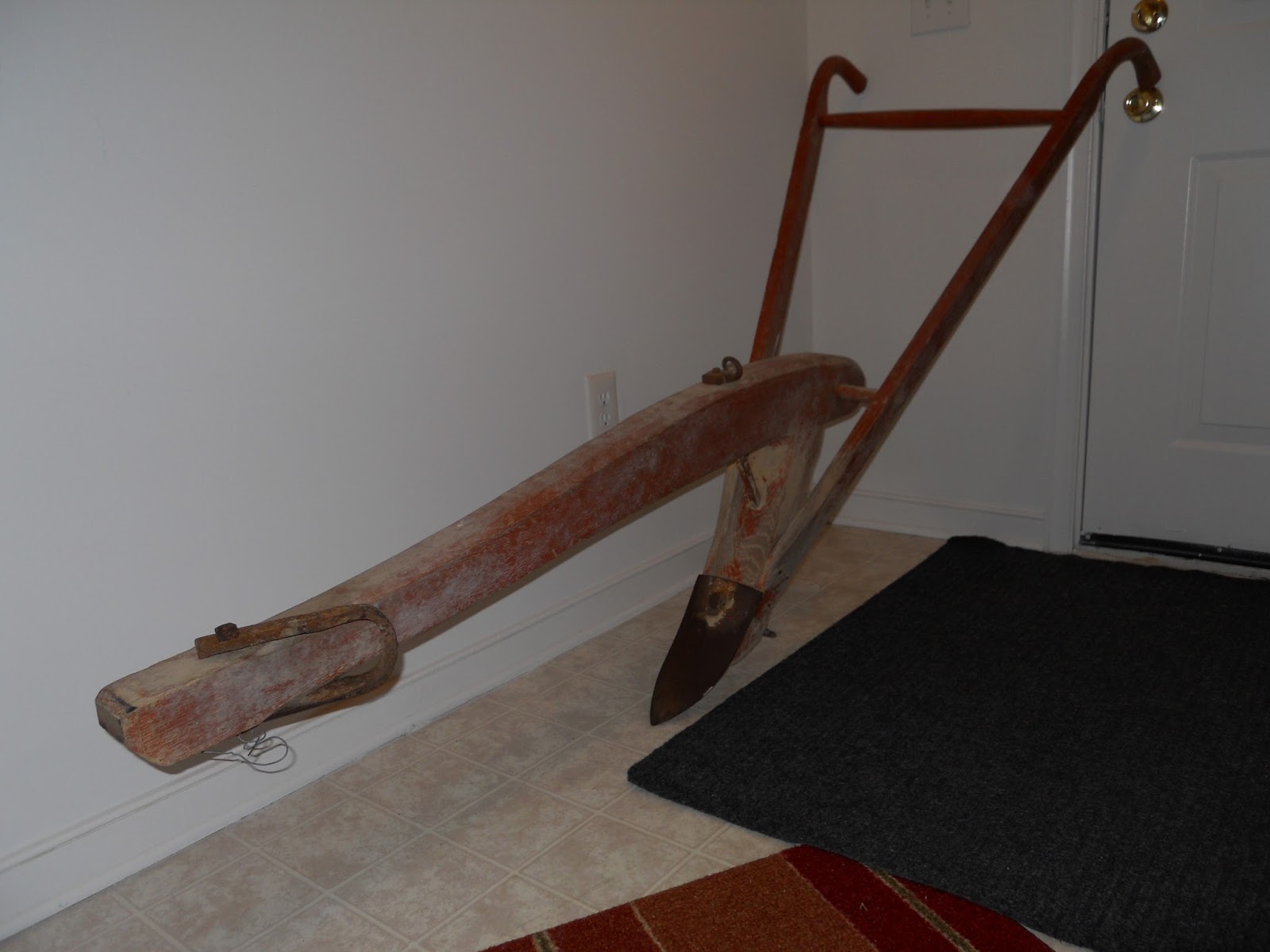
My Family Plow


One of my earliest posts way back in 2009 was about the simple plow. In that post I mentioned that as a boy I had remembered often seeing a horse/mule drawn shovel plow that my grandfather and his two sisters had shared on their neighboring south central Kentucky farms.

My guess is that the history of that plow probably goes way beyond that of my grandfather's generation. Being that it is a wood-beam plow hints that at least parts of it likely go back to the nineteenth century. It is difficult to be definitive on its age, as the only real significant change over time was the move from wood-beam to iron/steel-beam plows near the turn of the twentieth century.

Well, when my grandmother passed away in 2010, I got to get reacquainted with the old plow. In fact, I felt such a draw to this piece of family history that I bid and won it when pieces of her estate were auctioned the following fall. I kept the plow in a storage closet at my apartment while I live in Frankfort. When I moved to Petersburg, the plow made the 500 mile trip with me. But finding that I had no place to store the old plow I needed to find it a new home.

I donated the family plow to Pamplin Historical Park where it will be eventually used to help interpret various agricultural implements. I think it will make a good fit, as the shovel plow was commonly found on South Side Virginia farms and plantations throughout the nineteenth century.

Tuesday, June 2, 2015

My Petersburg Campaign Ancestor


If one visits Pamplin Historical Park's Breakthrough Trail it is rather quickly observed that the Confederate unit posted where part of the line broke was the 37th North Carolina. At the time the 37th was in Gen. James Lane's Brigade, of Cadmus Marcellus Wilcox's Division of A. P. Hill's Third Corps. Lane's Brigade had moved into this position along Arthur's Swamp and inherited the earthworks when they were vacated by Gen. Samuel McGowan's Brigade in last days of March. On the morning of April 2, 1865, the 37th bore the brunt of the Union VI Corps attack; and snapped.

A soldier not with the 37th on that fateful morning was my ancestor Levi Ham. Levi was not like the majority of Civil War soldiers. Compared to his comrades, Levi was old. When he enlisted in Company A in Ashe County's Jefferson, North Carolina, on May 1, 1862, he was in his mid-forties. The recent conscription law likely prompted Levi's enlistment. However, his service records indicate that he did indeed volunteer. Other Hams that served in Company A included Isaac, Jackson, Thomas, and William, all likely Levi's relatives.

Apparently Levi was mustered into Confederate service at Gordonsville, Virginia, for the duration of the war. Levi's early months in the army seem to have been quite difficult for him. He is noted as being admitted to the hospital in Danville, Virginia, on September 17, 1862, while his regiment was participating in the bloody battle at Sharpsburg, Maryland. Levi was suffering from chronic rheumatism.

Levi returned to the 37th on November 3, 1862, but must have relapsed, as on November 8, he was admitted to Richmond's massive Chimborazo Hospital. Twenty days later, Levi was transferred to a hospital in Scottsville.

Levi's service records note that he was absent without leave from August 1, 1863. However, it seems that at that time he had transferred to Company G of the 21st Virginia Cavalry, a unit that was raised from the southwest Virginia mountains bordering his Ashe County, North Carolina home. His records for the 21st show that he enlisted with it on July 10, 1863 at Rich Hills. The record also indicates that his horse was "at home," and thus he was "not ordered up." Confederate cavalry usually had to supply their own horses, and apparently Levi could not obtain his.

By September 1, 1863, Levi had returned to duty with the 37th after his brief stay in the cavalry. Levi was then present for duty from September 1863 to February 1865. As part of Lee's Army of Northern Virginia, the 37th fought in the terrible Overland Campaign during the spring of 1864. Horrific clashes with the Union Army of the Potomac occurred at the Wilderness, Spotsylvania, North Anna, and Cold Harbor. The Tarheel unit arrived in Petersburg in June 1864. They fought in several battles around the "Cockade City,"  and Richmond, including Deep Bottom, Reams Station, and Jones's Farm. Sometime during this period, according to his 1905 North Carolina pension application, Levi received a gun shot to the knee, which happened "near Richmond."

The winter of 1864-65 was particularly difficult on the troops of both armies in the Petersburg and Richmond earthworks. Somehow Levi received a "furlough of indulgence" dated February 4, 1865. The furlough described Levi as forty seven years old, five feet eight inches tall, with a "fair complexion and dark eyes, dark hair." It noted Levi was "by profession a farmer." The furlough was signed by Lt. Thomas L. Norwood, who commanded Company A at that time.

Apparently Levi never returned to the 37th. Perhaps he found home more to his liking than army camp life. His last service record states that he was "absent without leave since 27th Feb. 1865." Or, perhaps Levi found his family needing him more than he felt his comrades did back in the Petersburg earthworks. Levi was one of many thousands of soldiers at this point in the war who asked themselves which commanded stronger allegiance, home or army?  It seems Levi chose home. Even if his family was not suffering with his absence, maybe he had just seen enough of that terrible war and had suffered enough for his cause.

Thursday, May 28, 2015

"Little Powell's" Last Gallop


Only one man's name was supposedly included in the last words of both Gen. Robert E. Lee and Gen. Thomas Jonathan "Stonewall" Jackson. That man was General Ambrose Powell Hill. 

Known to most as A.P. or "Little Powell," Hill was born in 1825 near Culpeper, Virginia. He attended West Point, but illness caused him to lose a year, landing him in the class of 1847. Hill did make it south of the border in time to serve in the Mexican-American War, but only saw limited action.

In 1859, "Little Powell" married the Kitty Morgan McClung, the widowed sister of Kentuckian John Hunt Morgan. Hill called her Dolly. The couple eventually had four daughters, only two of which survived. When the Civil War came, Hill was made the colonel of the Thirteenth Virginia Infantry.

Hill's battle record as regimental, brigade, and division commander was outstanding. For example, his forced but timely march from Harpers Ferry to Sharpsburg on the afternoon of September 17, 1862, helped hold off McClellan's Union forces until night fell.

As corps commander, however, Hill initially struggled. His blunders at Bristoe Station in the October 1863 and North Anna in May 1864, were two instances where he disappointed Lee. At Petersburg, however, Hill seemed to get his footing back. In several actions around the "Cockade City," Hill's forces held their own. But "Little Hill" could not have known that on the morning of April 2, 1865, he would not live see that day's sun go down.    


Located less than a mile from where I live three separate historic markers note Hill's demise. The highway marker shown above is posted on Boydton Plank Road (US 1), just south of Duncan Road. It tells part of Hill's last ride.

Hill had returned to duty on March 31, after suffering from a recurring illness due in part from youthful indiscretions while a cadet at West Point. The sometimes debilitating sickness made riding a horse virtually impossible at times. On April 1, Hill spent the majority of the day checking on his troops who were entrenched in earthworks protecting the important supply lines of the Boydton Plank Road and nearby Southside Railroad.

That night the little general eventually made his way to his headquarters in Petersburg. There with him was his pregnant wife Dolly and two of his daughters. That night the Union artillery let loose a massive bombardment on Hill's entrenched troops as a precursor to the assault that would come the following morning at 4:40 a.m.


That assault, led by the Union's VI Corps, broke Hill's lines, which were held by Cadmus Wilcox's Division, consisting of the brigades of James Lane's and Eric Erson's North Carolinians and Edward Thomas's Georgians. 

The combination of pain and worry did not allow Hill to sleep. He got up around 3:00 a.m. and went to his headquarters. There he saddled up and went to check on his lines. Hill first rode to Lee's headquarters at Edge Hill where he found the commanding general battling insomnia as well. The men chatted and were soon joined by James Longstreet, whose troops had just arrived at Petersburg.

When one of Lee's officers announced that Hill's Confederate line had been broken, Hill rode off to try to rally his troops. Along with Hill were George Tucker and William Jenkins of his staff, and Charles Venable of Lee's staff. Hill sent Venable off to get some artillery support and proceeded on southwest with the other two. 

Before long the riders ran into two Union infantrymen, who they quickly captured. Hill ordered Jenkins to take them to Lee. Hill and Tucker continued to ride on just west of Boydton Plank Road. Hill hoped to make it to General Heth's headquarters to gain more information on the extent of the breakthrough. Before Hill and Tucker could go much farther they bumped into two more Federal infantrymen who had made it to the Southside Railroad and had headed back. Hill immediately wanted to capture them. Tucker went to demand their surrender and Hill yelled at them to throw their guns down.   


The two Union soldiers were from the 138th Pennsylvanaia. One, named Mauck, was a corporal, the other, named Wolford, was merely a private. A bold Mauck whispered, "Let us shoot them." Wolford aimed at Tucker and missed. Mauck, however hit Hill. The bullet took off the thumb of the general's extended left hand and then traveled into his chest, passing through his heart. The shot unhorsed Hill. He was likely dead before he hit the ground. Tucker made a break for it and escaped back to report to Lee. The commanding general remarked, "He is now at rest, and we who are left are the ones to suffer." A.P. Hill was killed exactly one week before Lee surrendered to Grant at Appomattox.

Just off of Boydton Plank Road, behind a circled subdivision of duplex apartments, and just down a dirt trail is a small stone maker with the simple words "SPOT WHERE A.P. HILL WAS KILLED." Two wilted wreaths from the 150th anniversary of his death stand near the marker along with two small Confederate battle flags. "Little Powell" is not forgotten.

A.P. Hill photograph courtesy of the Library of Congress.

Monday, May 25, 2015

Blandford Church - Then and Now


Since I knew I would be working today for Memorial Day, I took advantage of some amazing late spring weather on Saturday and visiedt a couple of cemeteries that contain thousands of Civil War veterans.

My first stop was to Blandford Cemetery. Remembering that I had seen a historic photo (below) of the church building there, I tried to position my shot (above) to mimic as much as possible the period image as I had recalled it. I think it came out pretty close. The below photograph was taken in April 1865, after the Union army had captured Petersburg. At that time the church was in a poor state of repair, but it has been lovingly restored since.


Like a few other places, Blandford Cemetery claims to be the birthplace of Memorial Day. David Blight in his book, Race and Reunion: The Civil War in American Memory, contends that recently freed slaves first decorated the graves of Union soldiers that had died at a prison at a Charleston, South Carolina horse race track on May 1, 1865.

If that was in fact the first "Decorations Day," then Blandford Cemetery was not far behind. On June 9, 1866, a young school teacher, Miss Nora Davidson, brought her students to Blandford to decorate the graves of those Petersburg citizens who had perished in a battle that occurred near the cemetery just two years before to the day.

The event became an annual tradition, and in 1868, Union Gen. John Logan's wife, Mary, witnessed the decoration of the graves. Mrs. Logan recalled years later that she had visited Blandford Church in the spring of 1868 and noticed the graves covered with flowers and small flags. When she returned to Washington D.C. she told Gen. Logan about the Petersburg grave decorations. Logan, who was head of the Grand Army of the Republic at the time liked the idea and issued General Order 11 on May 5, 1868, which designated May 30 as an annual day of decoration of graves of veterans who had died in the war.

People still come to Blandford Cemetery to decorate the graves. There are over 30,000 Confederate graves in Blandford and many on Saturday had flowers, wreaths, and flags on them. Most of those 30,000 graves are unmarked and belong to men who died in the numerous engagements around Petersburg from June 1864 to April 1865. Often originally buried where they fell, most were reinterred in Blandford in the years following the end of the war.

To give equal time to the Union men, I bought six little flags for those Kentucky USCT soldiers at Poplar Grove National Cemetery that I had researched and posted about earlier. When I arrived, I found that every grave there had a flag on it. It was quite a sight to see. I went ahead and placed my little flags at the Kentucky soldiers' graves and spent a few minuted thanking my lucky stars that our country has had, and continues to have, such committed men and women, who have willingly given their lives for our cherished liberties.


Blandford Church historic image courtesy of the Library of Congress.

Saturday, May 23, 2015

The Banks House Slave Quarters


Pamplin Historical Park owns several impressive historic structures. On the park's main campus is the Bouisseau family dwelling, which was known as "Tudor Hall." It was used by South Carolinian Gen. Samuel McGowan and his staff as their headquarters from October 1864 to the end of March 1865. Another impressive home is the Hart House, which is just across a branch of Arthur's Swamp from Tudor Hall. Just off Boydton Plank Road are yet two other historic houses. The Banks House and its domestic slave dwelling (pictured above).   


The slave quarters is of a common style for this part of Virginia. It is built as an elevated structure and consists of a central, two-sided fireplace and has divided rooms on either side; each with its own separate front entrance way. Both sides have front and rear glass windows and upstairs rooms. One side was likely used as the kitchen for cooking meals for the owners of the Banks House, as well as the dwelling (upstairs) for the cook and his or her family members. The upstairs rooms have a small four-pane glass window on each end. 


The other half of the dwelling was probably used for another enslaved family whose members served in additional domestic capacities in the Banks House. It is believed that the building dates back to the 1840s. The frame quarters floorplan reminds me of many of those I saw while in Kentucky, however many of the quarters there were constructed of brick or stone materials.

Following the Civil War, part of the duplex partition was removed to make the building a single family home with an inside open entrance way between the two sections. 


The home the slave structure inhabitants served is pictured above. The original section (right side) of the Banks House was constructed about 1750. Around 1770, an addition was constructed at the rear of this original section. Then around 1795 the home was significantly expanded with the the larger addition to the left. Finally, about 1810, another small addition was made near the rear entrance area.

The first known owner of the home was Robert Lanier, who purchased it in 1810. The house and surrounding land was then purchased by Scotsman named Thomas Banks in 1839, who named it "Wakefield."

While General McGowan's troops were camped near Tudor Hall in the fall and winter of 1864, Gen. James Lane's North Carolinians camped in proximity to the Banks House. After the Union army broke though the Confederate fortifications nearby on April 2, 1865, Gen. Grant made this headquarters at the Banks House. There he witnessed the XXIV Corps attack on Confederate Fort Gregg and came under enemy artillery fire. Fortunately, the Banks House and the slave quarters survived the adjacent fighting.


While I was wondering the grounds around the house slave quarters and the Banks House, I couldn't help but wonder what the enslaved people (if they in fact had remained there that long) thought about all the comings and goings of first the Confederate army and then the Union army to their little piece of the world. Were they aware that their freedom hung in the balance and depended on the Union army's success? Probably so. Or were they more concerned for their safety and just getting by with so many hungry soldiers about? If they were there on April 2, 1865, did they see Gen. Grant as a hero, or was he just another Yankee officer in a blue uniform? Did the families who inhabited and toiled in this humble building return after the war and finally get paid wages for their labor, or did they seek better opportunities now that they were free in Petersburg or even Richmond?

Most of these are questions can never be answered for certain. But I feel that I gain something, something special, from being near this original structure; seeing with my own eyes this little building--someone's home, and pondering these many many questions. 

Thanks goes out to Pamplin Historical Park for taking the time and expense to restore this important piece of American history. It would have been easy to simply raze the building and focus solely on the Banks House and its history, but thankfully it has been preserved to remind us of a difficult but important part of our nation's shared past.    

Friday, May 22, 2015

Just Finished Reading - The Confederate Alamo

Since moving back to Petersburg, I have been attempting to expand my knowledge and understanding of the city's nine month campaign in 1864 and 1865. One often overlooked but important engagement was that of Fort Gregg, on April 2, 1865.

I had read several positive reviews of The Confederate Alamo: Bloodbath at Petersburg's Fort Gregg on April 2, 1865, by John J. Fox, III (Angle Valley Press, 2010), and was happy to find it to be the well researched and written book that others described.

Fort Gregg sits about two and a half miles from my current residence. It is visible from I-85 (on the left if heading south), which runs between it and neighboring Fort Whitworth. While Fort Whitworth was designed a several-sided earthwork, Fort Gregg was constructed as a southward-facing earthwork bastion, which had a wooden stockaded rear.

Fox does an excellent job of setting the scene and the actions that led up to the battle at Fort Gregg. After the Union VI Corps broke through the thinly held Confederate lines southwest of Petersburg in the dawning light of April 2, 1865, they turned left and cleared the Rebels line of earthworks toward Hatcher's Run. To fill the VI Corps void, the XXIV Corps, led by Gen. John Gibbon, moved toward the main inner ring of fortifications protecting the city of Petersburg. Blocking their way was small Fort Gregg. Inside Fort Gregg was some 330 Confederates; mainly Mississippians, North Carolinians and Georgians. Fox uses a number of primary sources from participant defenders and attackers to effectively tell the Fort Gregg's terrible story.

The men inside Fort Gregg had been informed that they were the Army of Northern Virginia's last best hope of making a safe escape from Petersburg. If the men in Fort Gregg could hold out long enough against the Gibbon's XXIV Corps, perhaps Lee's army could link up with Joseph E. Johnston's force in North Carolina and continue the battle for Southern independence. The Confederate veterans in the fort fought with a desperate fury and held out before finally being surrounded. Those in Fort Gregg not killed (fifty seven) were either wounded and captured (243) or just captured uninjured (thirty three).

One defender, twenty one year old Lawrence Berry, attempted to work an artillery piece as the Union soldiers clambered over the fort walls. As Berry was about to pull the lanyard to fire his cannon, he was told to drop it or they would shoot. Berry exclaimed, "Shoot and be damned," and then pulled the lanyard. Those Union soldiers not killed by the blast, poured a deadly fire into Berry. The young Louisianan was not alone in fighting tooth and nail. Other Southerners rolled lighted artillery shells into the ditch in front of the fort into masses of Union troops stacking up there. Yet others threw bricks and rocks at the enemy, when ammunition became scarce.

Attacking Fort Gregg were some 4,500 Union soldiers. Although they outnumbered their defender opponents by over 12 to 1. They, too, exhibited tremendous bravery in attacking such a fiercely defended position. Fourteen attackers would earn the Medal of Honor at Fort Gregg for their bravery and heroism. In the fight Gibbon lost 122 killed and almost 600 wounded. Particularly hard hit were units from Illinois, Ohio, West Virginia, and New York.

In addition to the excellent twenty chapters and epilogue, Fox includes eight intriguing appendices that offer the order of battle and cover a number of controversies. The Confederate Alamo is one of those books that is difficult to put down. It is so well written with rich primary accounts that it provides one of the best military histories that I have read in quite some time. I highly recommend it to those seeking a better understanding of the end of the Petersburg Campaign. On a scale of one to five, The Confederate Alamo gets a five.    

Wednesday, May 20, 2015

Soldiers and Man's Best Friend


I came across these images of soldiers with dogs and found them so touching I thought I'd share them here. These canine companions must have been quite important to their owners to have been included in their wartime photographs. 

It appears that in the top image the hound slightly moved his head as his right ear seems sort of blurry. However, it is impressive that the dog stayed still long enough for the photograph to expose as well as it did. This image must have been taken very early in the war as the unidentified soldier holds a double barrel percussion shotgun, which was perhaps a photographer prop. But then again, perhaps not, as the man also has a powder flask at his waist. 


The unidentified Union soldier and his dog above also seem to sit still for an excellent image. The soldier appears to be wearing some type of corduroy pants tucked into boots. It looks like he is wearing a vest under some style of overcoat, all of which looks as much civilian as military to me. It is difficult to tell if there is a painted backdrop in the background, but it might be a camp scene of some type. I can't tell if the dog is a mixed breed or not, but he/she sure looks friendly and relaxed.

Dogs probably served as comfortable reminders from home for soldiers. And, whether these pooches were camp mascots or the soldiers just brought their family pets along for their hometown mustering photographs, it shows how important canines companions were to some men on both sides.

Images courtesy of the Library of Congress.

Sunday, May 17, 2015

Dying Far Far From Home - Temple Beard, 109th USCI


As Memorial Day approaches, I wanted to get in yet another tribute to a United States Colored Troop soldier from Kentucky who is buried in Poplar Grove Cemetery near Petersburg, Virginia. This particular soldier, Temple Beard, rests in grave number 4446.

Beard was from Butler County, Kentucky. He joined Company K, 109th United States Colored Infantry on June 19, 1864, in Bowling Green. Beard was twenty-seven years old when he mustered into the army and was listed as five feet ten and three-quarters inches tall. One of his service record cards lists his complexion was as "brown," another description card says "d[ar]k brown." His his eye color, too, was noted as brown. 

One of Beard's cards claims that his service was owed to David Beard; meaning, of course, David Beard was Temple's owner in Butler County. David M. Beard is listed in Butler County's 1860 census as being forty three years old and married to Mary J. Beard, who was forty-one. The Beard's had a daughter, Hester Ann, who was seven years old. David Beard is listed as a "Farmer" and owning $2800 in real estate and $4500 in personal property, which included Temple Beard. From Temple's enlistment form it appears that he enlisted without his owner's consent.

Temple Beard is shown as present for duty from his enlistment through the his regiment's transfer to Virginia in October 1864 and on through March 1865. Especially interesting to me, the 109th, served near Hatcher's Run (just about four miles from where I currently sit typing) in the spring of 1865. Temple's regiment witnessed the fall of Petersburg and was among the USCT units that pursued Lee's Army of Northern Virginia to Appomattox. The 109th returned to Petersburg and served guard duty there and at City Point (later known as Hopewell).

It was during this service of guard duty that Temple Beard died due to complications from pneumonia on May 3, 1865. Temple may actually have missed the chase of Lee, as his service records show that he was "Absent sick" at a post hospital at Point of Rocks (in nearby Chesterfield County) on March 26, 1865. Perhaps Beard had recovered from his March bout with illness and participated in the grueling chase of Lee, where he developed pneumonia. Or, maybe he was transferred to Petersburg for better care after the city fell on the night of April 2nd and early morning of the 3rd. Regardless, Beard was buried at the Fair Grounds Hospital at Petersburg.  

Temple Beard was, of course, not present when the 109th mustered out of service in March 1866. Instead, he was a war casualty; not by lead or steel, but by the deadliest killer, disease. Historians estimate that about two of every three soldiers who died in the Civil War died from disease. A host of illnesses including, typhoid, measles, small pox, dysentery, and pneumonia all claimed thousands of lives during the four year conflict; including that of Temple Beard. 

Thursday, May 14, 2015

Back of the Big House . . . In Town


When one thinks of antebellum slavery, a rural environment is usually envisioned, but the enslaved were obviously urban residents in Southern towns and cities as well. Among other occupations, urban slaves served as domestic help, skilled artisan craftsmen, factory workers, and coachmen. Like their rural counterparts, city slaves were often housed in proximity to their owners. However, unlike country field slaves, city slaves' domiciles were most often well constructed and made of durable materials, such as brick.

Earlier this week, while in downtown Petersburg, I located some buildings that I believe were once urban slave dwellings. The above picture shows the back of a two-level domicile, which is behind an impressive brick house on High Street. The suspected slave dwelling appeared to be a duplex structure, as it had two doors on the front side. Its construction is similar others I have observed in Southern urban areas.  


Next door to the dwelling in the first picture was the above structure. If I were to guess, I would say this back part of the the home to which it is attached served as its kitchen and/or house slave quarters.


This gray structure with red stutters is similar to the building in the top photo. It is located behind what was once the 1859 home of one of Petersburg's wealthy residents, Mayor John Dodson. The big house was also owned by former Confederate general William Mahone after the Civil War, and was later converted into the town's public library for many many years. As mentioned above, this two-level duplex design was common for antebellum urban slave quarters. 


The above dependency was attached to the larger home by a a slight breezeway. It, too, likely served as a kitchen and dwelling for the enslaved individuals that worked in the home.


This structure is behind the Ragland Mansion on Sycamore Street. The Italianate-style big house it likely served was built around 1857 for another of Petersburg's wealthy citizens, Reuben Ragland, and his family. Unlike the other urban slave dwellings shown here, it did not appear to have a chimney/fireplace. However, considering Ragland's wealth, it could be that this structure utilized a stove system instead.


This stuccoed structure is located behind and attached to a large home on Washington Street. It does not appear to be a kitchen, but rather solely a residence for enslaved domestics. 


Near the above stuccoed home is a frame house that is rapidly falling into disrepair. Behind it, and even perhaps on another property, is the brick ruins of what appeared to once be an urban slave quarters. 

Hopefully with some additional research time I can confirm or disprove that these structures were actually dwellings where enslaved individuals lived and worked.  

Tuesday, May 12, 2015

Petersburg's Monument to Joseph Jenkins Roberts


Since I spent the day at work on Sunday doing some training, I had today off to run some errands and do a little more sight seeing in downtown Petersburg. Along with visiting a number of antique stores, I took several pictures of the town's incredible historic buildings. I was happy to some historic homes in various stages of restoration work.

While wandering through the city's streets I stumbled upon the monument pictured above at the corner of Wythe Street and Union Street. As can be seen it is dedicated to one-time Petersburg resident, and later two-time president of Libera, Joseph Jenkins Roberts.

One of my early posts on "Random Thoughts" was about Roberts, so I won't recover old territory, but I thought it would be neat to show the monument.

Saturday, May 9, 2015

Dying Far Far From Home: Isham Whitsell, 118th USCI


Using the records of the National Park Service at Poplar Grove National Cemetery, I was able to determine to my satisfaction that the above headstone actually belonged to Isham Whitsell (according to the spelling in service records), not Hawkins Whetzel [Whitsell] as had been previously noted by an online source. I believe this because the initial letter "J." on the engraved headstone appears to look very much like the "I" in his service records death notice. Again, like other soldiers I have previously profiled, the misspelling of the last name appears to be a phonetic mistake or misspelling/translation from the original location grave marker.

But, there is much more to this sad story of gave number 5124. Isham Whitsell enlisted in Company B, 118th United States Colored Infantry in Owensboro, Kentucky, with his brother Hawkins Whitsell. They were owned by George Whitsell of Slaughtersville (now Slaughters), Kentucky, in Webster County.

Not only do the brothers' service records tell a story of their time in uniform, they also hint at a past that involved the interstate slave trade. The birthplace for both Isham and Hawkins was noted as Granville County, North Carolina. Did George Whitsell move from North Carolina to Kentucky and bring these two slaves along, or did they come west as the property of another owner and later sold to Whitsell? We will likely never know, but regardless they would end up serving, and unfortunately dying, not far from their old home on the Virginia/North Carolina state line, but far far from their Kentucky home.

Isham was listed as twenty-two years old when he signed up on August 16, 1864 with his brother, Hawkins, who was only two years older. Little brother Isham was listed as five feet four inches tall, while Hawkins was significantly taller at five feet eleven inches.

The 118th USCI was composed of nine companies of Kentucky men and one company of Maryland men. At the end of October 1864 they were transferred from Baltimore to City Point (now Hopewell), Virginia. Not long after arriving at their new location, Isham was sent to the army hospital at Bermuda Hundred. He is listed as being there starting on November 4, 1864. Hawkins, however, may actually have been the first of the two brothers to become sick. The older brother is shown as being in the hospital in Baltimore in October, where the regiment was finally organized before being sent to Virginia. Although likely severely ill, it appears that Hawkins made the trip with the regiment to the Old Dominion, as he was placed in the army hospital at Bermuda Hundred in November. Both brothers were sick with small pox.

On November 18, Hawkins died at the hospital. Isham died one week later, on November 25. Did the brothers spend their last few days together side by side in hospital beds? Did they discuss their transformation from slaves to soldiers? Were they content to die knowing they were trying to reunite the country and help end slavery? Did they remember fond times spent together? Did they hope for a better future for their race?

Both brothers were initially buried at the Bermuda Hundred/Jones Landing location where so many of the hospital deaths were interred. While I am quite sure that Isham's remains are those grave marked at Poplar Grove National Cemetery, perhaps, and hopefully, Hawkins was placed in one of the numerous "Unknown Soldier" graves there too; the brothers united forever.

Wednesday, May 6, 2015

Dying Far Far From Home: Harrison Graham, 116th USCI


One of the early scenes in Steven Spielberg's movie, Lincoln, shows the president speaking with a soldier who mentions he was a member of the 116th United States Colored Troops. The soldier explains to Honest Abe that his unit was sent east after training at Camp Nelson, Kentucky. The 116th was indeed transferred from the Bluegrass State to Virginia in the fall of 1864 to fight with the Army of the James. In the winter of 1864-65, the unit was moved to the all-African American XXV Corps. They participated in actions around Petersburg and helped pursue the Confederate Army of Northern Virginia to Appomattox. After Lee's surrender, the 116th returned to Petersburg for duty and was later shipped to Texas for duty. However, one solider that had fought with the unit through its time in Virginia did not make the trip. Corporal Harrison Graham would remain in Petersburg, forever.

Harrison Graham was 25 years old when he enlisted in Company H, 116th United States Colored Infantry. He is noted as being five feet, nine inches tall, which was about average for Civil War soldiers. Graham was described as "black" complexioned with black hair and black eyes, and was born in Garrard County. He joined his unit on July 9, 1864 at Camp Nelson. Before his enlistment Graham was owned by Richard Robinson, who apparently lived in Madison County, as it was credited for his service.

According to Graham's service records he was a reliable soldier, who was rewarded for his ability and character. On November 20, 1864, he was promoted to corporal while in the field by his colonel. However, noted on the same card was the fact that he had lost his canteen and was charged for it.

As mentioned above, Graham survived several engagements in the Petersburg and Appomattox Campaigns and returned to Petersburg sometime in mid-April 1865. While stationed in the Cockade City, Graham was shot. His service record states that he had died in camp on April 18, 1865 "of G.S. [gun shot] Wound received through criminal carelessness of a guard in camp [of] 115th U.S.C.T." While another of his service record cards also states that Graham was killed in the camp of the 115th, one claims it was the camp of the 116th.

Regardless of which camp it was, this tragedy is particularly sad. To have made it through the "shooting" part of the war, only to be killed by a gun shot wound inflicted by a comrade in camp is as tragic as those poor fellows that died in the last fighting at Appomattox. If Graham had not been shot in Petersburg it is not certain that he would have have survived various accidents and diseases before the 116th was finally mustered out in early 1867 after their service in Texas and Louisiana.

Graham, like his fellow 116th comrades, Henry Maddox and Daniel Anderson (who I have also profiled), would not make the trip back to their old Kentucky homes. These men who enlisted and trained at Camp Nelson would rest forever in Poplar Grove National Cemetery in their lonely soldiers' graves.

Monday, May 4, 2015

Dying Far Far From Home: Henry Maddox, 116th USCI


Much like I did when I was in Frankfort with the "Hometown Heroes" series, I thought I'd continue to look at several of the Kentucky USCT soldiers in the Poplar Grove National Cemetery here in Dinwiddie County, Virginia. However, unlike the Hometown Heroes, these stories will necessarily be much shorter. These men died in while they were in the service, not years afterward as was the case of those men in Greenhill Cemetery in Frankfort.

The subject of this particular post is Henry Maddox of Company G, 116th United States Colored Infantry. While Maddox's name is spelled Mattox on his gravestone, his service records show it was spelled Maddox. It seems that a good number of these men's names had different spellings on their markers from that in their records. One reason for this may be that they were buried in Poplar Grove as their second interment. Perhaps their comrades, many of which had only the rudiments of an education (if any at all), may have attempted to spell their deceased friends' names on a temporary marker, and when their bodies were moved to Poplar Grove, the spelling was continued on their permanent gravestone.

Henry Maddox was born in Henry County, Kentucky. He, like many African American Kentucky soldiers, enlisted at an early opportunity, which for Maddox was June 29, 1864. And, too, like many other black Kentuckians signed up at Camp Nelson. However, Maddox must have lived in Scott County when he enlisted, as that county is credited for his service. His owner is listed as David Sackett, but Maddox's enlistment paper was not included in his records to see if Sackett gave permission to enlist or not. Maddox's service records describe him as thirty-eight years old, and five feet, three inches tall. His complexion was described as "black."

As often happened to Civil War soldiers when the weather turned cold, Maddox became sick. He was entered into the "Base Hospital" on December 9, 1864. Maddox suffered from small pox. It was not a disease that only plagued USCT soldiers, but it did kill many of them. Maddox was ultimately one that perished to the disease. He died at the Post Hospital at Bermuda Hundred on January 3, 1865. Maddox, like fellow 116th soldier Daniel Anderson (the previous soldier profiled), initially was buried "between Bermuda Hundred and Jones Landing, Va, N[orth] of road;" a location sometimes called Watkin's Farm.

Today, Henry Maddox rests in grave number 5128 at Poplar Grove National Cemetery. It is not known if his family (if he had one) was notified of his death. If there was no one to mourn his death other than his comrades, and if there was no one who could claim pride in his service back in Kentucky, hopefully this small gesture will provide him with some measure of respect for his service to his country.

Thursday, April 30, 2015

My Visit to Southampton County, Virginia


I took advantage of some beautiful, cool, late April weather yesterday to travel about fifty miles southeast of Petersburg to Southampton County. Southampton may ring a bell for many of you that are Southern history enthusiasts; it was the location of the Nat Turner insurrection in August 1831.

The main reason I wanted to visit Southampton was because of my fascination with Turner's rebellion. Since I first read Stephen Oates's Fires of Jubilee: Nat Turner's Fierce Rebellion many many years ago, I have attempted to read anything that I can find on the subject.

My first stop was in the county seat of Courtland, presumably named for the county courthouse located there. In the nineteenth century Courtland was known as Jerusalem. The Jerusalem Plank Road (now Crater Road and Highway 35) ran between Petersburg and the historic Southampton town. The county courthouse (pictured above) was constructed in 1834, and thus missed the Nat Turner drama that occurred there three years before.


To the left of the courthouse is the county's Confederate monument. It was erected in 1902. Several Confederate companies were raised during the Civil War in Southampton County and the town contained a number of convalescent hospitals during the conflict. A small relatively new bronze plaque in front of the monument reads: "Not Forgotten - The two hundred and nineteen names that are engraved on the bricks before you are the men from Southampton County who gave their lives defending their families, friends and homes from the Northern Invaders. They were killed in action or died from wounds or disease in the War of Northern Aggression 1861-1865. We honor their bravery and sacrifice. We will not forget their struggle to preserve the principles on which our country was founded." I thought it was an interesting choice of words, and certainly an interesting interpretation for the Southampton men's motivations to go to war. However, I was not surprised that slavery was not mentioned, although in 1860, the county's population was almost half enslaved.


Right across Main Street from the courthouse was the Mahone Tavern. Confederate general William Mahone was born in Southampton County and as a youth his father, Fielding Mahone, purchased this building and an adjacent structure as a business venture. The tavern was constructed in the late 1700s and was one of the original lots in Jerusalem. The interpretive panel in front of the building explained that as a young man Mahone earned part of the necessary money to attend the Virginia Military Institute by gambling with the tavern's visitors. 


Also in Courtland is the Rebecca Vaughan House. This structure was moved from its original location out in a rural section of county in 2004. The house is currently being restored at the Southampton Agriculture and Forestry Museum and Heritage Village. It is noted as being the last house in which residents were executed during Nat Turner's rebellion. It appears there is a plan to have the house serve as a visitor's center for a proposed Nat Turner/1831 Southampton Insurrection Trail, if funding can be secured. I could not help but wonder if the people of Southampton are ready to embrace and promote this difficult history or not. It is a story that needs to be told and known, and I believe it would bring significant tourism dollars to their community.


I know I certainly would have benefited from a map of some kind that told me how to get to the places where events happened during the insurrection. All I was really able to locate was the Virginia highway marker, which is located along Highway 35 south of Courtland. As the sign says, the insurrection began some seven miles to the west of this location, but obviously, did not provide needed specifics on how to get scenes of the event.  


Beside the highway marker was a cotton field which appeared to have been picked and cut last fall. I found it fascinating that the Nat Turner slave insurrection marker would be located next to a cotton field. I would suppose that cotton was grown in this part of the state in the 1830, although I guess I always associate tobacco with this section and era.


After leaving the highway marker I attempted to take the closest road heading west just to get a feel for the terrain of the insurrection. I do not remember the name of the road, but along the way there were many more cotton fields and wheat fields. At a country intersection I found a dilapidated farmhouse (pictured above). It looked like it was about to crack in half. As I often do when I see such sites, I wondered who had lived here and what their lives had been like. Was the family that lived here black, or were they white? Were they prosperous or were they poor? Did they only farm or did they travel to work in town too? Was this house around during the Civil War, or was it from later times? So many questions.


On my circuitous return drive back to Courtland, I followed the General Thomas Highway. I had hoped that a helpful Virginia Civil War Trails sign would point me to Thomaston (pictured above), but alas, it was not to be. So, I made it back to Courtland and stopped in at the Walter Cecil Rawls Library. There a kind reference librarian allowed me to use their internet to find directions to the house. I had been so close during my drive, but was determined to find it, which I did easily with the directions. I guess that is a lesson for my next excursiona--always take directions in the first place.

Union General George Henry Thomas was born at Thomaston in Southampton County in 1816, and lived there until his appointment to West Point in 1836. When Thomas decided to remain loyal to the Union, his sisters, who still lived in the house at the time, spurned him. They refused to send his Mexican War sword, allegedly turned his picture toward the wall, and proudly supported their Southampton Confederate soldiers. Thomas never returned to Virginia. He lived in California after the war, where he died in 1870. He was buried in his wife's city of Troy, New York. After his death, his sisters, apparently contrite, supported the erection of his monument in Washington D.C. 


Traveling back cross county with my trusty Virginia highway map I got back to Highway 58 and headed west. Before getting too far on 58, I spotted two more highway markers. One noted the former location of a plantation called Buckhorn Quarters, and was near where Nat Turner spent the night after his slave force was defeated near Jerusalem by the militia. Turner managed to escape and hide out in Southampton County for about seventy days until he was finally captured and hanged. 


Beside the Buckhorn Quarters plaque was an additional and intriguing marker. It notes the Southampton County roots of the famous Supreme Court plaintiff Dred Scott. Scott's famous case in 1857 ruled that congress could not legislate slavery and that African Americans could not be citizens. The Dred Scott Decision threw yet another log on the sectional fire and brought the country closer to civil war.

There is so much important history in this still largely rural southeastern Virginia county. I would highly recommend a day's visit, or more, if you find yourself in area.

Tuesday, April 28, 2015

Dying Far Far From Home: Daniel Anderson, 116th USCI


It didn't take me long being back in Petersburg to head over to Poplar Grove National Cemetery. I had visited there a couple of times when I lived here previously, but I had not done much other than walk through glancing at the graves of men from Pennsylvania, Delaware, Wisconsin, Michigan and many other states. However, even back then, I do remember seeing a number of United States Colored Troops' grave stones.

This time, and now knowing that a number of Kentucky USCT regiments served in the Petersburg Campaign, I got to wondering if there might be some Bluegrass State men buried there. After a little bit of searching on the internet, I found a brief list that indeed enumerated a number of men serving in USCT regiments from Kentucky. Fortunately, that list included the grave numbers where those men rest. With these numbers it was not difficult at all to find the individual graves.

All of the stones in Poplar Grove have been placed on the ground rather than standing perpendicular as in most national cemeteries, such as Arlington. This practice was started apparently in effort to help speed the required mowing maintenance of the cemetery. The only down side is that it seems this has also sped up the erosion of the wording on some of the stones.

One of the first stones I found was number 5130 and that of Daniel Anderson, who served in Company K of the 116th United States Colored Infantry. To find out more about Anderson I searched his service records on the Fold 3 website. Anderson's service records indicate that he was born in Bourbon County, Kentucky, but apparently lived in Fayette County, as that county was credited for his enlistment. His owner's name was Thomas Barber. Apparently Anderson enlisted without Barber's permission.

Anderson enlisted at Camp Nelson on July 6, 1864. He was only twenty years old and stood five feet nine inches tall. His complexion was listed as black. Anderson's service records seem to show that he was a solid soldier, but as so often happened to many Civil War soldiers, he contracted a disease. His was small pox. Small pox is caused by an infection by the variola virus and can be contracted from person to person or though contaminated items, such as clothing and blankets. In addition to the visible feature of red spots, which often leave large pock marks on the skin, small pox's flu-like symptoms include: fever, headaches, severe fatigue and back pain, and possibly vomiting.

Anderson was admitted to the U.S. Flying Hospital (the MASH of the day) on December 8, 1864, just five months after enlisting. The young Kentuckian did not last long. Anderson died in the army hospital at Point of Rocks, Virginia (just outside of Petersburg) on December 27, 1864. Anderson's service records note that he was first buried "between Bermuda Hundred, Va & Jones Landing, N(orth) of Road." Anderson was moved to Poplar Grove when it was established as a national cemetery in 1866. Apparently Anderson's original grave contained some marker for identification.

One wonders if young Daniel Anderson had family back in Kentucky. And if so, were they notified of his death in a far off place called Petersburg, Virginia? If so, they were likely proud that their son served, and although he did not die on the battlefield, he nonetheless gave the ultimate sacrifice for his country and those that remained in slavery.