Friday, February 7, 2014

Thoughts on Minstrel Songs

Perhaps I should have included some commentary when I started posting minstrel song lyrics. I have not made these recent posts in order to provide any glorification to this popular nineteenth century form of entertainment. These songs perpetuated stereotypes of African Americans that were unfair and derogatory. The depictions of blacks on many of the songs' sheet music covers and the nonsensical lyrics put incorrect images of African Americans into white Americans' minds.  However, these songs - I believe - can help us form a better understanding of race relations during the era when they became so cherished.

Many of the minstrel songs were composed by men who had little actual interaction with blacks or had not spent much time in the South. Stephen Foster was from Pennsylvania, Dan Emmett was from Ohio - and although he was in a minstrel group called the Virginia Minstrels and is often credited with writing "Dixie"- Emmett like Foster was a man of his time and of limited knowledge of African Americans. George Christy, likewise, was from New York.

Some African Americans saw minstrels differently though. Frederick Douglass printed some thoughts in his newspaper the North Star in 1848 after seeing a performance by the anti-slavery group of singers The Hutchinson Family. Douglass praised the Hutchinsons' performance and contrasted it to black-face minstrel shows, which he saw as despicable depictions of African Americans:

"The circumstances attending the visit paid last week to our youthful and beautiful city, by these mountain songsters [The Hutchinsons], makes it deserving of special notice. The pro-slavery and narrow-souled demon had preceded them.—Old Hunkerism [Democrats], filled with pride and selfishness, dreaded the presence of these high-souled mountaineers in Rochester. It had no taste for their soul-enlarging and heart-melting melody. To defeat what it could not enjoy, was its first object. The Hutchinsons were described as poor performers; their popularity was said to be on the wane; abolitionism had ruined them. Other modes were meanly adopted to disparage them in the estimation of the people of Rochester. In this mean work of detraction, we scarcely need say that the miserable dough-face who edits the Cass paper [Democrat newspaper] in this city, and through whom our daughter was basely excluded from "Seward Seminary," on account of her complexion, very appropriately took the lead. This self-elected umpire of taste in the city of Rochester, claims as much skill in matters relating to the harmony of sounds, as he assumes with respect to the harmony of colors. We warn the good people of Rochester against attending either seminaries or concerts, on pain of being expelled from respectable and refined society, should they venture to do so before obtaining the opinion of this "most learned judge" whose word is sufficient to set at defiance and veto the wishes of a whole seminary of young ladies and misses. We believe he does not object to the "Virginia Minstrels," "Christy's Minstrels," the "Ethiopian Serenaders," or any of the filthy scum of white society, who have stolen from us a complexion denied to them by nature, in which to make money, and pander to the corrupt taste of their white fellow-citizens. Those performers are undoubtedly in harmony with his refined and elegant taste! Then those beautiful and highly sentimental songs which they sing, such as "Ole Zip Coon," "Jim Crow," "Ole Dan Tucker," "Jim along Josey," and a few other of such specimens of American musical genius, must spread over his spirit a charm, and awaken in his bosom a rapture only equalled by that celestial transport which thrills his noble heart on witnessing a TREMENDOUS SQUASH!"    

Wednesday, February 5, 2014

Keemo Kimo


"Keemo Kimo"
George Christy and Woods'
Celebrated Banjo Song
[about 1854]

In South Caralina de darkies go,
Sing song Kitty can't you ki-me oh!
Dat's whar de white folks plant de tow,
Sing song Kitty can't you ki-me oh!

Cover de groud all over wid smoke,
Sing song Kitty can't you ki-me oh!
And, up de darkies heads dey poke,
Sing song Kitty can't you ki-me oh!

Chorus:
Keemo Ki-mo, Dar! oh whar?
Wid my hi, my ho, and in come Sally singing
Somtimes penny winkle, lingtum, nip-cat
Sing song Kitty can't you ki-me oh!

Milk in de dairy nine days old,
Sing song Kitty can't you ki-me oh!
Frogs and de skeeters getting might bold,
Sing song Kitty can't you ki-me oh!

Dey try to sleep but it ain't no use,
Sing song Kitty can't you ki-me oh!
Dere legs hang out for de chickens to roost,
Sing song Kitty can't you ki-me oh!

Chorus:
Keemo Ki-mo, Dar! oh whar?
Wid my hi, my ho, and in come Sally singing
Somtimes penny winkle, lingtum, nip-cat
Sing song Kitty can't you ki-me oh!

Dar was a frog lived in a pool,
Sing song Kitty can't you ki-me oh!
Sure he was de biggest fool,
Sing song Kitty can't you ki-me oh!

For he could dance and he could sing.
Sing song Kitty can't you ki-me oh!
And make de woods a-round him ring,
Sing song Kitty can't you ki-me oh!

Chorus:
Keemo Ki-mo, Dar! oh whar?
Wid my hi, my ho, and in come Sally singing
Somtimes penny winkle, lingtum, nip-cat
Sing song Kitty can't you ki-me oh!

Here's the 2nd South Carolina String Band version.

Image courtesy of the Library of Congress.

Monday, February 3, 2014

Maxims for Young Farmers and Overseers!

Looking through the various antebellum agricultural journals printed in the slaveholding states and available on Google Books has been quite informative. In these one can get advice on just about anything related to farming, animal husbandry, and much much more. There are articles on beekeeping and grapes; and, of course, cotton. There are thoughts on female education, and boring wells for water. Poultry of every kind come in for mention, and manures from compost to guano to calcareous marls. On top of this, the advertisements are intriguing too. They offered mills of all kind, plows of all kinds, cultivators of all kinds, and even advertised plantation land for sale.

It appears, too, that there were some attempts at humor presented also. Printed in the March 1857, edition of the American Cotton Planter and Soil of the South, which was published Montgomery, Alabama, was a brief article titled "Maxims for Young Farmers and Overseers!" At first I thought it was a serious submission, but I quickly understood that it was an valiant attempt at satire.

Maxims for Young Farmers and Overseers!

Dr. Cloud - Dear Sir: The following ten maxims are respectfully dedicated to young farmers and overseers , in the hope that in this day of agricultural progress they may effect some good:

For Young Farmers

1. As soon as you have planted your crop, be sure to make a calculation how much you will make. If you have made liberal allowances for bad seasons, sickness, and such like subtractions, you will probably be not more than two-thirds over the mark; but then, you will have had all the pleasures of anticipation, and you can easily convince yousself [sic] that your arithmetic was right, if something else was wrong.

2. Be sure not to plow deep. Geologists say the earth is a hollow globe, and you might get through the crust. Besides, if the current philosophy be true, the the interior is liquid fire, you might get your feet burnt.

3. The old adage that "time is money" may do well for the face of a Yankee clock, but it is altogether beneath the philosophy of Young America. Therefore lie in bed until your breakfast is ready, and be sure to go a fishing every Sunday evening. Your corn and cotton will grow as well as while you sleep, as when you are awake; and if the grass grows, who cares for grass?

4. Scientific agriculturalists make a great noise about rotation of crops. Don't believe a word they say. "Rotation of crops, indeed!! Wonder if the rotation of a wagon wheel don't it land in a mud hole at last? Bug who? Every body knows that good land makes more cotton than poor land - so continue to plant your best field in cotton as long as you please. If it wears out, you can go to Texas.

5. As you value your future prospects in life, and your reputation as a physiologist, never suffer a curry-comb to scratch the sides of your mules. It wears them out, (the curry-combs) and curry-combs cost money. If the pores of their skin should be clogged up with dust, they can rub themselves against a tree or the corner of a fence; and everybody knows there is glorious luxury in scratching!

For Overseers

6. If you are an overseer, and a young one at that, look sour at your negroes the first day, and kick up a general row the second.  Africans are nothing but brutes, and they will love you the better for whipping, whether they deserve it or not. Besides, by this manly course you will show your spunk. To be sure, a half dozen of them may take to the woods, but that is no loss to you.

7. Be sure to make your office a sinecure.- Congressmen, Judges, and civil officers generally do so, and why not overseers? To this end, ride once in the forenoon to where you can see your hands, and then gallop off to some store, blacksmith's shop, or wherever you can find a crowd to listen to your interesting conversation. This is the only way to "magnify your office."

N.B.- Whatever else you may neglect, never forget to put yourself in the possessive case in regard to your owner's property - say "my negroes, my mules, my cotton," &c. Your employer is a lazy skunk, and has no right to any thing.

8. Swear like "our army in Flanders," yourself; but whip every negro on the plantation who dares to use profane language - the ebony scamps, what right they to imitate their overseer?

9. If your horse becomes lame, or from any other cause cannot carry you, as in No. 7, seek some "boundless contiguity of shade," where you can enjoy a comfortable snooze - nothing like "otium cum dignitate."

10. If your employer desires you to plant his cotton or corn in a manner different from that which you think best, be sure to spoil every thing, in its cultivation. You will then prove to him that his plans are wrong, and yours right.

CLOD THUMPER,
Jannary [sic], 1857.

Sunday, February 2, 2014

Treatment of Slaves

One can gain significant insight into slaveholders' thoughts by reading submissions to antebellum Southern agricultural journals. My last post came from apparently a Virginia woman, who provided suggestions to her fellow slaveholding housekeepers on how to efficiently manage those enslaved individuals employed in domestic tasks. The Southern Planter, published in Richmond, Virginia, printed it in 1843.

Today's post comes from another planting journal, "The Southern Cultivator, A Monthly Journal, Devoted to the Interests of Southern Agriculture and Designed to Improve both the Soil and the Mind; to Elevate the Character of the Tillers of the Soil, and to Introduce a more Enlightened System of Agriculture." The Southern Cultivator was published in Augusta, Georgia.  This brief submission was provided by an anonymous writer from Wilkinson County, Mississippi. It was published in 1860.

"Treatment of Slaves - Mr. Guerry"

EDITORS SOUTHERN CULTIVATOR - Allow me in a few lines to express my gratification in reading the sensible and gentlemanly article of Mr. Guerry in the current number of the Cultivator.

The article replied to reminded me of the phrase common among a certain class of overseers -"getting their satisfaction out of a negro!" It is this unrelenting, brutalizing drive, drive, watch and whip, that furnishes facts to abolition writers that cannot be disputed, and that are infamous. Mr. Guerry is right - treat your negroes well and he will respond to it with fidelity and honesty; kind words, humane consideration, justness in discipline, unhesitating authority when required, forbearance towards venal offenses, arousing pride of character, recognizing the personality of each one, not only in the week's rations but in the week's work - these make the negro most effective as a worker in the place of his appointment, these make the Institution truly "patriarchal" in character, and rob the phrase of its satire, as used by the Greelyites of Abolitiondom. But it may be said, how can the owner of hundreds of slaves treat them as proposed? God pity the man who owns more than he can intimately know and characteristically govern, either in person or by proxy. If the owner is a full grown man, even if it has to be done by proxy, his spirit will prevail, and the manager of the far-off quarter place will have a perpetual consciousness of responsibility that will, in good degree hold him to his duty. And good men may be obtained for this office and should be. The licentious, profane, the cruel, the false overseer should be kept on the home place or sent to Ohio.

If it were possible, by law, or public opinion, to prevent the acquisition of negroes beyond, say one hundred, the institution would be more efficiently worked; the negro more intrinsically more valuable, because the better cared for and better governed, and the many evils incident to quarter places obviated. But this may never be.

Public opinion however may be so educated to as to put its condemnation upon many things that we know are cancerous and fungous to slavery; that offend pure morals and common humanity; that corrupt the slave and degrade the white man. We may and should make the slave the friend, and so defy scoundrel book-pedlars and Ohio fruit-grafters and the whole crew of John Brown spies and strikers, who make us winter visits annually. B
Wilkinson county, Miss., June, 1860.  

Image courtesy of the Library of Congress.    

Friday, January 31, 2014

Management of Servants


From - The Southern Planter: A Monthly Periodical Devoted to Agriculture, Horticulture and the Household Arts. Volume III, Charles T. Botts, Editor, Richmond, 1843. Page 175.

"Management of Servants"
Mr. Editor - The management and conduct of servants, especially about a house, has been a source of much trouble and vexation to the housekeeper or manager; and to an observing person, the turmoil and labor of the mistress of a family, in the management of her servants seem to warrant the conclusion, that the trouble of housekeeping more than counterbalances the comforts and enjoyments procured by the labors of her domestics. Indeed, very few Virginia ladies, comparatively speaking, are brought up in a way calculated to make them what we would call good managers. Now what I want to suggest, is, the propriety of adopting the following advice.

First, let me remark, that most servants are incapable of understanding the explanation of any thing which they can not see with their eyes; therefore it is useless to tell them to do any thing which requires a long explanation, or which they are daily unaccustomed to do. It is by far the best plan, to allot to each his particular duties, and to have their affairs so arranged that one will not be dependent on the other. Let not one be employed about the same thing; for if there is more than one, they will depend on each other; and, moreover one can do more than two or three if they are employed closely together; probably some will not believe this, but let them try it.

Never change your servants from one line of business to another, for it takes them some time to get into the habit of doing things regularly. Be always as concise as possible in giving orders; for servants cannot retain many things in their heads at one time. Never scold when a servant neglects his duty, but always punish him, no matter how mildly, for mild treatment is the best; severity hardens them. Be firm in this, that no neglect go unpunished. Never let a servant say to you "I forgot it." That sentence, so often used, is no excuse at all. Finally, let regularity mark every action, and the consequence will be, that every thing will be done in its right place and at its right time; and the comforts and happiness of the family will be secured.
CECILIA  

Image courtesy to the Library of Congress.

Thursday, January 30, 2014

Jenny Get Your Hoe Cake Done


Jenny Get Your Hoe Cake Done,
The Celebraed Banjo Song, 
as sung with great Applause at the 
Broadway Circus
by
J. [Joel] W. [Walker] Sweeny


De hen and chickens went to roost,
De hawk flew down and bit de goose
He hit de ole hen in de back
I really believe dam am a fac,
  Oh, Jenny get de hoe cake done my dear,
  Oh, Jenny get de hoe cake done.


As I was gwain long de road,
Pon a stump dar sat a toad.
De tadpole winked at Pollewog's daughter,
And kick'd de bull frog plump in de water.
  Oh, Jenny get de hoe cake done my dear,
  Oh, Jenny get de hoe cake done, love!


High heel boot widout any strap,
Hand me down my leghorn hat,
Ise gwine to de Astor house to dine,
I won't be back till half past nine
  Oh, Jenny get de hoe cake done my dear,
  Oh, Jenny get de hoe cake done, love!


Massa and Missus gwain away,
Left home for de break ob day,
Den you har de white folks say,
Stan clar and det de banjo play --
  Oh, Jenny get de hoe cake done my dear,
  Oh, Jenny get de hoe cake done, love!


Apple cider, un percimmon beer,
Christmas comes but once a year,
Ginger puddin and pumkin pie,
Gray cat kick dat black cat's eye
  Oh, Jenny get de hoe cake done my dear,
  Oh, Jenny get de hoe cake done, love!


Massa un Misse promise me
When dey died to set me free,
Now dey both are dead and gone,
Left ole Sambo hoeing out corn
  Oh, Jenny get de hoe cake done my dear,
  Oh, Jenny get de hoe cake done, love!


Old Massa, and Misse gone away;
Da left home one morning gest about day;
And den you har dat nigger say,
Gi me down de banjo and let de nigger play!
  Oh, Jenny get de hoe cake done my dear,
  Oh, Jenny get de hoe cake done, love!


You eat me sugar, and drink my tea,
And ran about de old field and talk about me;
Dare was a nigger in de gutter and turned right about
And up stept Jo and got his toothnocked out,
  Oh, Jenny get de hoe cake done my dear,
  Oh, Jenny get de hoe cake done, love!


Dare was a frog jumped out de spring,
It was so cold he couldn't sing,
He tied his tail to a hickory stump,
He rared an pitched but he couldn't make a jump,
  Oh, Jenny get de hoe cake done my dear,
  Oh, Jenny get de hoe cake done, love!


The old hen and chickens at the stack,
An old hawk flew down amongst de pack,
And struck the old hen whack middle ob de back,
And I really do believe dat tis a fact.
  Oh, Jenny get de hoe cake done my dear,
  Oh, Jenny get de hoe cake done, love!


Now white folks, I'd hab you to know,
Dare is no music like de old banjo,
And if you want to hear it ring,
Jist watch this finger on de string.
  Oh, Jenny get de hoe cake done my dear,
  Oh, Jenny get de hoe cake done, love!

Here's a version by the 2nd South Carolina String Band.

Image and lyrics courtesy of the Library of Congress

Wednesday, January 29, 2014

Comments on Kentucky's Condition

On December 7, 1864, Assistant Inspector General E. H. Ludington wrote to Secretary of War Edwin M. Stanton (pictured at right) giving his honest opinion of the situation in Kentucky.

Ludington explained, that as he penned, a Kentucky delegation was on the way to suggest a change in the state's military administration. At that time Stephen Gano Burbridge was in charge of the Bluegrass State and the native Kentuckian had stirred up a hornet's nest of animosity among the citizenry.

The assistant inspector general first commented on the "condition of the state."  It's dangerous nature stood out. He wrote, "There is scarcely any security for person or property. In nearly every county guerrillas are destroying the property and taking the lives of all who have been, or now are, in the U.S. armies."  The divided nature of the commonwealth also came in for mention. "The citizens are so bitterly arrayed against each other as to afford immunity, if not assistance, to these desperadoes, for each party is glad to see men of the other murdered. From this intestine hatred guerrillas have their origin and maintenance," he wrote.

Ludington's thoughts on the "temper of the people" came next. He contended (and rightly so in my humble opinion) that "Kentucky remained in the Union to preserve slavery and avoid becoming the theater of war, although strongly in sympathy with the rebellious States. Being humored and favored for the first two years, many people avowed their devotion to the Union; but the moment that Government attempted to draft men or enlist negroes, the true feeling of these people was evinced. They resisted our officers, and became more violent in their denunciations of the administration than the original rebels. A large majority of Kentuckians are to-day undoubtedly disloyal."

The troops found in Kentucky, Ludington believed, were without "drill nor discipline," and were more of "a unformed mob" than an military force. He claimed the home-grown troops were more concerned for the state than the nation and that they were more effective in persecuting "personal enemies" than the guerrillas. Ludington advised that "Not a regiment raised in Kentucky ought to serve in the State."

Kentucky's civil government also came in for comment. He claimed that Governor Bramlette's aspiration for higher office (senate) "qualifies his Unionism." He maintained that "The Governor's policy is simply self first, State second, Union last." However, in Ludington's eye's the governor did not have the backbone to stand up to the Lincoln administration, and "therefore its policy need not be affected in any way by his views."

As far as military administration of the state, Ludington claimed that Burbridge had made his fair share of mistakes and that "He is now heartily hated by a majority of the people in the State. . . ." Ludington did not believe Burbridge required removal, but qualified that "the substitution of a man stronger in capacity and character would be an advantage."

Lastly, the assistant inspector general outlined four "suggestions as to policy."
1. "It is absolutely necessary to crush out the guerrillas in the State. This may be effected by placing in each exposed county 100 good troops from another State, mounted and well officered."
2. "All troops raised in Kentucky should be assigned to duty elsewhere. They would become efficient, and there would be no objection to the Governor's organizing and officering them, and thus one great cause of complaint upon his part would be removed. No troops should be allowed in State service."
3. "Noisy and active sympathizers with rebels and rebellion should be dealt with most rigorously. Offenses should be clearly proved, and after proof, no relenting. Every distinction should be made in favor of active and tried Union men."
4. "The policy of the Administration should be rigidly enforced, and Kentucky feel herself governed, as she is now is not either by civil or military authorities. If the Governor should array himself against the Administration, there should be no hesitancy in superseding him."

Image courtesy of the Library of Congress

Thursday, January 23, 2014

Dan Rice in Louisville


Going through old newspaper advertisements, one never know what will be found. I have come across several ads for circuses in Kentucky's antebellum and Civil War newspapers, but most were just small affairs. However, it appears that the great Dan Rice brought his show to Louisville in early May1861.

A little over three years ago I shared some thoughts on the book Dan Rice: The Most Famous Man You've Never Heard Of by David Carlyon. Rice's shows certainly must have been something to see. I'm sure they were popular attractions, especially to those individuals that came to town for the show from rural areas. It's difficult to image the looks on the faces of men, women, boys, and girls watching "all the dancing horses, performing ponies, educated wild animals," and "comic mules." Seeing exotic animals like the elephant, rhinoceros, and zebra for the first time probably evoked a sense of wonder and amazement.   

Monday, January 20, 2014

The Banjo


When I found this image from 1865 struck me as quite interesting. It was printed as carte de visite size, and therefore likely it was meant to be collected. It portrays an African American young man sitting on the ground against a wall and plucking or perhaps tuning a banjo.

But, the writing on the wall behind him is what really caught my attention. It reads "De Jubelo Hab Cum, I'se gwyne to change my tune." In other words - in my interpretation - now that freedom has arrived its it time to make a way for myself. I can't help but wonder if there is some significance to the brick under his right leg. Is it perhaps a reference to a some kind of foundation?

Any insight or thoughts out there?

Image courtesy of the Library of Congress.

Sunday, January 19, 2014

Henry Cornelius Burnett: Kentucky Confederate

I don't know about you, but when I read, I often imagine what historical personalities looked like if I don't know for sure. When I later do find a photograph or portrait of that person, sometimes I'm close, sometimes I'm way off the mark.

When I read about Henry Cornelius Burnett recently, I suppose I went with my stereotypical image of an antebellum Kentucky politician - and I was pretty much spot on. I can see Burnett now in a heady debate in the halls of Congress, pounding the table and red in the face, arguing for his constituents. One newspaper report described Burnett as "a big, burly, loud-mouthed fellow who is forever raising points of order and objections, to embarrass the Republicans of the House."

Burnett had a interesting legislative career to say the least. He was born in Essex County, Virginia - just northeast of Richmond - in 1825, before moving to Kentucky with this family as a youngster. The Burnetts settled in Trigg County and Henry was education at local schools. He soon was accepted to the state bar and then was elected to represent the First District in Washington D.C. in 1855.

A strong proslavery Democrat, Burnett supported fellow Kentuckian John C. Breckinridge in the 1860 presidential election and remained in his congressional seat after 11 slave states seceded. Burnett returned home to Kentucky for the spring 1861 adjournment of Congress. Burnett returned to Washington in the summer and argued against secession. With the end of the short summer session he again came home to Kentucky in August. The following month Kentucky pledged it allegiance to the Union, which then apparently spurred Burnett to raise a Confederate regiment, the 8th Kentucky.

Burnett was not done with politics though.  He participated in the formation of the Confederate Kentucky government at a November convention meeting in Russellville. He was soon sent to Richmond to advocate for Kentucky's inclusion to the Confederate family. In the meantime, in abstentia, he was expelled from the U.S. House of Representatives. Returning west, Burnett joined the Confederate army at Fort Donelson, Tennessee, but he managed to escape the surrender of the army there in February 1862.

Burnett resumed his political career as a member of the Confederate Senate in early 1862, where he remained throughout the war representing the Bluegrass State. With the Confederacy's defeat Burnett was forced to request a pardon from President Andrew Johnson, apparently without success. Arrested and sent to Louisville upon return to Kentucky, Burnett was released on bond and never stood trial. He returned to his law practice in Trigg County, but a bout with cholera ended Burnett's short life at 40.

Image courtesy of the Library of Congress.

Saturday, January 18, 2014

Rose of Alabama


Since a reader recently commented that they found all things Alabama intriguing, I thought I would do another Yellowhammer State related post. 

Like so many minstrel songs, "The Rose of Alabama" chose to have a Southern setting and an enslaved protagonist in love - although in this song it is difficult to tell if he is more in love with Rose or his banjo. The song's music was copyrighted in 1846, but it likely had an even earlier origin. The catchy tune was a favorite for decades after. 

Here's a version by the 2nd South Carolina String Band.


Images courtesy of the Library of Congress.

Friday, January 17, 2014

The Spradlings Keep it in the Family


I have noticed a trend with a number of the antebellum African American barbers that I have located so far. It appears that many of these men kept this skilled trade in their families. It certainly makes sense that barbers would pass on a trade that was one of the few occupations where free men of color could advance socially and economically. Men then, as now, wanted their posterity to advance.

In Louisville, Washington Spradling was a leading figure in that free black community. He was able to parlay his barber's trade into quite a pile of diversified wealth. Washington's sons, too, held to barbering. The 1860 Louisville Directory and Business Advertiser shows that both Washington Jr. and William Spradling worked in barber shops, like their father.

It is difficult to tell if both sons owned their own shops, but it would not be surprising given their father's wealth. While the advertisement above that ran in two Louisville papers in 1855 shows William Spradling's business at 88 Third Streeet, the directory lists him as a free man of color and barber at 209 Third. Possibly he moved his business in the intervening five years. His home was noted as at 417 Green Street.

Brother Washington Spradling, Jr., too, is listed as a free man of color barber, working at Fifth between Market and Jefferson Streets. His home was at 421 West Green Street.

The barber patriarch, Washington Spradling, Sr. is listed in the directory like his sons as a free man of color barber, but with his business at 303 West Green, and living nearby at 421 West Green.

Also included in the directory were 24 other free men of color barbers. And, while no others appear to be father-son combinations, their inclusion in the directory show their importance as a provider of a needed service, and their large number shows the popularity of the barber trade among free men of color.    

Wednesday, January 15, 2014

Washington Spradling Interviewed by Samuel G. Howe

I have been able to locate quite a few choice sources so far during my preliminary research into Kentucky's antebellum and Civil War African American barbers.

One man - probably Kentucky's wealthiest free man of color - Washington Spradling, had transitioned his occupation as a barber into the holder of significant amounts of Louisville real estate, and thus became a leader in the city's free black community.

Spadling had used some of his money to purchase his children out of slavery, and along with dispensing legal advice, Spradling loaned money to friends and business associates to help them do the same for their families. In addition, it appears that Spradling also helped fugitives make their way on to freedom via the Underground Railroad.

In 1863, while working with the American Freedmen's Inquiry Commission, Samuel Gridley Howe (pictured above) interviewed Spradling to get his thoughts on slavery and free blacks in Louisville. Howe was the husband of Julia Ward Howe, who had penned the "Battle Hymn of the Republic," and was one of John Brown's "Secret Six" financial supporters for the Harpers Ferry raid in 1859.

In the interview with Howe, Spradling commented:
"I was born a slave. My father bought me, and I bought my own children five in number, paying from $275 to $700 apiece for them. I have bought thirty-three other slaves, a good many of whom have repaid me, a good many have not. There is now $3337.50 due me from slaves that I have purchased.

There is no provision made here for the care of poor and sick colored persons, except in case of small pox. A pony purse [pooled funds] is made up among the colored people to bury the dead who leave no property. Our principle difficulty here grows out of the police laws, which are very stringent. For instance, a police officer may go to a house at night, without any search warrant, and, if the door is not opened when he knocks, force it in, and ransack the house, and the colored man has no redress. At other times, they come and say they are hunting for stolen goods or for runaway slaves, and, some of them being great scoundrels, if they see a piece of goods, which may have been purchased, they will take it and carry it off. If I go out of the state, I cannot come back to it again. The penalty is imprisonment in the penitentiary.

Such cases have been tried very often, but I have heard of but one conviction under the law. It is not a common thing to have such trials here in the city, where the colored people are mixed up, and it is hard to find a person; but here is one case I knew of. The mother of a young man who lives here moved across the [Ohio] river, and, being very sick and about to die, sent for him; but he could not go, and did not attend the funeral. He married here, & his wife preferred remaining here.

Another difficulty is this. If a freeman come here, (perhaps he may have been born free) he cannot  get free papers,and if the police find out he had got no free papers, they snap him up, and put him in jail. Sometimes they remain in jail three, four and five months before the are brought to trial. My children are just tied down here. If they go to Louisiana, there is no chance for them, unless I can get some white [person] to go to New Orleans and swear they belong to him, and claim them as his slaves. As I understand it, a freeman cannot get permission to go to the state and come back. There are many cases of assault and battery which we can have no redress. I have known a case here in which a slave bought himself three times. The last time, he was chained on board boat, to be sent South, when a gentleman who now lives in New York saw him, and bought him, and gave him his free papers.

I have to pay taxes to the amount of sixty dollars a year for schools. There is no colored school in any other part of the state except in this city. Colored children in Lexington, Frankfort, and other places, have to come here, if they go to school at all.

Slave women generally work round in the fields in this state. It frequently happens, that if a slave is lame or really unable to work and take care of himself, his neighbors try to persuade him to go home to his master and let him take care of him; but in such cases they often prefer to purchase themselves. A father or mother, if free, may buy their children or a free husband may buy his wife, or a free wife her husband and they can have their free papers. A brother cannot buy his sister, and giver her free papers."

*Paragraphs added for readability.

Monday, January 13, 2014

Blind Tom Played Louisville in 1860


On the eve of the Civil War, the blind slave boy Thomas, a piano prodigy, played at the Masonic Temple in Louisville, Kentucky. Tom's performance was advertised (below) in the Daily Louisville Democrat on March 30, 1861. 


For details on Tom's story click here.

Saturday, January 11, 2014

Down in Alabam


Ah! Ah!
My old massa he's got the dropser, um,
he's got the dropser, um,
he's got the dropser, um
He am sure to die 'kase he's got not doctor, um
Down in Alabam'.

Chrous
Ain't I glad I got out of de wilderness,
Got out of de wilderness,
Down in Alabam'.

Old bind horse come from Jerusalum,
Come from Jerusalum,
He kicks so high dey put him de museum,
Down in Alabam'.

Chrous:

Dis am a holiday, we have assembled, um,
we hab assembeled, um,
we hab assembled, um,
To dance and sing for de ladies and genelemun,
Down in Alabam'.

Chrous:

Far you well to de wild goose nation,
wild goose nation,
wild goose nation,
I neber will leave de old plantation,
Down in Alabam'.

Chrous:

Friday, January 10, 2014

Hometown Hero: Morrison Butcher, Co. H, 114th USCI


Morrison Butcher was allegedly 25 years old when he enlisted in Company H, 114th United States Colored Infantry on June 29, 1864, in Lexington. He was born in Franklin County, Kentucky, and gave his owners name as Ed Crockett. Since Crockett did not sign Butcher's enlistment papers he apparently did not give the 5' 9" Butcher permission to enlist.

I was unable to find an Ed Crockett in the 1860 census, but did find a Richard E. Crockett, who may be the same person. Richard E. Crockett was listed as 32 in that census and lived with wife Sarah, and children Samuel, Belle, and Florence. Crockett also owned two enslaved individuals, a 34 year old male and a 22 year old woman, who lived in one slave dwelling. Slave ages - and likewise USCT ages - were notoriously inconsistent and therefore it is possible that this Crockett's 34 year old enslaved man was Morrison Butcher. It is not know if the listed enslaved man and woman were married.   


Morrison Butcher enlisted as a private, but his commissioned officers must have noticed particular qualities of leadership, as he was promoted to corporal on February 28, 1865. Butcher received a 60 day furlough in August 1866, but he had been demoted back to private the previous month.  He was mustered out with the rest of the 114th at Brazos Santiago, Texas, in April of 1867.


Butcher returned to Franklin County, Kentucky after his service was over. He appears in the 1870 census as a 35 year old brickyard worker and married to Mary Butcher, 33 years old. Is Mary possibly the slave woman listed on Richard E. Crockett's slave schedule? In the Butcher household were children Mary Belle 13, and Louisa 9, both of whom were attending school. Also, younger children, Eva 5, Henrietta 2, and John 2 months are listed.

1880 still found Morrison Butcher in Frankfort, and again, his age is inconsistently listed, this time as 39. Morrison was now employed as a fireman at a distillery. Mary Ann 35, kept house, and stepdaughter Molly was a washer and ironer. Daughter Lou [Louisa] was a 17 year old servant, and Henrietta was 12. Granddaughters Kitty Tom was 5, and grandson Burley was 1 month old.

Morrison Butcher was still a distillery fireman in 1900 at 60 years old. Mary was listed as 40, and son Perry Butcher 20, was a coachman. In 1910, only Morrison and Mary lived in the household. He was 74 and had no occupation listed, and Mary was a 50 year old washerwoman.

Morrison died on September 15, 1912. His birthday was listed as May 7, 1839, making him 72 years old if correct. His father's name was James Butcher and his mother's name was Lucy. His father had been born in Anderson County, Kentucky. Morrison Butcher's cause of death was determined by the coroner as gangrene and rheumatism.  

Not only is Morrison Butcher remembered with a military headstone in Frankfort's Greenhill Cemetery, his name is proudly engraved as well on the Franklin County Colored Soldier's monument that is prominently displayed near his grave.   

Monday, January 6, 2014

Slave Jail Break in Lexington


I came across the above (spliced together) advertisement on the front page of the December 2, 1854, issue of the Lexington Observer and Reporter. It tells the interesting story of seven enslaved men held in notorious slave trader Lewis Robards's jail. It explains that they made their escape by way of sawing through one of the iron bars on a window.

The first enslaved man listed, Joe, was a blacksmith, who likely had knowledge of what it would take to get through the iron bar. Additionally, three of the men were owned by the same man, a Washington Bolton, and therefore one might speculate that they collaborated in planning the escape since they knew each other. The other four were all owned by different masters. One, George, was personally owned by Robards. The others came from Fayette and the surrounding counties of Scott and Woodford. All of the men were in their twenties.

Unfortunately, it is not known whether these men made good on their getaway or not.  


In that same issue, and in a different notice - this one on page four - Robards advertised his slave trading services. Here Robards mentions his jail from which the slaves on the front page evidently escaped. The jail's location was on Short Street, which was adjacent to the Fayette County courthouse, and as the notice explains, "a few doors below the 'Bruen House'" hotel. 

Robards specialized in the sales of "fancy girls" at one of his "pens." These young mixed race girls were gathered for sale to both local and distant buyers. The same year that this advertisement was run and the slaves made their jail break, former Kentuckian Orville Browning wrote in his diary of a visit to Robards's jail. Browning had moved to Illinois in the early 1830s and later was successor of Stephen A. Douglas in the U.S. Senate, but visited relatives in Kentucky occasionally. Browning wrote:

"After dinner visited a negro jail - a very large brick building with all the conveniences of comfortable life, including hospital. Tis a place where negroes are kept for sale - Outer doors & windows all protected with iron gates, but inside the appointments are not only comfortable, but in many respects luxurious. Many of the room are well carpeted & furnished,  & very neat, and the inmates whilst here are treated with great indulgence & humanity, but I confess it impressed me with the idea of decorating the ox for the sacrifice. In several of the rooms I found very handsome mulatto women, of fine persons and easy genteel manners, sitting at their needle work awaiting a purchaser. The proprietor made them get up & turn round to show to advantage their finely developed & graceful forms - and slaves as they were this I confess rather shocked my gallantry. I enquired [sic] the price of one girl which was $1,600." 


Also, in this same issue, another Lexington slave trader Pierce Griffin, who by way of his agent Asa Collins, advertised "NEGROES WANTED!" Griffin specialized in the Deep South trade, often sending his chattels to the Forks of the Road market at Natchez, Mississippi. Here, via Collins, Griffin notes that he has recently located in "the JAIL known as PULLUM'S in Lexington." Slave trader William A. Pullum had earlier operated a slave jail that was subsequently used by Robards starting in the late 1840s and then by Griffin in the 1850s, as this ad notes.

Interestingly, both Robards and Griffin use the virtually the same language to close their ads. Robards: "The highest cash prices will be paid for Young and Likely Negroes." Griffin: "I will pay the highest prices IN CASH for good likely young Negroes."    

Saturday, January 4, 2014

Plantation Horns

Although pictures are worth a thousand words, they seldom give us a good idea of the full story behind them. Take for instance the photograph to the left. It is from the Library of Congress collection. The image shows a man on the front steps of his home and holding a plantation horn. The picture's description states that the scene of the photo was in Marshall, Texas, which is in northeast part of the state, near the Louisiana border. This area of the Lone Star State was a flourishing land of cotton in the antebellum era. The man was apparently a former slave as the discretion says, and the picture was taken in 1939. Was this man a driver, or perhaps the son of a driver? Did he personally use the horn or possibly inherit the horn? Was it given to him by the plantation's master? Was the horn a symbol for strength? Or, was it a reminder of a trying past?

Like so many other questions about the past, these will probably go unanswered. But, if we want to know more about the role of the plantation horn, there are sources available that tell of its story and give us at least some information so we have a better understanding.

Plantation horns were a means of regulating time. Like bells, horns told the enslaved workers when to get up, when to go to the fields, when to break for meals, and when to knock off for the day. A former slave in Texas told of his experience and the plantation horn:

"We has ter git up early every day in de year, rain or shine. De slaves was woke up every mornin at four thirty by a slave blowin a horn it was his job ter gits up and blow a bugle and den he would go ter work in de fields wid de rest of de slaves. Dar was no danger of you not wakin up when de bugle blowed cause he blows it long and loud. He allus gits up of a mornin and gits his bugle down and comes out and climbs on a platform wintah and summah and blows his bugle. Dis platform was about eight or ten feet tall."    

Thursday, January 2, 2014

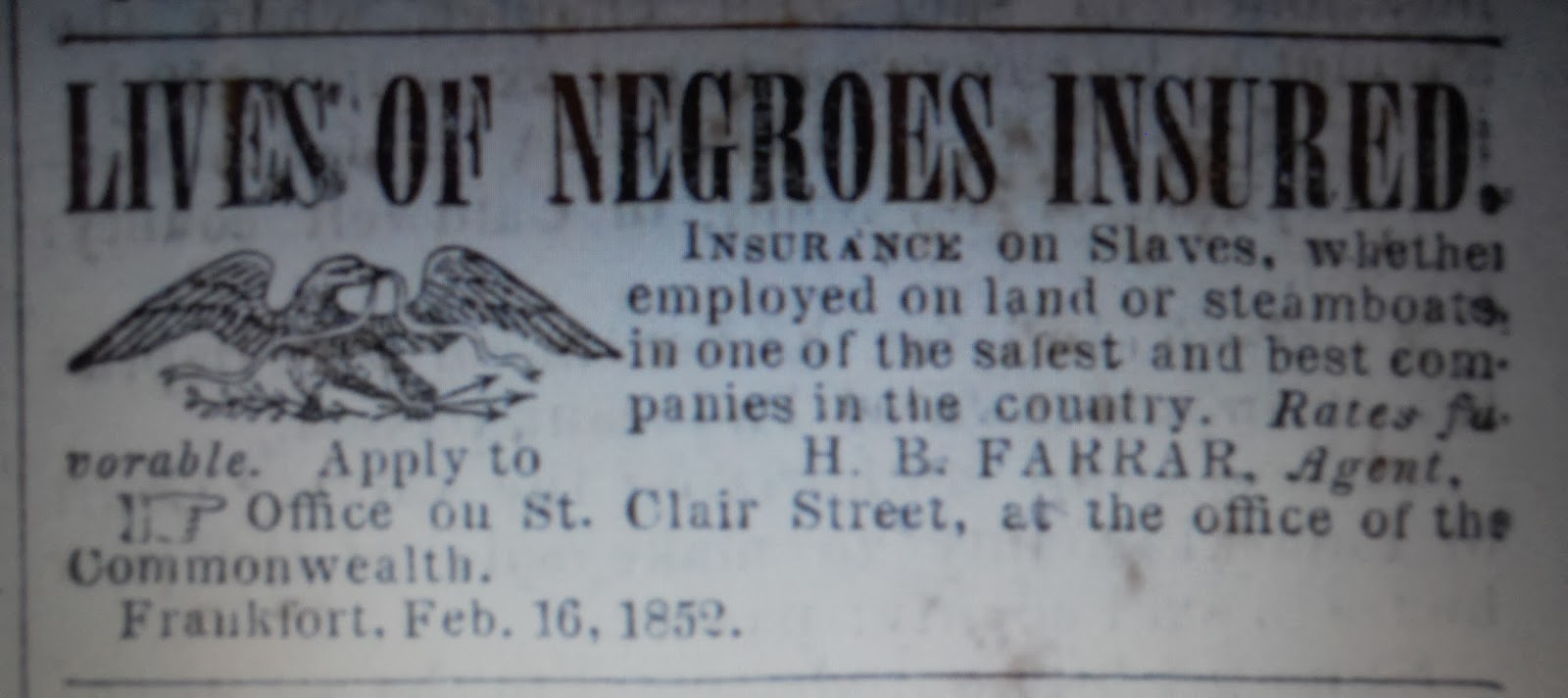
Life Insurance for Slaves


Doing my research on slavery advertisements in Kentucky's Civil War newspapers last spring I was surprised not to come across ads by companies offering life insurance to owners for their enslaved property. From the slaveholders' perspective, it seems a wise business decision to protect an investment with insurance coverage. 

Life was fragile in the antebellum era. Diseases, infections, and agricultural accidents all claimed both black and white lives at an alarming rate during this period. Therefore it would seem that insurance companies would want to promote their services in publications, especially in a state that claimed the third most number of slaveholders. 

But, it was not until searching in earlier newspapers that I started to locate some of these types of advertisements. The notice above from the famous (and still surviving) Hartford Insurance Company was found in the Lexington Observer and Reporter in the July 5, 1854, edition.    


Another ad (shown above) ran in the Frankfort Daily Commonwealth on February 11, 1854. It interestingly mentions that insurance could be purchased for slaves "whether employed on land or steamboats." Period steamboats could be especially hazardous occupations as craft were constantly blowing boilers and hitting snags causing hundreds of people to burn or drown. Unlike the first advertisement, this one does not mention a specific company, only the name of the local agent, who's office was in the newspaper office building in Frankfort.


Union Mutual Life Insurance Company agent, S. Carpenter, Jr. ran an advertisement in the April 7, 1853, edition of the Bardstown Herald. This ad offered insurance to both "White Men and Negroes." The notice also attempted to provide assurance of a sound investment with "one of the safest and most responsible companies in the Union."

I am still a little surprised that I have not come across more advertisements like these. Perhaps these insurance policies were costly and thus prohibitive to Kentucky's many small slaveholders. Unfortunately, no real information is given on the cost. Or, perhaps the terms were not favorable to owners who felt a greater risk of their property by running away rather than by loss of life.   

Wednesday, January 1, 2014

150 Years Ago Today - Emancipation Day Celebrated 1864

Without doubt the most significant effect of the Civil War was the eventual emancipation of almost four million enslaved individuals who lived in the slaveholding states. Emancipation came sooner to some of those people than others.

On the sea islands off the coast of South Carolina a Union military force had landed and established a foothold there in the fall of 1861. And, while the slaveholders fled, the enslaved remained. An experiment of sorts in Reconstruction began in the spring of 1862, in which slaves were paid wages for their labor and had the ability to receive an education for the first time ever.

One of the first teachers to arrive at Port Royal was Charlotte Forten. Forten was born free in Philadelphia in 1837 to a wealthy family of color. Her grandfather, James Forten, had been a leading early black abolitionist. She received an education in Massachusetts and began her teaching career there. However, Forten's desire to be part of the significant changes occurring due to the war signed up to go teach the freed slaves on the coast of South Carolina.

Through triumphs, tragedies, and struggles Forten worked diligently to share the benefits of education with those who had never dreamed of reading and writing before the arrival of the Union army. Charlotte wisely kept a journal of her experiences with the former enslaved and from that primary source we have a much better understanding of this early attempt at Reconstruction. Life on the Sea Islands was published in 1864 in Atlantic Magazine. On January 1, 1864, Forten wrote of the first anniversary of the Emancipation Proclamation as it celebrated  on the sea islands.

"New Year's Day - Emancipation Day - was a glorious one for us. The morning was quite cold, the coldest we had experienced; but we were determined to go to the celebration at Camp Saxton [named for Gen. Rufus Saxton], - the camp of the [African American] First Regiment South Carolina Volunteers, - whither the General and Colonel [Thomas Wentworth] Higginson had bidden us, on this, "the greatest day in the nation's history." We enjoyed perfectly the exciting scene on board the Flora. There was an eager, wondering crowd of the freed people in their holiday-attire, with the gayest of head-handkerchiefs, the whitest of aprons, and the happiest of faces. The band was playing, the flags streaming, everybody talking merrily and feeling strangely happy. The sun shone brightly, the very waves seemed to partake of the universal gayety, and danced and sparkled more joyously than ever before. . . .

The celebration took place in the beautiful grove of live-oaks adjoining the camp. It was the largest grove we had seen. I wish it were possible to describe fitly the scene which met our eyes as we sat upon the sand, and looked down on the crowd before us. There were the black soldiers in their blue coats and scarlet pantaloons, the officers of this and other regiments in their handsome uniforms, and crowds of lookers-on, - men, women, and children, of every complexion, grouped in various attitudes under the moss-hung trees. The faces of all wore a happy, interested look. . . .

Our hearts were filled with an exceeding great gladness; for, although the Government had left much undone, we knew that Freedom was surely born in our land that day. It seemed too glorious a good to realize, - this beginning of the great work we had so longed and prayed for."

Later in 1864, while still on the South Carolina coast Charlotte Forten grew ill and had to leave. She returned to Philadelphia. Forten committed the rest of her life to various causes of social justice. She died in Washington D.C. in 1864.

The Port Royal Experiment basically came to an end when President Andrew Johnson ordered Gen. Saxton to begin the process of returning confiscated lands to the former white owners. Some owners never returned though, which provided an opportunity for black land ownership that in many cases has been passed down to descendants and continues today.