Friday, May 13, 2011

A Threat?

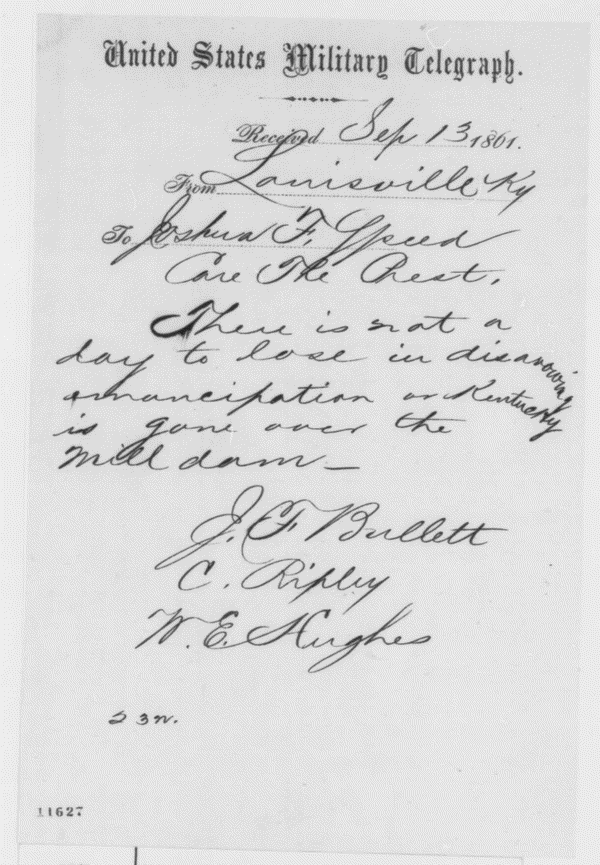
I found the above short note at the Library of Congress. It was sent to President Abraham Lincoln's friend, Kentuckian Joshua Speed, by Kentuckians Joshua F. Bullitt, Charles Ripley and W. E. Hughes and apparently was intended for both Speed and Lincoln, as it says "Care The Prest.," and appears in the Lincoln papers. It goes against my previous thinking that Kentuckians were not contemplating the possibility of emancipation in 1861. It reads:
"There is not a day to lose in disavowing emancipation or Kentucky is gone over the mill dam -"

This appears to be referring to the need for Lincoln and the Republican Party to proclaim that they did not plan to emancipate the slaves of the South and Border slave states in order to keep Kentucky from seceding. Was this a threat? It was sent on September 13, 1861, just days before Kentucky's brief attempt at neutrality ended. Lincoln had clearly stated in his first inaugural address that previous March that, "I have no purpose, directly or indirectly, to interfere with the institution of slavery in the States where it exists. I believe I have no lawful right to do so, and I have no inclination to do so." So, I am not so sure. Maybe they wanted another confirmation. It's not real clear to me.

I do know that Bullitt was later arrested by order of the Lincoln administration for conspiring to overthrow the government, so possibly it was a threat.

If anyone has any ideas, I'd be interested to hear your thoughts?

Tuesday, May 10, 2011

CW 150 at History.com

The more I see the less I like the programming on History (formerly the History Channel). With shows like Ice Road Truckers and Swamp People, which have almost nothing to do with History per say, I have little reason to spend time on channel 46 of my basic expanded cable.

However, History has somewhat redeemed themselves in my eyes. Last week a teacher on our educator advisory board for the Kentucky Historical Society sent me a link that I had not previously seen on History.com (History's web presence).

This website's designers have developed an excellent and interactive tool that I think both experts and novices, the young or the old, can learn from and enjoy.

On the homepage there are seven choices to learn about; Who They (soldiers) Were, Weapons of War, How They Died, 5 Deadliest Battles, Paying for the War, West Point Warriors, and Civil War topics, which offers another six sets of choices; Technology, Union, Confederate, Battles, Places/Events, and Culture. In these "topics" a number of options are available. For example, in Place/Events topics from Andersonville to West Virginia Statehood are covered; while in Culture, topics from Black Codes to Uncle Tom's Cabin are examined.

Take a few minutes to check it out at the link below:

Wednesday, May 4, 2011

The Union War

It seems that Dr. Gary Gallagher's new book, The Union War is causing quite a stir among Civil War scholars. In the book Gallagher calls into question several historians' recent interpretations of the main motivation for the North fighting the war.

Naturally, my curiosity was peaked when I started seeing the reviews and comments, so I ordered a copy and made a quick read of it, which wasn't difficult in that, as with most of Gallagher's books, it is well written, and this one was relatively short (162 pages of text).

Here is the work's description that the book jacket provides:
"Even one hundred and fifty years later, we are haunted by the Civil War - by its division, its bloodshed, and perhaps, above all, by its origins. Today, many believe that the war was fought over slavery. This answer satisfies our contemporary sense of justice, but as Gary Gallagher shows in this brilliant revisionist history, it is an anachronistic judgement.

In a searing analysis of the Civil War North as revealed in contemporary letters, diaries, and documents, Gallagher demonstrates that what motivated the North to go to war and persist in an increasingly bloody effort was primarily preservation of the Union. Devotion to the Union bonded nineteenth-century Americans in the North and West against the slaveholding aristocracy in the South and a Europe that seemed destined for oligarchy. Northerners believed they were fighting to save the republic, and with it the world's best hope for democracy.

Once we understand the centrality of union, we can in turn appreciate the force that made northern victory possible: the citizen-soldier. Gallagher reveals how the massive volunteer army of the North fought to confirm American exceptionalism by salvaging the Union. Contemporary concerns have distorted the reality of nineteenth-century Americans, who embraced emancipation primarily to punish secessionists and remove slavery as a future threat to union - goals that emerged in the process of war. As Gallagher recovers why and how the Civil War was fought, we gain a more honest understanding of why and how it was won."

First, let me say that I think Gallagher is largely spot-on. Numerous relatively recent histories place emancipation as a motivation for the North fighting the war primary to union. I think to do this, is like Gallagher explains, anachronistic. Union was such a strong idea to most of the people of the United States before the war that the firing on Fort Sumter didn't cause the remaining four states to break away and join the Confederacy; it took Lincoln's call for 75,000 northern volunteers, and thus an expected invasion of the South by federal troops for Virginia, Arkansas, North Carolina and Tennessee to sever their cherished bonds of union. And, still after secession, many people in those four states remained sympathetic to the Union cause.

The ideal that the Union offered to Northerners and the Border States brought forth a type of jihad - if that is not too strong of a word - that would not be complete until the Union was restored. The North was going to do everything it had to do in order to keep the country from splitting, and it had the men and means to do it.

All of this is not to say that slavery wasn't the precipitating factor that caused the war. The southern states seceded because they felt threated by a Republican president and thought their best chances of preserving the institution that was the backbone of their society and economy was to leave the Union. If the South had not seceded then the North would not have had reason to fight to keep the Union together; thus no war. It is my opinion that the majority of northern soldiers had little interest in ending slavery other than as a means of helping the Union win the war and restore the Union.

Where I think Gallagher maybe missed in his interpretation (unless I missed it) is at least mentioning that African Americans were active agents in causing the war. Largely it was not the slaves from the states that first seceded who ran away in the antebellum years, but rather those from the slave states that seceded last or not at all (Border States). But it was those Deep South states that cried foul when runaways were not returned, or when caught, put up a fight. Most of the famous rescues and publicized runaway episodes such as Anthony Burns (Virginia), Henry Box Brown (Virginia), John Price (Kentucky), Margaret Garner (Kentucky), Jermain Loguen (Tennessee), the Cynthiana Riot (Maryland), as well as the famous Frederick Douglass (Maryland), came from the upper-South states. But, it was South Carolina, Mississippi and others of the Deep South that claimed that the North was not holding up their part of the Constitution by returning fugitive slaves as a significant reason for breaking the bonds of union. So, in my opinion, the runaway African American slave was an active agent in bringing on the war, and thus an active agent in restoring the Union and ending his bondage.

Tuesday, May 3, 2011

"Let Justice Be Done!"

To say the least 1864 was a difficult year for white Kentuckians. Their physical world was being torn apart by raiding guerrillas and their social world was being turned upside down as African Americans flocked to the Union army to enlist.

Not only was the Union army recruiting blacks to join their forces, they were also impressing slaves from both Unionist and Confederate owners. Often making those that didn't want to enlist serve anyway.

A short article appeared in the Frankfort Tri-Weekly Commonwealth on March 4, 1864 under the headline, "Let Justice be Done!" explained the unfair treatment Unionist slaveholders felt they were receiving at the hands of the federal government.

"General [Stephen G.] Burbridge has issued an order extending to the impressment of negroes to other counties than those included in the order heretofore. Now, General, we think it decidedly wrong that the order includes the negroes of loyal as well as disloyal persons. Let the negroes of loyal persons remain with their owners, and impress only the negroes of the rebels and their sympathizers. The necessity of impressing negroes and other property alone rises from the rebellion, and the aiders and abettors of the rebellion are the ones from which the impressments should be made. Let justice be done the Union people, by letting their property alone. Let justice be done the rebels and those who give them aid and comfort, by taking their negroes and property for Government use."

This perceived injustice and hard-handedness toward the loyal people of Kentucky was one of several reasons that the commonwealth came to identify itself more with the Confederate cause after the shooting stopped. Like the people of the Confederate states that seceded over the Union's threats to slavery, those in the slaveholding border states too associated liberty with property, only they felt their best chances to remain slave owners was to stay in the Union, not leave it. The Emancipation Proclamation, although it technically did not effect them, started the slippery slope that ended the institution with the 13th amendment to the Constitution. Enlisting and impressing former slaves were just more nails in the institution's coffin.

Tuesday, April 26, 2011

My, Major Kalfus How You Have Changed!


I recently finished reading, The Battle Rages Higher: The Union's Fifteenth Kentucky Infantry, by Kirk C. Jenkins. Although I had read a significant amount about Kentucky's Confederate soldiers, I honestly had not read much about the Union fighting men of the commonwealth. The book provided good background information on how at least a portion of Kentucky's majority Unionist population experienced the war, which I think will be helpful if I continue to pursue my research on white Kentuckians' opposition to black enlistment.

The 15th Kentucky was raised from men that came from a number of different counties. Soldiers from Jefferson, Bullitt, Shelby, Nelson, Hardin, LaRue, Hart, and Spencer, among others, signed up to fight to save the Union. One soldier in particular had an especially interesting story.

Henry Frederick Kalfus was born on April 14, 1832 in Shepherdsville, Ky (Bullitt Co.-highlighted on map above) and was educated at Hanover College (Indiana), and the Kentucky School of Medicine, where he received his medical degree in 1860. He had married Elizabeth Birkhead in 1854, and raised Company D of the 15th Kentucky after the war broke out. He was elected its captain, and was promoted to major of the regiment on October 9, 1862, a day after the unit had fought at the Battle of Perryville, Kentucky.

The 15th Kentucky fought too at Murfreesboro, [Stones River] Tennessee. During the winter battle (Dec. 31-Jan.2, 1862), their young colonel, James Brown Forman was killed. Promotions appeared to be available for almost all of the officers in the regiment, but opposition to President Lincoln's Emancipation Proclamation (to take effect on Jan. 1, 1863) prompted fifteen officers in the regiment to tender their resignations in late January. Maj. Gen. William S. Rosecrans, the army's commander, rejected them all.

In early February, five officers again attempted to resign, but also were rejected by Rosecrans. Kalfus, expecting a promotion was denied when the resignations were rejected and retained his rank of major. Disappointed in the status quo, he wanted out of the service, but he apparently did not want to lose honor by making it look like he resigned due to not being promoted. So, he resigned...but based his stated decision on opposition to the Emancipation Proclamation.

The Louisville Democrat published his stated reason for resigning on March 14, 1863:
"That I am painfully convinced that the war is not prosecuted by the present party in power [Republican] in accordance with the principles and policy under which I enlisted eighteen months ago; that I enlisted to fight rebellion, to fight treason, to fight for a reconstruction [emphasis in original] of the Union as it was, but not for the degradation of the white man to an equality with the negro; and being unwilling to sacrifice my liberty of opinion, and more unwilling to encourage insubordination by the utterance of sentiments while in the service which might be considered inconsistent with good order and proper discipline in the army, and as I could not as conscientiously and as zealously discharge my duties as formerly, I respectfully desire that my resignation be accepted; and moreover, that the service would not suffer, because the vacancies of the regiment were now filled, and a competent senior Captain ready to take my place."

A few days earlier Kalfus helped ensure that his resignation be accepted when he did just what he stated he would not do in his letter to the Louisville Democrat. While working on earthworks, and observing African Americans labor at the task, he said so as to be heard by others that, "I am willing for negroes to be employed for such work as this, but when guns are put in their hand we are all going home." Kalfus was arrested and then given a dishonorable discharge. Col. Beatty, who commanded the brigade the 15th was in, wrote in his diary that Kalfus, "will, I doubt not, be a lion among his half-loyal neighbors when he returns home."

Beatty was correct. Kalfus well knew the sentiments of the majority of his fellow Kentuckians about Lincoln's Emancipation Proclamation, and thus the possibility of arming African American slaves for combat. The Louisville Democrat wrote about the Kalfus's discharge on March 14. "Had Captain [Major] Kalfus acted with more shrewdness and less honesty he could have withdrawn easily with high honor. Had he resigned on some hypocritical pretense, it would, no doubt, have been more in accordance with official custom and dignity, besides there would have been nothing like treason in the case." Flirting with treason would be in near future for Kalfus.

In August of 1864 Kalfus was arrested for conspiracy with members of the Sons of Liberty to aid the Confederate cause by releasing rebel prisoners and committing terrorist acts in the North. Kalfus was released from incarceration in a prisoner exchange, but upon returning to Louisville found that he was to be arrested again and made his escape to Canada. He returned to Kentucky after the war was over and went back to practicing medicine. He died in Louisville in 1890.

Although the details of the Kalfus story are quite unique, his change in sentiment after the Emancipation Proclamation is representative of a significant portion of Kentucky's white male population, and yet another reason that Kentucky became so identified with the Confederacy after the Civil War was over.

Saturday, April 23, 2011

"Only One Killed"

The following poem was written by Julia L. Keyes (1829-1877), an Alabama woman, after she read a notice in a newspaper during the Civil War under the headline "Only One Killed." It speaks of the disregard for the preciousness of human life that that terrible war brought; a callousness that developed in people, both North and South, with the loss of so many lives.

Only one killed -- in Company B;

'Twas a trifling loss -- one man!

A charge of the bold and dashing Lee --

While merry enough it was, to see

The enemy, as he ran.

Only one killed upon our side --

Once more to the field they turn.

Quietly now the horsemen ride --

And pause by the form of the one who died,

So bravely, as now we learn.

Their grief for the comrade loved and true

For a time was unconcealed;

They saw the bullet pierced him through;

That his pain was very brief -- ah! very few

Die thus, on the battle-field.

The news has gone to his home, afar --

Of the short and gallant fight,

Of the noble deeds of the young La Var

Whose life went out as a falling star

In the skirmish of that night.

"Only one killed! It was my son,"

The widowed mother cried.

She turned but to clasp the sinking one,

Who heard not the words of the victory won,

But of him who bravely died.

Ah! death to her were sweet relief,

The bride of a single year.

Oh! would she might, with her weight of grief,

Lie down in the dust, with the autumn leaf

Now trodden and brown and sere!

But no, she must bear through coming life

Her burden of silent woe.

The aged mother and youthful wife

Must live through a nation's bloody strife,

Sighing, and waiting to go,

Where the loved ones are meeting beyond the stars,

Are meeting no more to part.

They can smile once more through the crystal bars --

Where never more will the woe of wars

O'ershadow the loving heart.


Lest We Forget!

Thursday, April 21, 2011

Circular No. 8, March 1, 1864

While doing some preliminary research on my new area of study - white Kentuckians opposition to black Union army enlistments - I ran across a letter from Kentucky Governor Thomas Bramlette to President Lincoln voicing his opposition and that of the state as a whole.

The first part of the letter reads:
"I see the Provost Marshall General U. S has issued his circular for the enrollment of slaves preparatory for draft. I had hoped that nothing would be done to disturb the confidence and good feeling which was being rapidly established in your Administration of the Government; and that nothing should occur to change a friendly support to an active hostility of your Administration, by those who have already endured much and suffered greatly for their Country. My earnest desire has been to unify the sentiment of my people in harmony with the legitimate measures of the Administration for the suppression of the rebellion. I had hoped for the sympathy and cooperation of the Administration. This hope cannot survive the attempt to inflict this wrong upon us."

Naturally, I was curious about what this circular said, so I referenced The Official Records of the War of the Rebellion - or the O.R. as historians refer to it. On March 1, 1864 the Provost Marshal General's (James B. Fry) Office issued Circular No. 8. It consisted of 6 points:

1. Pursuant to section 24 of the act approved February 24, 1864, amendatory of the act of March 3, 1863, boards of enrollment in districts in which there are any colored persons held to service will without delay proceed to enroll all such persons as are liable to military duty.
2. Enrolling officers will conduct the enrollment in the manner prescribed by existing orders and regulations and such other directions as the acting assistant provost-marshalls-general of the States may give.
3. Enrollment lists will be made upon the printed forms (Nos. 35 and 36), altering the heading to suit, and in the column headed "Former military service" the name of the person to whom service is owed is written.
4. A list, with a recapitulation of the number enrolled, will be made for each sub-district, and as soon as the enrollment of the district is completed these lists will be forwarded to the acting assistant provost-marshal-general for transmission to the Provost-Mashal-General. Copies of the list will be kept in the offices of the district provost-marshal. Those lists by sub-districts will not be consolidated.
5. The provost-marshal will furnish each person to whom the persons owe service a list of those owing service to him who have been enrolled, specifying their names, ages, and date of enrollment.
6. It is made the duty of the acting assistant provost-marshal-general to superintend this enrollment, and to give such orders and directions as may be necessary to make it accurate and complete.

While the other points are largely tedious instructions, the first point obviously is quite significant. It referred directly to the border states of Kentucky, Missouri, Maryland and Delaware. While it also referred to some areas where the Union army occupied territory in the Confederacy, in many of those places, by the time this circular was issued, slavery was in fact dead on on its death bed.

Slavery was not dead in Kentucky. The Bluegrass state, along with her sister border states, was not subject to the Emancipation Proclamation, and men, women and children continued to be bought and sold and worked without compensation.

Slaves serving in the Union army was probably the last thing on Kentuckians' minds in 1861 when hostilities started. But, by 1864 Kentuckians knew that if slaves were allowed to enroll in the Union army, that would be the beginning of the end of slavery in the Commonwealth. The end of the practice of slavery meant the loss of millions of dollars in property and production. White Kentuckians also knew that if blacks were allowed to serve in the military it would be a step toward citizenship and social equality...something that they did not want to consider and something they would not have imagined three short year before.

Governor Bramlette continued his letter by stating:
"We offer freely our own Sons for the defence of the Government. You may call out as many as you choose by draft or otherwise and Kentuckians will obey the call without a murmer

Surely this should satisfy the demands of all whose object is the defence and preservation of our government. If you require a soldier we offer you a Kentuckian.-- Will nothing but a Negro satisfy the Administration? What superiority has the slave over the Kentuckian that he should be prefered? I beg you to pause, consider and weigh well the consequences, before you spring a mine the awakened thunders of which may crash upon the ear of the present and coming generations. Kentuckians will obey willingly any law requiring their services in defence of their Government -- for this they hold to be their duty -- but they will not obey a law violative of their Constitutional rights as Citizens, which dishonors them by preferring the slave to the loyal Kentuckian and which takes private property for public use without just compensation, and without any necessity or excuse. Such law can only be enforced by a hard and dangerous constraint .. Kentuckians will sacrifice every thing for for principle -- but principle for nothing."

Bramlette's claim that white Kentuckians would willing serve the Union army if called on apparently does not hold water. It is true that more Kentuckians served in the Union army than in the Confederate army. Historian Anne E. Marshall, in her book Creating a Confederate Kentucky, claims that between 66,000 and 76,000 men served in the Union army while between 25,000 and 40,000 served the Confederacy." But, of those that served in the Union army, 24,000 were African American soldiers. Marshall also contends that, "Of Kentucky's eligible white males, 71 percent chose not to fight at all." African Americans proved more committed, as "40 percent of Kentucky's able bodied African American males served the Union." Only the state of Louisiana sent more blacks to the Union than Kentucky.

In the spring of 1864, to paraphrase a song from one hundred years later, the times, they were a changin', but most white Kentuckians did not want to see or believe it.

For Bramlette's complete letter go to: http://memory.loc.gov/cgi-bin/query/r?ammem/mal:@field(DOCID+@lit(d3136600))

Friday, April 15, 2011

The Last Full Measure at the Library of Congress

The Library of Congress web site (www.loc.gov) is quickly becoming my favorite place to find primary sources. It is simply amazing how much historic information on almost any subject in America's past can be found over there.

Their Civil War photograph collection has always been top notch, and a first place stop for historians to find illustrations to their texts. But, there has been an recent addition to this fine collection. On exhibit now, not only in their Washington D.C. facilities, but also online, is The Last Full Measure, the Liljenquist Family Collection of Civil War era photographic portraits. The following is the description that the Library of Congress provides about the collection:

The Last Full Measure: Civil War Photographs from the Liljenquist Family Collection

The Last Full Measure: Civil War Photographs from the Liljenquist Family Collection presents a stunning array of Civil War-era ambrotype and tintype photographs that associates human faces, often startlingly young, with statistics on both sides in this wrenching conflict. This exhibition features portraits of enlisted men in uniform—both Union and Confederate—and serves as a memorial to those who lost their lives during the war by displaying images of 360 Union soldiers in uniform—one for every thousand who died—and 52 rare images of Confederate soldiers—one for every five thousand casualties. More than 620,000 Union and Confederate soldiers died in the Civil War, a greater number of deaths than occurred in all other American wars combined through Vietnam.

Surrounding visitors to the exhibition, these portraits invite quiet contemplation of the human costs of the war and the courage and determination that characterized the people on both sides. The names of most of those pictured have been lost during the passage of time. As it preserves these portraits, the Library of Congress is also using the power of electronic media to recover as much information as possible about these individuals and to add details about their uniforms, hats, guns, swords, belt buckles, canteens, musical instruments, and the other items that surround them. A digital comment book at the end of the exhibition allows visitors to post their thoughts about individual photos and to reflect on the Civil War.

The Last Full Measure also tells the story of the family that has built the powerful collection of Civil War portraits, now numbering more than 700 images, from which this exhibition is drawn. As they continue adding to the collection, Tom Liljenquist and his sons Jason, Brandon, and Christian seek to inspire in others an interest in the amazing personal stories that are at the heart of all history. The Last Full Measure marks the beginning of the Library’s sesquicentennial commemoration of the Civil War, in which three million Americans donned uniforms and countless others provided support on and off the field of battle—each person making a contribution to this defining chapter in the continuing story of the United States of America.

Take a few minutes to browse through this treasure trove of history. The faces of these men and women, both black and white, both Union and Confederate, are the faces of a generation that experienced the most trying time in America's history.

Here's the link: http://myloc.gov/Exhibitions/civilwarphotographs/Pages/Default.aspx

Thursday, April 14, 2011

On To New Things

Courtesy Library of Congress-American Memory

Well, I submitted my article, "'Principles Opposed to the Public Peace:' Kentuckians' Reactions to John Brown's Raid" on Tuesday. I certainly do not think I have seen the last of the paper since I am sure more editing will be needed if it is accepted, but I have already started thinking of my next study.

Initially I thought about doing something on one of the United States Colored Troop regiments that was raised in Kentucky, but that would most likely require significant research time at the National Archives in Washington D.C. And, while I am certainly not opposed to spending as much time as possible in the nation's capitol deep in research, it is probably not realistic at this point.

I also thought about working on a string of studies about how Kentuckians experienced other national issues in the 1850s. Starting with the Compromise of 1850 (including the Fugitive Slave Law) and the Nashville Convention and going through John Brown's raid. These studies could be a number of articles that would probably turn into chapters, but obviously a study such as this would require it being book-length. Chronologically, other topics that would be of interest to me in this particular study would be Kentuckians' responses to: Uncle Tom's Cabin, The Kansas-Nebraska Act, The Margaret Garner case, Brooks's caning of Sumner, Bleeding Kansas, the Dred Scott decision, the Lincoln-Douglas debates and end with my work on John Brown's raid. The only problem with this idea is that would require a significant commitment and would take a long time.

But, I believe that I have decided on something different. Piggybacking off of my previous work on Kentuckians' reactions to John Brown's raid, I think I might continue to explore the Bluegrass state and race. After recently reading Anne E. Marshall's Creating a Confederate Kentucky it reminded me of how vehemently Kentuckians opposed African Americans enlisting in the Union army. Although this topic has been touched upon in recent scholarship it doesn't appear that anyone has explored it in depth. Another positive to this particular topic is that there should be no shortage of sources from all across the state and from numerous perspectives.

One primary source I easily found at the Library of Congress is pictured above. Although it is not from a Kentuckian (it is from native Hoosier Ambrose Burnside) it does mention how he thought Kentuckians would respond to the issue of African American enlistments in the Commonwealth. It reads:

The following Telegram received at Washington 320 PM. June 26 1863,

From Cincinnati 2 PM.

Dated, June 26 1863.

Prest Lincoln

I am satisfied from my knowledge of Ky that it would be very unwise to enrol the free negroes of that State It would not add materially to our strength and I assure you it would cause much trouble I sincerely hope this embarassment to the interests of the public service will not be placed in our way Please Answer at once1

Very Resp'y

A E Burnside

Maj Genl

Tuesday, April 12, 2011

Shots of Fort Sumter...150 Years After


Today, in honor of the sesquicentennial of Fort Sumter, I thought I'd share some images that I took while in Charleston last week. Being in Charleston a week before the 150th anniversary of the assault on Fort Sumter was a real special treat. I had been to Charleston three times in the past, but I had never had the time to take a trip out to the historic fort. To say the least, standing on that historic ground was quite a moving experience.


To get out to the fort we had to take a boat ride from Liberty Park at the Aquarium thorough the harbor that lasted about 3o minutes. There was some recorded narration available on both the trip to the fort and on the way back, but when we boarded we went to the lower deck, so we only found that out on the way back.


It was a beautiful day for a cruise out to Fort Sumter. It was breezy, but nice and sunny. The view from the water level deck was amazing. The fort is visible over my left shoulder.

Native Kentuckian, Major Robert Anderson, the U.S. commander, moved his force from Fort Moultrie to Fort Sumter on December 26, 1860. Provisions ran low for the garrison over the next three months as South Carolina refused efforts to resupply the force. After the bombardment began on April 12, Anderson and his men lasted 34 hours until he finally capitulated.

There were no reported casualties in this the first battle of the Civil War, but Pvt. Daniel Hough was killed instantly when a cannon went of prematurely on shot 47 of a planned 100 gun salute during the surrender ceremony. The 100 gun salute was reduced to 50.

On April 14, 1865, Anderson returned to Fort Sumter to re-raise the flag he had lowered 4 years before. President Lincoln was assassinated later that evening back in Washington D.C.


This shot is from inside one of the surviving casemates. Our interpretive ranger explained that construction on Fort Sumter was started in 1829 by importing granite, much of it from New England, and building an island on which the masonry fort was built. Unbelievably, when the fort was bombarded on April 12, 1861, it still was not fully completed. Most of the masonry work was completed by African American slaves and free men of color and the bricks were made on local plantations. During the bombardment over 3,000 shots were fired at the fort!


The interior of Fort Sumter looks much different than it did 150 years ago. Battery Huger, a Spanish American War era installation now dominates much of the grounds, but it is easy to get a feel for what the fort looked like by viewing the surviving walls.


Michele and I on very historic ground.


It was possible to see Morris Island (about a mile away) quite clearly from Fort Sumter. Morris Island is where the famous 54th Massachusetts (African American soldiers) attacked Battery Wagner on July 18, 1863 and is depicted in the motion picture Glory.

Also clearly visible on the ride back to Charleston was Castle Pinckney. Pinckney was built by the U.S. government in 1810 and named in honor of Revolutionary War hero Charles Cotesworth Pinckney. This fort was the first federal installation in Charleston that fell to South Carolina's forces. During the Civil War this fort held Union prisoners taken at First Manassas for a short time.

On our return to the National Park Service Visitor Center at Liberty Park we had the opportunity go through the excellent exhibits that told the story of this American treasure. I highly recommend taking some time to visit Charleston during the Civil War Sesquicentennial and learn more about this opening round of the war.

Sunday, April 10, 2011

Dixie, Where is Dixie?

Courtesy Library of Congress-American Memory

Saturday, April 9, 2011

Hemp for Traitors

Courtesy Library of Congress-American Memory

Sunday, March 27, 2011

Thursday, March 24, 2011

...And That's What's the Matter!

When Stephen Collins Foster wrote "That's What's The Matter" in 1862 the country was being torn apart by civil war. Foster, a Democrat from Pittsburgh, Pennsylvania, and related to previous President James Buchanan by marriage, had earned much of his living writing songs with slavery themes and often in blackface dialect. But, Foster's choice to side with the Union was probably not a difficult one for him and he doesn't appear to have harbored Copperhead sympathies. His lyrics in "That's What's The Matter" bear this fact out as he pokes fun at the Confederacy and strongly supports the Union war effort.

Author Ken Emerson in Doo-dah! Stephen Foster and the Rise of American Popular Culture explains that, "The song scolds the 'rebel crew' as if they were naughty boys, delights in their comeuppance at Shiloh, and praises the iron-clad Monitor and its true-blue captain, John Ericsson." At this particular time Foster was living in New York City and and according to Emerson "Since it has been built and launched in Brooklyn, the Monitor was a source of special pride to New Yorkers (and perhaps of additional pride to Foster because its guns had been manufactured in Pittsburgh."
The song's lively opening lines are, to me, some of Foster's most catchy.

"We live in hard and stirring times,
Too sad for mirth, too rough for rhymes;
For songs of peace have lost their chimes,
And that's what's the matter.

The men we held as brothers true,
Have turn'd into a Rebel crew;
So, now we have to put them thro',
And that's what's the matter."


The song also apparently carried some significant cultural weight as well, as it's title appeared on the Civil War era envelopes pictured above and below.


If you are interested in seeing a short performance of this song give this link a look and listen:

Sunday, March 20, 2011

Kentucky in Minstrelsy


I have been developing a real interest in antebellum minstrelsy lately and one observation that I have made is that Kentucky comes in for its fair share of mention in these songs. Not that that is rare, as almost all Southern states make an appearance in these tunes, but the Bluegrass State seems to have had a special appeal to the composers. Historian William J. Mahar, in Behind the Burnt Cork Mask: Early Blackface Minstrelsy and Antebellum American Popular Culture, explains that Virginia far out paced the other slave states mentioned in minstrel songs, but was followed by Kentucky, Louisiana, Mississippi and South Carolina.

Sometimes the Bluegrass State appears in titles such as the above pictured "Julius From Kentucky," or Stephen Foster's famous "My Old Kentucky Home, Good Night." But, in many more Kentucky is mentioned in the lyrics.

In "Ring, Ring the Banjo," Foster again references Kentucky, but this time instead of reminiscing of Kentucky, one gets the impression that the slave did not have such a good experience:
"Once I was so lucky, my massa set me free,
I went to old Kentucky to see what I could see;
I could not go no farder , I turn to massa's door,
I lub hum all de harder, I'll go away no more."

In "Darling Nelly Gray," written by Benjamin R. Hanby, in 1856, Kentucky is again a happy place for the slave who loses his Nelly to slave traders that take her to Georgia to "toil in the cotton and the cane."
"There's a low green valley on the old Kentucky shore,
There I've wiled many happy hours away,
A-sitting and a-singing by the little cottage door,
Where lived my darling Nelly Gray."

In Clare [Clear] de Kitchen,which dates back to minstrelsy of the early 1830s, Kentucky is mentioned as "old," not so much as old chronologically as old in being familiar and favored. Kentucky's mother state, Virginia, is also referenced :
"In old Kentuck in de afternoon,
we sweep de floor with a brand new broom,
an dis de song dat we do sing,
Oh! Clare de kitchen old folks, young folks,
Clare de kitchen old folks, young folks,
Old Virginny never tire."

Christy's Minstrels turned out "Happy Uncle Tom," in 1853, which refuted Harriet Beecher Stowe's interpretation:
"Oh, white folks we'll have you know,
Dis am not de version of Mrs. Stowe,
Wid her all de darks are unlucky,
But we am the boys from old Kentucky,
Den han de banjo down to play,
We'll make it ring both night and day,
And we care not what de white folks say,
Dey can't get us to run away."

It could be that Kentucky is mentioned so often due to its nearness to many of the composers of these songs. Foster was from Pittsburgh, Pennsylvania and spent some time working in Cincinnati, and he had relatives in Kentucky. Minstrelsy, especially early on, seems to have followed the flow of steamboat travel, and Kentucky being prominent on both the Ohio and Mississippi River routes, could be another explanation. Uncle Tom's Cabin influenced much of the antebellum era's popular culture, and with much of the book being set in Kentucky, that probably also had something to do with Kentucky often being mentioned.

If you know of other references to Kentucky in minstrelsy I would be interested to hear about them.
Saturday, March 19, 2011

Kentucky Union Officer Marcellus Mundy to Abraham Lincoln on Colonization

Louisville Hotel. Louisville Ky

July 28. 1864

Mr. President.

Will the Government undertake to Colonize the negroes of Kentucky out of the state, if the people of Kentucky will emancipate them? I do not ask this question idly: but with the determination to take the stump as an advocate for emancipation if it be answered in the affirmative. Kentucky is the only loyal state in which the institution holds a tenure that can not be disturbed without manifest wrong and injustice and therefore the more necessity the people should of their own accord dig the root from our soil. If Kentucky emancipates, then will slavery in the United States become eradicated; and she certainly will not be asking too much to ask to have them colonized out of her border when emancipated. We need not discuss the causes which may lead the Kentuckians to adopt emancipation as it is sufficient to know that they are ripe for that policy if the government will render a little judicious aid of the kind I suggest. I will give you in brief the suggestions I have made to some of the leading slave owners of the state: "Our labouring negro men being taken for the army to support the women and children will be a burthen and no profit to us as we will in the future have no market south for our slaves. Negroes can never be valuable to us in Ky when the institution has been destroyed in the south and enmity to the institution lines our northern and eastern borders." And to those to whom I have conversed upon the subject adopt my views and I can safely say that the only drawback to successful emancipation, is a disinclination to have the negro population freed and kept among us, and certainly the government will, to advance a great scheme like this, frought with good, forget whatever prejudice may have been engendered against our state by the impolicy of our representative men and to accomplish the great work in a lawful and constitutional way, hold out her helping hand. As soon as I receive your affirmative reply I will devote my time and energies to this course

Respectfully

M Mundy

[Note 1 Mundy was colonel of the 23rd Kentucky Infantry.]

Courtesy Library of Congress-American Memory

Tuesday, March 15, 2011

Drew Gilpin Faust on Washington's "Burial of Latane"

I often walked around Lexington, Virginia when I was completing a graduate fellowship at the Stonewall Jackson House a few years ago. My walks took me by the Stonewall Jackson Memorial Cemetery on a number of occasions. At the entrance of the cemetery there is an information board explaining the location of famous people buried there. The cemetery is filled with important Confederates military and civilian personalities such as Jackson, Virgina war governor John Letcher, and poetess Margaret Junkin Preston. Also buried there is William Nelson Pendleton, artillery commander for the Army of Northern Virginia, as well as his son and Jackson aide Alexander "Sandie" Pendleton, who was a wartime casualty. The information panel also explains that there is another individual resting in peace at the cemetery, William D. Washington. Washington produced what may be the most popular Confederate painting to come out of the war, The Burial of Latane.

I recently finished reading renowned historian Drew Gilpin Faust's Southern Stories: Slaveholders in Peace in War. This great collection of essays included an article titled "William D. Washington's Burial of Latane" that contained an interpretation of the work which I found particularly interesting.

As stated above, The Burial of Latane was created during the Civil War (1864) by Virginian William D. Washington. The image first hung in the Washington's Richmond studio, but interest quickly grew in the painting and it was moved to the Confederate Capitol, where a bucket was placed under it to solicit donations to the Confederate war effort.

The image depicts the interment of Lt. William Latane, a cavalryman in J.E.B. Stuart's command, and the sole casualty in Stuart's daring ride around the Union's Army of the Potomac in the spring of 1862. Latane's body was left among strangers when he fell but was carefully laid to rest by loyal lady adherents to the Southern cause and their slaves.

Faust explained the slaves' role in the painting. "Slaves leaning on their shovels here bury no the family silver [to keep it from the Yankees], but a nation's spiritual treasure. And the Confederacy's mission of converting the African is advanced by this graphic enactment before slave onlookers of the drama of Christian sacrifice and redemption, with a white southern man [Latane] in the inspirational role. Washington's work thus forcefully emphasizes this central aspect of southern national purpose. Whites and blacks together affirm their commitment to God and nation in a ritual of community worship."

The black slaves are kept in the shadows to the left while the white women, especially the one center with the Common Book of Prayer are shown as enlightened and blessed. Faust claims that "Working together, the races are at the same time kept carefully apart... Physically linking them is a blond child, a representation of southern innocence and purity, who evokes, in a kind of play on symbols, the many popular prewar illustrations of Harriet Beecher Stowe's Little Eva. Although in Uncle Tom's Cabin Eva dies to redeem the South from the sin of slavery, here she lives to affirm the moral legitimacy of the southern nation's peculiar institution. It is the northern army, not slavery, that bears responsibility for the death this painting illustrates."

Faust explained, "The Burial of Latane embodies the larger Confederate discourse about gender by illustrating its exemplary ritual. Women here enact their roles in Christian sacrifice and celebration; the burial is at once a holy and political communion. Even the clothes of the white ladies emphasize the conjoint religious and political significance of the narrative - two dressed in the black of Christian mourning, the others in the colors of the Confederate flag. And as strangers to the dead Latane, they generalize the particularity of the event to embrace a broader affirmation of Christian and national unity. Latane, like Christ, died for us all."

Faust summarizes the work: "The divergence between the realities of southern civilian life in 1864 and the ideal portrayed by William Washington is both dramatic and significant. In the years after Appomattox, adherents of the Lost Cause came to view the popular engravings of the Latane scene as a touching rendition of the virtues of loyalty and sacrifice the war had called forth. William Washington knew better. His painting was designed as nationalist rhetoric, as a persuasive rationale for continued struggle in the face of erosion of Confederate loyalty all around him. Instead of a paean, it was a plea. Curiously, however, it ultimately became a promise. The postwar engraving of Latane achieved its enormous popularity because it assured a defeated people that the South, like the dead lieutenant, could rise again."

Two years before the painting, the burial scene was captured in verse soon after the event in 1862, and published in the Southern Literary Messenger:

The Burial of Latane

By John R. Thompson

The combat raged not long, but ours the day;
And through the hosts that compassed us around
Our little band rode proudly on its way,
Leaving one gallant comrade, glory-crowned,
Unburied on the field he died to gain,
Single of all men amid the hostile slain.

One moment on the battle's edge he stood,
Hope's halo like a helmet round his hair;
The next beheld him dabbled in his blood,
Prostrate in death, and yet in death how fair!
E'en thus he passed through the red gate of strife
From earthly crowns and palms to an immortal life.

A brother bore his body from the field
And gave it unto strangers' hands, that closed
The calm blue eyes, on earth forever sealed,
And tenderly the slender limbe composed:
Strangers, yet sisters, who, with Mary's love,
Say by the open tomb, and, weeping, looked above.

A little child strewed roses on his bier,
Pale roses, not more stainless than his soul,
Nor yet more fragrant than his life sincere
That blossomed with good actions, brief, but whole.
The aged matron and the faithful slave
Approached with reverent feet the hero's lowly grave.

No man of God might read the burial rite
Above the Rebel--thus declared the foe
That blanched before him in the deadly fight;
But woman's voice, in accents soft and low,
Trembling with pity, touched with pathos, read
Over this hallowed dust the ritual for the dead:

" 'Tis sown in weakness, it is raised in power;"
Softly the promise floated on the air,
And the sweet breathings of the sunset hour
Came back responsive to the mourner's prayer;
Gently they laid him underneath the sod
And left him with his fame, his country, and his God.

Let us not weep for him, whose deeds endure;
So young, so brave, so beautiful, he died
As he had wished to die--the past is sure
Whatever yet of sorrow may betide
Those who still linger by the stormy shore.
Change cannot touch him now, nor fortune harm him more.

And when Virginia, leaning on her spear--
"Victrix et vidua," the conflict done--
Shall raise her mailed hand to wipe the tear
That starts as she recalls each martyred son,
No prouder memory her breast shall sway
Than shine, our early lost, lamented Latane.

Monday, March 7, 2011

Ephemeral Newspaper Notices

One of the fun parts of researching is getting distracted by reading the numerous notices that appear in mid-nineteenth century newspapers. Some are intended to be humorous, while others are just short pieces of information that are clearly intended to do nothing more than take up some extra white-space. Some express various tragedies, which have always helped sell news; others are just town gossip recycled from other papers. Some notices are separated by break lines, while others are marked by the popular pointing finger.

On attempt at humor...and one has to wonder if they really found it funny back then, was in the Frankfort Daily Commonwealth in the winter of 1859-60. It stated: "A couple of wild girls have been arrested in C---- for indulging in the amusement of breaking their neighbor's windows. They no doubt thought with Pope---" 'Tis woman's part to ease man of his panes." Another, in the October 22, 1859 issue of the Daily Louisville Democrat stated: "A lady correspondent in the Paducah Herald says that the ladies of that city use more tobacco than the gentlemen. They chew the snuff. It is supposed to be retaliatory - a sort of quid pro quo." Other humorous notices were only a line or two. "PARADOX.-When is a man most down in the world? When he is hard up." Or, "WAR TO THE KNIFE.-A tough goose." I suppose our humor has evolved somewhat in the last 150 years.

An example of gossip is found in the October 21, 1859 edition of the Louisville Daily Democrat. It referenced the Uniontown News and stated: "GAMBLING-Public rumor states that there is a good deal of poker-playing in our town, and that good-sized piles of money pass from one person to another, on games of hazard nearly every night."

A tragedy notice in the November 11, 1859 edition of the Paris Kentucky Western Citizen stated that, "A drunken man was run over by the passenger train near Midway on Saturday last, and one of his arms taken off. He was lying drunk on the track, and it was impossible to stop the train after his discovery by the engineer. His name was not given." Another, in the same town paper but printed a couple of weeks before stated: "FIRE-The stable on the property of John R. Williams, near town, was burned down early on Sunday morning last. Mr. Hagan who has the property leased lost about $100 worth of provender. We do not know the value of the stable. The fire was, undoubtedly, the work of an incendiary [arsonist]."

Not surprisingly, a number of these notices that I have recently ran across deal with some aspect of slavery or African Americans. For example, in the December 17, 1859 issue of the Covington [Kentucky] Journal there were two short notices. The first listing stated: "A slave of Mrs. E.B. Coleman, was missed by the family in Lexington, Ky., four weeks ago; a few days since her body was found in a pond near the house. The affair is involved in mystery, as no one knows of any cause that could have prompted the suicide." This notice stands out to me for a couple of reasons, and like much research, it bring up more questions than it answers. The first reason it stands out is that it was apparently assumed that the slave committed suicide. It appears that all speculation of foul play has been dismissed. Is it possible that it was an accident and not a suicide? It seems that the editor would not even consider the possibility that merely being a slave; without the control over one's own life decisions, would make one contemplate ending their life.

Another notice in the same paper and on the same page stated: "Two negroes were frozen to death on Tuesday night last, near the city of Louisville. They were both under the influence of liquor at the time." Interestingly, the notice directly above it stated: "On Wednesday the citizens of Greencastle, Indiana, demolished every liquor establishment in the place. The outbreak was occasioned by some poor fellow who froze to death the night previous, while in a state of intoxication."

These two notices were right beside each other, but contained what, at least to me, seem to be very different messages. Race, of course, figures into the accounts. The blacks in Louisville appear to have received what they deserved for being intoxicated, while the "poor fellow" in Greencastle received the power of the community to effect change by destroying the chance for his misfortune to happen again.

Some notices came from far distances. One in the Frankfort Daily Commonwealth on December 30, 1859 stated: "They have had a fugitive slave excitement in Dakota City [Iowa?]. An Alabamian caught one of his runaway negroes there. He had him arrested, but while being taken before a U.S. Commissioner, the officer was beset by a crowd of Abolitionists, and the negro succeeded in making good his escape."

As previously mentioned, these short ephemeral notices often leave us with more questions than answers, but they do give us some insight into the social and cultural atmosphere of the mid-nineteenth century that can often not be found elsewhere. Plus, they provide pleasant diversions when one gets bogged down and saturated with their research topic.

Sunday, March 6, 2011