Tuesday, September 15, 2015

The William Gaines Family and their Slaves


Today, I was searching for some images for a project I am working on at work. I found the above picture while searching and thought I'd share it on here since it was new to me. 

The Library of Congress website description states that this was taken in Hanover County, Virginia, in 1862 on the plantation of Dr.William Gaines. The photographer was George Harper Houghton. 

Being curious, I thought I'd look up Gaines in the 1860 census. Interestingly there were two William Gaines listed--both on the same page, so I am guessing they were father and son. 

The first "Wm. Gaines" was indeed listed as "Dr. & farmer." He was only twenty-five years old. Only initials are given for this Mrs. Gaines, who was twenty-seven, and their daughter, who was three. Either Gaines accrued a sizable fortune early, or more likely, was provided a good start by his father as he is listed as owning $29,300 in real estate and $11,970 in personal property. 

The other Gaines, "Wm. F. Gaines," was fifty-six years old and was a "M.D. & farmer." Mr. Gaines, Sr. had $56,000 in real estate and $54,475 in personal property. His wife "J.G." was forty-seven. The next listed household is that of W.H. Wood, an overseer; presumably the elder Gaines's plantation manager. 

William Gaines is shown as owning fifteen slaves in the 1860 slave schedules, living in what looks to be seven slave dwellings. I assume this is Gaines the younger. William F. Gaines owned seventy-four slaves and their twelve slave quarters. I am guessing that those enslaved individuals shown in the photograph above are those of Gaines, the older, but that is purely speculation on my part.

I found that William Gaines, who's date of birth makes it the son, fought in Company I, Fifteenth Virginia Infantry. He enlisted less than a week after Virginia seceded.

Photographer George Harper Houghton apparently took the above image while accompanying soldiers on the Peninsula Campaign from his home state of Vermont. Some of Houghton's amazing work can be seen here.


Tuesday, September 8, 2015

Lexington, Virginia's Antebellum Black Barbers


Since I am searching census records online, it seems best to focus on those of towns and cities, where black barbers are most likely to work. I don't want to totally ignore rural county records, as barbers may live out of town limits and come to those more populated areas to do their work, but at present it makes sense to seek those in urban areas first.

I reported on 1860 census finds in Goodson (Bristol) and Abingdon in Washington County, Virginia in my last post. My next location to search was Lexington in Rockbridge County. I have a soft spot in my heart for Lexington as I completed a graduate fellowship there at the Stonewall Jackson House in the summer of 2004, the wonderful memories of those three months remain with me to the present. Interestingly, while there, I went several times to have hair cut by an elderly African American man. Unfortunately, I cannot remember his name, but I do remember him telling me stories of his service in World War II driving a deuce and a half.

The 1850 Lexington census only consisted of twenty-seven pages, so I worked my way through them rather quickly and found two barbers. They both resided in the household of Edward J. McCampbell, a twenty-five year old lawyer. I assume the men were boarders. One, Thomas Campbell, was listed as a twenty-one year old black man, who was a native of Virginia. The other, Joseph Cooper, was a twenty-five year old mulatto, who was also a native of the Old Dominion. Neither are shown as owning real estate. The 1850 census did not record personal property worth. It is speculation on my part, but perhaps these men rented a shop together and roomed together.

The 1860 census included what appeared to be a set of brothers; or perhaps cousins. Robert Bibey was a twenty-five year old mulatto, who owned $30 in personal property and is listed as not able to read or write. Sauney Bibey was twenty-two years old and was described as mulatto and illiterate as well. Also in the household was Julia Bibey, who was twenty-three years old. Was Julia Bibey Robert and Sauney's sister, or one of the men's wife? She is listed as mulatto like the men, but that is certainly not conclusive either way.

The other 1860 Lexington black barber was Charles Evans. This young man was only fourteen, and is listed as a mulatto. He is not shown with any wealth. However, his is in the household of Hariet Mays or Mayo, a forty-five year old washer woman, who had $30 in personal property. Perhaps Hariet was Charles's mother. Regardless, they lived next door to the Bibeys and Charles likely worked shaving and cutting hair with Roberty and Sauney Bibey.

Image courtesy of the Virginia Military Institute Archives.

Saturday, September 5, 2015

Virginia Antebellum Black Barbers

I'm not sure where I'm going to find the time and energy to do the research and writing, but some preliminary searching in the 1860 Virginia census is turning up a significant amount of promising information on the state's antebellum black barbers. I had made some limited searches as evidenced from previous posts about some mentions of barbers in Richmond newspaper stories and advertisements,but had not started a thorough search of any county until this past week. We'll see if I can keep up the hunt and what comes out of it.

I thought I'd take a start with the Washington County census. Washington County is located in the southwest part of the state and has historic towns in Bristol and Abingdon. I figured that if the Old Dominion is anything like Kentucky, those towns would have a black barber or two. They did. I fact, I located three.


A few other reasons I chose Washington County as a starting place is that I have ancestral connections to the area, and having lived and worked nearby, I thought it would be a interesting point of entry. But, the main reason is that while looking up some information on famed Confederate guerrilla leader John S. Mosby after having visited Warrenton, I came across the listing of barber Christopher Martin (above) on the same census page as Mosby.  

Before the war, Mosby worked as an attorney in Goodson (present day Bristol) and covered cases in both Washington County, Virginia, and Sullivan County, Tennessee. In fact, Mosby joined a local regiment called the Washington (County) Rifles before ending up in the cavalry, and then forming his own famous guerrilla battalion.

Martin, like many of the barbers in Kentucky, had accumulated a significant amount of wealth for a free man of color. He is listed with $1000 in real estate and $200 in personal property. Martin's large family included six children. Although teenage sons Albert and Frank do not have occupations listed, I would not be surprised if they served as barber apprentices in their father's shop.


Also in Goodson (Bristol) was William Rucker, who is noted as owning the same amount of wealth as competitor Christopher Martin. Rucker, too, has a teenage son, William Jr., who may have assisted in his father's barber shop. The census indicated that Rucker had been born in North Carolina.


The final barber located in Washington County was in Abingdon. Thadeus A. Harris, although a few years younger than Martin and Rucker, was significantly more wealthy. Harris is shown with $3000 in real estate and $1000 in personal property. Harris apparently was married to housekeeper Mary, who was about twelve years his junior. The couple had a one year old daughter named Sarah. Also in the household was a twenty-one year old barber Samuel Sheffy.

This limited sample group fits many of the same patterns that I had found in my Kentucky research. All of these Washington County barbers were in their thirties, and were all listed as mulatto. I will be interested to see if the number of black and mulatto barbers even out as I increase my findings. Also, all of these men held solid amounts of wealth for the time period.

I'll keep you all posted on what I find as more counties get perused.

Wednesday, September 2, 2015

The Ubiquitous Edmund Ruffin


On our trip Isle of Wight County, and while driving down Highway 10 through Prince George County, I spotted a sign indicating the birthplace of Edmund Ruffin. In my latest post on Ruffin, I mentioned that he seemed to be present a many historic events, such as John Brown's hanging and Fort Sumter. After doing a little more reading, I was reminded that the old "hot spur" was at the Battle of First Manassas, too.

Ruffin wrote about his experience in the war's first big battle in his extensive diary: "I was overtaken by one of Kemper's field pieces, which I was sure was on the route to the battle-field, or to wherever it could do the best service. . . . The officer in command, Sergeant Stewart, knew me, & as passing, invited me to take a seat, the only one vacant, on the cannon, which invitation I gladly accepted." After traveling a short distance on the cannon, the crew stopped. "I most gladly took the opportunity to dismount from my very uneasy & also precarious seat on the cannon & with leave, asked & was granted, seated myself on the gun carriage. My previous ride had been disagreeable to me, as my position must have been ludicrous to anyone enough unoccupied to be an observer." A bumpy ride across a cornfield brought the gun to a halt and Ruffin observed the Union army retreating and the Confederates cheering. Ruffin later learned that Kemper's artillery had been ordered out of the battle due to it hard service during the fight.

However, with the Yankees on the run, the Confederate artillerymen thought it a perfect chance to cause some additional pandemonium. "By order two of Kemper's guns were unlimbered, & quickly ready for firing. I, having before obtained the captain's permission, fired the first of these guns--either 10 or 12 being thus directed, & rapidly fired off. We could not see the effect from our position--but soon some of the enemy were seen escaping by a lateral road to our left, from the first position fired at." Ruffin later learned from battle reports that the shot he fired hit on a stone bridge over Cub Run and forced a wagon to overturn, which clogged the route of Union retreat.

I'm sure the old man couldn't have been happier to see the Yankees fleeing back toward Centreville and Washington D.C. beyond.  Ruffin went on to see the fighting at Seven Pines, but he probably never felt quite the same exhilaration as that day at Manassas.

Tuesday, September 1, 2015

Suffering for the Cause


While at Bacon's Castle this past weekend we picked up several brochures they had displayed that highlighted other local historic sites. After driving on to Isle of Wight County and having lunch in the great "Main Street" town of Smithfield, we drove a few more miles to see St. Luke's Church (above). St. Luke's is the oldest church in Virginia. Services began here according to some sources as early 1632.


Taking a leisurely stroll through the cemetery that surrounds the old brick church, I spotted a "Southern Cross" beside one of the graves. Curiosity got the better of me so I walked over to see who was buried there. When I read the name "Emmett M. Morrison," and that he was colonel of the 15th Virginia Infantry Regiment, it didn't help ring any bells in my memory. While there though, I thought I would go ahead a snap a shot his headstone just in case I decided to look him up and to help me remember his name.  


Well, what I found in Morrison's service records, and with some online research, provided yet another example of the extent some Confederate soldiers went to in attempt to realize their new nation.

Morrison's grave being located in Isle of Wight is no surprise. He was born there, grew up there, and after the war, he worked and died there.

The 1850 census shows Morrison as a nine year old in his father, Edwin's, household. Edwin Morrison was a hotel keeper and along with his family of six, there were ten other individuals living in what I assume was their hotel. Interestingly, one of the occupants was an eighty year old free black woman named  Sabina West. Edwin owned eleven slaves.

I was unable to locate Edwin Morrison in the 1860 census, but he does show up in that year's slave schedules as the owner of fifteen slaves. By that time his son Emmett was attending Virginia Military Institute in Lexington, Virginia.

When Virginia seceded in April of 1861, Edwin was among a number of the cadets sent to Richmond to train the Confederate recruits arriving from across the South. It didn't take long for young Emmett to land in a permanent regiment. With his military skills and knowledge on full display he was elected as the captain of Company C of the 15th Virginia Infantry. He was promoted to major on August 19, 1862, and lieutenant colonel on April 22, 1864, but with the rank dating back to January 24, 1863.

Between young Morrison's promotions from major to lieutenant colonel, the 15th Virginia fought at the Battle of Antietam on September 17, 1862. During the engagement Morrison took a severe slug wound to his right shoulder. After being attended to at a field hospital he was captured and sent to Fort Henry and then Fort Delaware before he was finally exchanged.  

Morrison fought on the Bermuda Hundred line in Pickett's division in the fall and winter of 1864. He reported sick and was admitted to a hospital in Petersburg in January 1865, but soon returned to duty. After resuming his duties, Morrison was captured at Sailor's Creek on April 6, and was sent to Old Capitol Prison and then to Johnson's Island prison. He was released in the summer of 1865 after taking the oath of allegiance.

After the war Morrison returned to his native Isle of Wight County. He married Sarah Wilson in 1872, and became a teacher at Smithfield Academy (which still stands). He later held positions as a surveyor, superintendent of schools, and postmaster. He lived to the old age of ninety, dying in 1932.

Sunday, August 30, 2015

More Virginia Slave Dwellings


Yesterday, Michele and I took a drive down to Surry County to visit Bacon's Castle. It was a wonderful trip fill with lots of great history. Bacon's Castle is the oldest brick house in Virginia and is the only example of Jacobean architecture in the United States. It was built by Arthur Allen in the mid-1600s. The house stayed in the Arthur family for many years before it devolved to the Hankins family, who operated the plantation during the Civil War years. 


On the property are a number of out buildings, including a mid-19th century slave dwelling and smokehouse. The slave quarter is a typical two story duplex frame and clapboard design. 


However, instead of central chimney shared by the two apartments, each gabled end had its own chimney. Each apartment has its own door entrance.  


An interesting feature were the small upper-level two-over-two windows. The building was not guest accessible, so I was unable to inspect the upper story to see if they included a fireplace as did the ground floor.


On our drive back to Petersburg we stopped at the City Point Unit of Petersburg National Battlefield in Hopewell. Here the National Park Service interprets the Union army's supply base during the Petersburg Campaign, as well as Appomattox Manor, the Eppes family plantation. On its grounds are several period outbuildings. Shown above is the laundry (left) and kitchen (right) building. Similar to the structure at Bacon's Castle, it had two sections. The laundry side had a stairway to the upper-level, although it was also inaccessible. A smokehouse stands to the building's left.

The story of the Richard Eppes family and his scores of slaves was fascinatingly told to us by park ranger Emmanuel Dabney. Eppes owned land on several non-contiguous plantations, but lived at Appomattox Manor until the summer of 1862, when he and his family fled to the safety of Petersburg as the Union army made its toward Richmond during the Peninsula Campaign. Many of Eppes' slaves used the opportunity to grasp their freedom.


The final slave dwelling I photographed this weekend is located in Sutherland, which is just southwest of Petersburg. Once known as Sutherland Station, it was on the Southside Railroad. Fighting occurred here during the April 2, 1865 Union army breakthrough as they neared their goal of capturing the rail line. The slave dwelling rests behind the Fork Inn, also known as the Sutherland Tavern, once a stagecoach rest stop, hotel, and tavern built in 1803. The property was owned by Elizabeth Sutherland during the Civil War.

Ms. Sutherland appears in the 1860 census as seventy-five years old. She is listed as being involved with "Farming and Private Inn and Tavern" business.She owned $9,000 in real estate and $21,300 in personal property. She owned twenty slaves, ranging in age from seventy-five to ten months, who lived in three slave dwellings.

Although often overlooked in favor of their more impressive "big houses," these structures are important pieces of Virginia history that all appear to be safe at present. Hopefully these buildings will continue to be preserved and interpreted so we can better understand and appreciate the lives of those who lived and toiled long hours at these sites.  

Wednesday, August 26, 2015

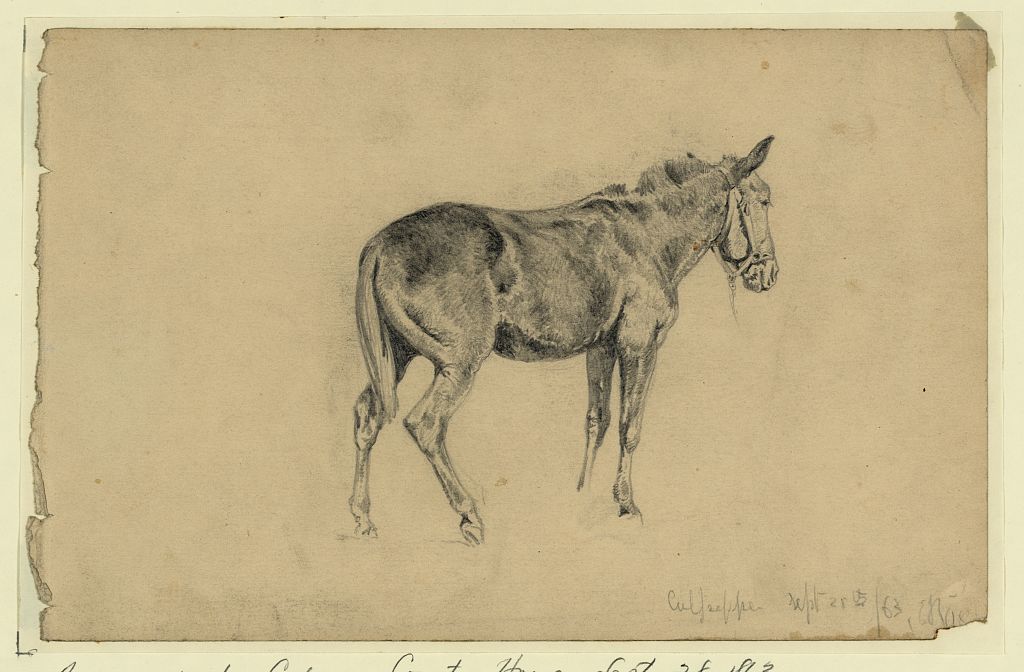
Sketches of Union Army Mules


"A Tough Customer. Army Mule," by Edwin Forbes. Rappahanock Station, Virginia, February 5, 1864.


"An Army Mule." Culpeper Courthouse, Virginia, September 28, 1863.


"The Meditative Mule." Culpeper Courthouse, Virginia, September 28, 1863.


"A Played-Out Mule in Hospital." Rappahannock Station, February 5, 1864.

Images courtesy of the Library of Congress.

Tuesday, August 25, 2015

The Mule Driver


"The Mule Driver," by Edwin Forbes, November 23, 1863 at Kelly's Ford, Virginia.

Image courtesy of the Library of Congress.

Monday, August 24, 2015

Edmund Ruffin's Losses


Few men wanted Southern secession, or did more to try to make it happen, than Virginian Edmund Ruffin. The long-haired old man's appearance at Harpers Ferry shortly after John Brown's raid and his reappearance at the abolitionist's hanging were not by coincidence. He wanted to witness history in the making. Later, he was at Fort Sumter's bombardment as well. Some claimed he pulled the lanyard to fire the first shot.

During the war, Ruffin lost one of his plantation homes to Yankee arsons and his slaves absconded. But if Edmund Ruffin knew anything (and he knew plenty) he knew loss. Two of his children had died as mere babies, his wife had died, and three grandchildren had died. Three of his adult daughters died, and one of his daughter-in-laws, who he considered a daughter, had died.

However, the death of Ruffin's second son, Julian, was especially hard on the old fire-eater. Julian was born in 1821 in Prince George County. As a young man he had helped his father establish the Southern Magazine and Monthly Review. Julian was obviously proud of his father's influence and contributions to Southern nationalism, for in 1861, Julian named a newborn son, after grandpa and his adventures; Edmund Sumter Ruffin.

Julian was a sergeant in Company B, 12th Battalion of Virginia Light Artillery when the end came. His service records indicate he enlisted  the unit in Petersburg on August 10, 1863 for the duration of the war. Apparently Julian had served in a different unit previously. Julian's service did not last for the duration of the war though. He was killed in the fighting at Drewry's Bluff on May 16, 1864. With a broken heart and seemingly in denial Edmund Ruffin penned in his diary on May 23: "My mind cannot take in the momentous fact, nor my perceptions approach to the measure of reality."

Ruffin could not take much more, and when Confederate defeat finally became a reality, he ended his ruined world by his own hand. On June 17, 1865, he took time to write in his diary: "I here declare my unmitigated hatred to Yankee rule-to all political, social & business connection with Yankees-& to the Yankee race. Would that I could impress these sentiments, in their full force, on every living southerner, & bequeath them to every one yet to be born! May such sentiments be held universally in the outraged & down-trodden South, though in silence & stillness, until the now far-distant day shall arrive for just retribution for Yankee usurpation, oppression, & atrocious outrages-& for deliverance & vengeance for the now ruined, subjugated, & enslaved Southern States!"

Using a stick to trigger his weapon, Ruffin's gun misfired on first attempt. He recapped the piece and was successful in his second try. The old hot-spur was buried on his former plantation, Marlborough, in Hanover County, suffering no more losses.

Image courtesy of the Library of Congress.

Saturday, August 22, 2015

Henry A. Wise's Loss


Wanting to learn more about Virginia's enigmatic politician, Henry A. Wise, I recently completed reading Craig M. Simpson's 1985 book, A Good Southerner: The Life of Henry A. Wise of Virginia. I enjoyed the book and found Wise to be as an intriguing personality as I imagined.

You might remember that Wise was governor of the Old Dominion when John Brown struck at Harpers Ferry in 1859. The book's chapter on Wise and Brown was quite fascinating. Although Wise certainly was at odds with Brown's ideals of racial egalitarianism, the governor had a healthy respect for Brown's courage and commitment to his cause. One might even say that Wise admired Brown.

Wise was succeeded as governor by John Letcher, but his political influence continued. He strongly encouraged the state's secession during its April 1861 convention. When war broke out, Wise, although in his mid-fifties, raised a combined infantry, artillery and cavalry unit appropriately named Wise's Legion. In the summer of 1861, Wise was made a brigadier general. At best, Wise had a checkered track record during the war. His touchiness and honor-bound nature caused him to clash any fellow officers who presented the slightest offense. An 1861 foray into Western Virginia and his inability to work with fellow former governor Gen. John Floyd serves a perfect example.

In early 1862, Wise was transferred to North Carolina. There, he immediately rubbed Gen. Benjamin Huger the wrong way. On February 8, in a fight at Roanoke Island while Wise was sick, his oldest son Obadiah Jennings Wise, a former editor of the Richmond Enquirer, was killed in the battle. Wise the younger was born in 1831, and like his father, held honor most high. Before the war Obadiah fought several duels, some of which came at the defense of his father and his political policies.

Obie, as he was sometimes known, was part of the Richmond Light Infantry Blues, a local militia unit that dated back to 1789. During the Civil War the Blues became Company A of the 46th Virginia Infantry. Apparently Obie was hit in the wrist of his sword-carrying arm while leading his company in the fight at Roanoke Island. Quickly bandaging the injury, he soon received a mortal wound.

Thus, Henry A. Wise not only suffered defeat in northeastern North Carolina, he lost what some considered his favorite son. Obie's body was recovered and when father saw son, Wise exclaimed, "Oh, my brave boy, you have died for me, you have died for me." Obie was buried in Hollywood Cemetery. Father joined son in Hollywood in 1876.

Image courtesy of the Library of Congress.

Friday, August 21, 2015

Wade Hampton's Loss


My continuing study of the Petersburg Campaign has brought a new admiration for the military skills of Wade Hampton. Whether displaying his daring in carrying out the Beefsteak Raid, or his tactical ability at Reams Station, Hampton's cavalry was a proven commodity for Robert E. Lee's Army of Northern Virginia.

Wade Hampton sacrificed more than just his enormous fortune for the Confederate cause; he lost a son. At the Battle of Hatcher's Run in February 1864, Lt. Preston Hampton was cut down in the fighting. It is difficult to imagine the pain Hampton must have felt in learning the sad news. In a kind attempt to sooth the mourning father, Gen. Lee wrote the cavalryman. Lee had intimately experienced a similar loss when his daughter Annie died in 1862 at age twenty-three. 

Lee wrote:
"My dear General, I grieve with you at the loss of your gallant son. So young, so brave, so true. I know how much you must suffer. Yet, think of the great gain to him; how changed his condition, how bright his future. We must labor in the charge before us, but for him I trust is rest and peace for I believe our merciful God takes us when it is best for us to go. He is now safe from all harm and from all evil and nobly died in the defense of the rights of his country. May God support you under your great affliction and give you strength to bear the trials He may impose on you. Truly your friend, R.E. Lee"  

Image courtesy of the Library of Congress.     

Tuesday, August 18, 2015

Gen. Cullen Battle's Grave


Have you ever wondered where you will rest in peace? I know, that's a pretty morbid thought. But, I admit, I've wondered. Will it be in the area where I last reside? Or, will I find myself in a generations-old traditional family plot?

Similarly, I sometimes wonder why certain people end up in certain cemeteries. Today, I was over at Petersburg's Blandford Cemetery with a colleague doing some preliminary research on project. One of the graves we visited was that of Confederate General Cullen Andrews Battle. Doing some quick thinking of what I knew of Battle, I found myself at a loss as to why he was buried in Petersburg.

Cullen Battle was born in Hancock County, Georgia, in 1829, but moved with his family to Eufala, Alabama as a boy. After studying at the University of Alabama, Battle read law and was admitted to the bar in 1852. A tried and true secessionist, Battle was close friends with Alabama's leading fire-eater, William Lowndes Yancey. After John Brown's raid, Battle raised a local militia unit and offered its services to Virginia. However, Virginia Governor Henry A. Wise already had enough in-state militia. Battle's unit continued to drill though and maintained a readiness as sectional tensions increased.

When war finally came in 1861, Battle was made major of the 3rd Alabama Infantry. The 3rd eventually made their way to Virginia and fought during the Peninsula Campaign, at South Mountain, and Antietam. For competent service, Battle was promoted to colonel of the 3rd at the end of 1862.

Battle received promotion to brigadier general in February 1864, taking command of Gen. Robert E. Rodes's former brigade. Battle missed a good deal of service due to injuries and illness. After missing time in the summer of 1864 for dysentery, he returned but was wounded at the Battle of Cedar Creek that fall. That wound kept the general out of commission for the remainder of the war. Although major general is listed on his headstone, it appears that promotion was never made official.

In 1880, Battle resettled in New Bern, North Carolina, and edited a newspaper. Later, he resided in Greensboro, North Carolina, where he died at age 75 in 1905 .

So, why wasn't Battle buried in Greensboro, New Bern, or even back in Alabama? The answer it seems was just a wish. Apparently, Battle's son, Henry, a Petersburg minister, desired to have his father's body be brought to and buried in the Cockade City. Sometimes it is as simple as that.  

Thursday, August 13, 2015

A Sample of Warrenton's Town Slave Quarters


My visit to Warrenton had me seeking out evidence of the town's antebellum slave life. I was a little surprised it was actually not too difficult to find. While I only took a hand full of shots of what appeared to be surviving slave quarters, there were a number more dotting the town's landscape, often behind beautiful historic homes. 

Parking at the town's visitor center put us adjacent to what is known as the Mosby House. And behind the Mosby House was the two story building pictured above. Although I did not go in the building, if I had to guess, I would wager that the right side door of the building entered into what served as the home's kitchen and the left door probably when up stairs to an apartment room. While many slave quarters that I have encountered in Virginia are two story structures, most are more horizontally oriented. I found it an extremely interesting design. 


A short walk across the yard was what probably served as a smokehouse. This square-shaped brick building with a pitched-point roof is common for Virginia smokehouses.


Although the home is called the Mosby House, it was actually built by Edward Spillman, a judge, in 1859. The famed Confederate guerrilla leader Col. John Singleton Mosby owned the home after the Civil War. Later, Confederate general Eppa Hunton owned the home. 


Walking down a side street I noticed the above brick building. It, too, was likely a kitchen and house slave/cook's quarters. It looks like it has been converted into a small home office or guest apartment.


The small frame building shown above fits the description of a town slave quarters. The structure has had a few alterations and additions to it but it was quite small as can be seen when comparing it to the car parked next to it.

Now I am curious to explore some other old Virginia towns to see if Warrenton's town slave quarters are just uncommonly common.

Monday, August 10, 2015

Fauquier County, Virginia Courthouse Then and Now


circa 1863

2015

This past weekend I was able to do a little bit of exploring in Warrenton, Virginia. This beautiful and friendly little town is located in Fauquier County, just west of Manassas, and north of Culpeper, Virginia. 

I had remembered seeing a Civil War-era photograph of the county courthouse on the Library of Congress website, so I thought I'd do "then and now" shot. It was not taken from quite the right angle and distance, but it will have to do.

The Fauquier County courthouse was originally constructed in 1790, but that building burned, as did buildings constructed in 1819 and 1854. Today's building was built in 1890 and was reconstructed on the foundation of the 1854 courthouse. During the Civil War, Warrenton experienced alternating bouts of occupation by both Union and Confederate troops. 


Just out of the courthouse picture above is the above monument to Col. John Singleton Mosby. Known as the "Gray Ghost" during the Civil War, Mosby made Warrenton part of his focus during the war and his home after the conflict. His switch to the Republican Party and candid comments in his memoirs on the Confederate cause made him unpopular with some of his fellow Virginians, but others cherished the memory of the Gray Ghost and his amazing lightning-quick strikes against the Union army. Mosby died in 1916 and was buried in the Warrenton Cemetery. 

If you get the opportunity, take a trip Warrenton. So much history abounds there waiting to be seen and learned. I don't think you will be disappointed.

Historic photograph courtesy of the Library of Congress.

Friday, August 7, 2015

Petersburg's Bollingbrook Street - Then and Now


1865


2015

Last Saturday I was fortunate enough to take in a walking tour given by Petersburg National Battlefield ranger and curator Emmanuel Dabney. The subject of the tour was Petersburg's enslaved and free black communities before and during the Civil War. Emmanuel has researched extensively in primary sources and has developed a fascinating tour.

Our last stop was on Bollingbrook Street to discuss several commercial businesses and individual homes and their ties to slavery. One surviving home, the Nathaniel Friend house, stands at the corner of Bollingbrook and Cockade Alley. Behind the home and along the cobblestoned Cockade Alley are what used to be the Friend House's kitchen, slave quarters, and smoke house, all connected. The slave quarters part of the contiguous structure is now the popular restaurant, Brickhouse Run.

Across Cockade Alley is what used to be Farmer's Bank. Behind the bank building, and built on the original foundation, is a structure that was reconstructed where an urban slave quarters stood. Wrapped around it and a recreated smoke house is a high brick wall, a common site in Southern urban slave settings.

Just a few steps west down Bollingbrook and on the south side of the street was the slave jail of Henry Davis. The building, although altered somewhat over the years, still stands. Back on the north side of Bollingbrook is a small grassy vacant lot where William Tench's auction house once stood. Owners could have Tench sell their surplus slaves here, or those needing additional laborers could find them here.

Although I had walked these streets numerous times, almost all of the information was new to me. It is difficult to understand the deep impact slavery had on the economy, society, and culture in Southern cities like Petersburg until one takes the time to hear and learn thes storied behind these places.

Sunday, August 2, 2015

Memorializing USCT Valor at Petersburg National Battlefield


There is not an overabundance of memorials at Petersburg National Battlefield. Unlike at Gettysburg, Antietam, Chickamauga, or Vicksburg, where monuments almost overawe visitors, at Petersburg they merely dot the landscape. One that is quite inconspicuous honors the United States Colored Troops from the XVIII Corps (Army of the James), who fought bravely and with marked success.

While the USCT fighting at the Battle of the Crater is probably better remembered in history, they fought with much more success in the initial fighting of the Petersburg Campaign on July 15, 1864. In this engagement USCTs under the ultimate command of William F. "Baldy" Smith charged and captured a significant part of the eastern section of the Confederate Dimmock Line, including Batteries Six, Seven, Eight, Nine, Ten, and Eleven. A sergeant-major in the 1st USCI recalled the action at Battery Seven: "The boys made a bold charge although they were exposed to cross-fire of three forts, and were harassed by infantry and cavalry. They scaled the fort, and the enemy, becoming panic-stricken, ran like deer, leaving three pieces of cannon."

Following the earthworks that connected the various battery posts the black soldiers made their way south down the line. Making another charge, Colonel Joseph Kiddoo of the 22nd USCI wrote that "My men wavered at first under the hot fire of the enemy but soon, on seeing their colors on the opposite side of the ravine, pushed rapidly up and passed the rifle-pits and fort." Thus Battery Eight was bagged.

Battery Nine was apparently given up as a lost cause by the Confederates and the USCTs concentrated on Battery Ten. The 4th USCI charged it and fairly won an artillery piece, caissons, and horses. Battery Eleven, too, was given up by the Confederates when it previously support battery fell.

Unfortunately for the Union cause, the ground gained on June 15, was to be a hollow victory. Smith, worried about his unmitigated success, and thus fearing a Confederate counterattack called off the press. The black soldiers though had won some hard earned respect from their fellow white soldiers. One officer of the 6th USCI stated "It was rather interesting to see the old veterans of the Army of the Potomac stare when they saw the works we had captured. The old soldiers would hardly believe that colored troops had done it, but had to do so." Another officer estimated that the USCTs had lost between 160 and 200 killed or wounded in the day's fighting.

Sunday, July 26, 2015

Just Finished Reading - Shifting Grounds

Significant scholarly works have been written on the diversity of political thought in the white antebellum and Civil War South. William Freehling's The South vs The South quickly comes to mind, but fewer books have attempted to examine the transitions that were necessary to spark a nation-making attempt that eventually consisted of eleven states called the Confederate States of America.

That gigantic hole is now largely filled with Paul Quigley's Shifting Grounds: Nationalism and the American South, 1848-1865 (Oxford University Press, 2012). This eye-opening look at the South's evolution, from a strong United States nationalist position to that of a separate entity, and then with defeat, a non-nation of commemoration, should find an eager audience.

Although national events such as the Missouri Compromise (1820) and the Nullification Crisis (1832-33) predate Quigley's time frame, the Mexican-American War and the lands acquired from that conflict sped up sectional division. New territory meant new states, which meant making difficult decisions and taking strong actions on which newly formed states would be slave and which would be free. So, what was to be gained or lost? To the South what to be lost was a balance of power in Congress. With a loss of balance of power, presidential elections, and Supreme Court appointments was potentially the loss of their economic, social, and cultural way of life; i.e. slavery. The Compromise of 1850 brought about the first true Southern considerations about secession and serious thoughts of creating their own nation; one that was designed to protect slavery and guarantee its ability to expand as new land was added.

The nineteenth century was an era of nation making. European efforts in places like Italy, Hungary, and Ireland brought about a certain romantic idealism which often overlooked the difficulties encountered along the way. Southerners' questions abounded though: "What made a nation? Could an individual or a group change nationality at will? How should one balance different layers of identity and loyalty when they came into conflict? How did nation-states secure and maintain legitimacy at home and abroad? What were the rights and responsibilities of citizenship?"

To help illustrate some of his points, Quigley looks at traditional forms of American nationalism and how the South adapted them for their own purposes. Events such as Fourth of July celebrations and the legacy of the Revolutionary War, symbols such as the American flag, and heroes like George Washington were all incorporated in different ways in the new Confederacy's claims for nationhood.

Of course, the Civil War brought challenges to what white Confederates had hoped would be a more free nation than that experienced in the old United States. However, conscription (just a year into their national experience), slave impressment, crop confiscation, and geographical pockets of strident Unionism that had be controlled, all made nation building a more difficult experiment than originally expected.

The Confederate nation ended with its army's defeats on the battlefields, but although no longer in existence, the suffering and sacrifices experienced by the soldiers and their families created a culture of commemoration and pride in heritage that continues to this day. Without understanding how the Confederate nation came into being, one cannot truly understand or appreciate the cultural divide that has existed since 1865.

I highly recommend this excellently written and researched book. It was truly one of those rare books that I found difficult to close and eager to reopen. On a scale of one to five, I give it a well deserved five.

Saturday, July 25, 2015

I Will Give $2 Reward


I have been on quite the reading tear; and will have some "Just Finished Reading" posts soon. But, in between books, I did some browsing through the Chronicling America newspaper database on the Library of Congress website. Of course, I got distracted by the notices and advertisements.

The latest book I am reading is a biography of Hinton Rowan Helper, the North Carolinian who wrote The Impending Crisis of the South in 1857. I was searching through the database to see if any reactions to the book were made in Virginia's newspapers. Not finding much, I paged through the August 1, 1860 edition of the Richmond Daily Dispatch when the ad pictured above particularly caught my eye.

In it Mary Brown, "A free woman of color" offered a $2.00 reward to anyone who happened to find her "FREE PAPERS," which she lost on Saturday, July 28 "near the Old Market." The importance of the papers are indicated in the considerable reward and in the fact that Ms. Brown mentioned that "They were in a tin box," presumably for safekeeping.

As one might image free papers were invaluable for free people of color in the slave states. Without their papers free people had to rely on a white patron who could vouch for their free status. Those without a white patron, they could be subject to be imprisoned and advertised as a runaway and then sold when not claimed.

Having such as common name, an attempt to find out more about Mary Brown by searching in the 1860 census turned up too many black and mulatto free Mary Brown's in Richmond to pinpoint the one in the advertisement. Some of the Mary Browns had occupations listed. Among them were: "washer," "nurse," "wash woman," and "servant." Of course it is pure speculation, but I could image the Mary Brown in the advertisement was likely employed in a similar type position and was probably doing her market shopping when perhaps she was distracted by something and sat her tin box containing her spending money and free papers down and moved on forgetting to retrieve the box.

Did Ms. Brown have the tin box returned? If so, who found it? Was it found by another free person of color or a white shopper at the Old Market? If they were not found, was she able to petition for a new set of free papers? How long did it take to get a new set of free papers? Did she have to pay a fee to get a new set of free papers? Did she experience much trouble over not having her free papers? Always . . . the questions!

Wednesday, July 22, 2015

Help Save Almost 300 Acres at Shiloh


Save 295 acres at Shiloh!
The morning of April 6, 1862 was one of shock and alarm as the men of General Ulysses S. Grant’s Union army found their camp at Pittsburg Landing being attacked by Confederates under General Albert Sidney Johnston. Colonel John McDowell, whose brigade occupied the extreme right flank of Grant’s army, rushed his troops forward to meet the threat. Colonel Preston Pond, Jr.’s Louisiana brigade greeted them with fierce volleys and eventually overwhelmed the Yankees. With the Union right flank collapsing, the Confederates swept the field.
Today, the Civil War Trust is pleased to announce our immediate effort to save the exact site of McDowell’s stand against Pond’s Confederates. This 295-acre area of land is the most signi ficant unprotected land on the western edge of Shiloh National Military Park. With your help in saving this land we are not only adding to the protected acreage at Shiloh, but also providing an important buffer between the battlefield and likely development on the park’s western border.

Sunday, July 19, 2015

Sacrificing for the Cause - John C.C. Sanders


One of the exciting things about learning new historical information is being introduced to the personalities one encounters along the way. I had certainly heard of General John C.C. Sanders, but knew few details of the man's pre-war or wartime experiences. Doing just a little research produced some remarkable findings which show his commitment to the cause for which he was fighting.


John Caldwell Calhoun Sanders was born on April 4, 1840, in Tuscaloosa, Alabama. He was named for the great states' rights and proslavery South Carolina politician (above). This is not all that surprising as thousands of sons during this time period were named for famous military and political personalities. In addition, Sanders' father, Charles P. Sanders, was a native South Carolinian, who likely held Calhoun in veneration.

The 1850 census give a little more detail into the Sanders family. At that time they lived in the Eutaw District of Greene County, Alabama. John's father, Charles, is listed as a thirty-seven year old physician, who owned $1000 in real estate. John's mother, Elizabeth Ann is listed as thirty-one and also a South Carolina native. The family must have moved to Alabama just a few years before John was born as older brother Matthew L., who was listed as 14 years old, had been born in their home state, while another older brother, William H (12) and John (10) were both born in Alabama. Also included in the family were younger sisters, Arabella F. (7), and Martha L. (5). All of the Sanders children were shown as attending school. I was unable to find Charles P. Sanders in the 1850 slave schedules.

The Sanders family prospered the the following decade. In 1860, Charles was listed as "Doctor & Planter." He had increased his wealth in real estate to $15,300 and personal property to $30,000, of which included 25 slaves. The slaves consisted of eleven males ranging in age from sixty to one year old, and fourteen females that were from fifty-five to one year old. All of the slaves are listed as black, except for a one year old female that was described as mulatto. The Sanders' family workforce lived in six slave houses.

By 1860, apparently son Matthew no longer lived in the household, and William, now twenty-one was listed as a doctor, like his father. John is listed as nineteen and as a "Col.[lege] Student." Arabella was now sixteen. Perhaps Martha did not live, as the only other children are listed as initals and hers does not fit. The other children were: H.A. Sanders, a fourteen year old girl; E.A. Sanders, a seven year old girl, and C.P. Sanders, a two year old girl.

John must have been a promising student as he was attending the University of Alabama when the war started. Although his parents objected to his decision to withdraw from school and join up, John would not miss the chance to serve his new nation and headed back to Greene County, where he helped raise Company C of the 11th Alabama Infantry. His experience as a University of Alabama cadet and winning personality helped him gain the captaincy of the company. He was only 21 years old.

The 11th was quickly forwarded to the seat of war in Virginia and barely missed participating in the Battle of First Manassas. The regiment was included in the brigade of Cadmus M. Wilcox and fought some difficult battles in the Peninsula Campaign. John was grievously wounded in the leg during the Battle of Glendale (Frayser's Farm). A fast recovery brought John back in time to fight more, and as the brigade's senior captain, he led the 11th in battle at Second Manassas and Antietam, where he was wounded in the face.

John was soon made colonel of the 11th; at only twenty-two years old. The 11th fought at Salem Church during the Chancellorsville Campaign, and at Gettysburg. On July 2, 1863, Sanders was shot in the knee.


When Wilcox was promoted to division command, the brigade was placed under Sanders's command for a time. But then when General Abner Perrin took command of the brigade, Sanders was back in charge of the 11th. After a particularly difficult fight at the Wilderness, however, Perrin was killed at Spotsylvania on May 12, 1864. Sanders once again assumed command of the brigade. He officially was promoted on June 7 to brigadier general. Sanders was only twenty-four years old. As fighting devolved to Petersburg, Sanders's brigade fought in several battles south of the important rail junction city. On July 30, Sanders's brigade was one of the principal units that successfully counterattacked against the Union forces at the Battle of the Crater.

Sanders's brigade was moved north of the James River to fight at Second Deep Bottom in mid-August. The mobile brigade was quickly moved back south of Petersburg where it fought at the Battle of Globe Tavern (above photograph), also known as Weldon Railroad, on August 21. During the Confederate attempt to regain its lost ground Sanders's brigade, now fighting with Mahone's division, attacked. In the fight John Caldwell Calhoun Sanders was shot through both thighs. The wound severed his femoral arteries and he quickly bled to death. He was only twenty-four. Sanders was laid to rest in Hollywood Cemetery in Richmond.


Today, the quiet fields around where Globe Tavern once stood and a fierce battle once raged only grow crops or sit empty. Fortunately, no longer do muskets crack and artillery boom. Only the sounds of an occasional passing car, cranky crows, and sometimes, rumbling railroad freight cars disturb the peace. It is here though that we should remember those who lost their lives, both Union and Confederate. After all they were all Americans.