Thursday, April 9, 2015

Richmond's Free Black Barbers Assisted the Confederacy, and Why it Made Sense


I had been wondering if black barbers advertised in newspapers in other upper-South states like Virginia and Maryland like they did in Kentucky, so I did a little keyword searching in the Chronicling America feature on the Library of Congress website. And while I did not find many ads, I did come across the above short article, which I found intriguing.  

It was printed in the July 16, 1861, edition of the Richmond Daily Dispatch. With the Civil War just started and Virginia seceding only three months before, constructing fortifications around Richmond--now the Confederate capital--were important for the city's defense. In addition, only days after this article ran, the first large engagement of the war occurred at Manassas, Virginia.

The article claimed that "several hundred" free blacks were "listed" at the City Hall for this work. Whether listed meant enlisted, or merely a census was being taken for potential work projects is not known. However, the author notes that he noticed many of the town's barber shops closed due to their operators being preoccupied with either the work or being counted.

Surprisingly, or on the other hand, perhaps not so surprisingly, the author claimed that free black barbers were "confessedly superior in intelligence, worth, and breeding to their [I assume he means non-barber free black] compatriots." The author, and certainly other whites, understood the service that these free men of color and talent provided to "the white male population unaccustomed to the having process, and who have been in the habit of availing themselves of the barbers' skill."

Although the barbers were willing to help in the Confederate cause, it appears that the town's whites would have preferred that these free men of color be exempted from working on the fortifications so that no inconvenience would come to their white patrons. Besides, the author argues that men who had experience in working with "nothing heavier than a razor will necessarily make an unproductive hand at rolling a wheel barrow or shoveling dirt." Obviously this is a fallacious argument, but not a shocking one from someone who saw free men of color with a prejudiced eye. 

So, why would free black barbers offer to help the Confederacy? It would be unwise to claim that they all had the same motives. Some may have indeed felt an obligation to help their new nation. I suspect, however, that most of them fully understood the potential economic repercussions if they did not show support. If the black barber ads tell us anything it is that these men flattered their patrons and relied on them coming into their shops in order to keep their businesses open, food on their families tables, and clothes on their backs. If a free black barber evidenced anything other than unwavering patriotic duty to the Confederacy, they would likely suffer being blackballed, certainly lose clients, and potentially be put out of business.    

Wednesday, April 8, 2015

Just Finished Reading - The Confederate Heartland

Let's face it, when it comes to Civil War studies, especially those of the Confederate variety, the Eastern Theater gets most of the love. There have been various arguments put forth on why this is so, but regardless, it remains mostly true. Being from Tennessee, however, I started my Civil War interest by appreciating the Western Theater, and if I'm being honest, I probably still lean toward that region in my reading choice.

So, when I finally came across The Confederate Heartland: Military and Civilian Morale in the Western Confederacy (LSU Press, 2011), by Bradley R. Clampitt, it quickly made by reading wish list.

The Confederate Heartland examines how morale among the Western Theater's soldiers and citizens ebbed and flowed in the last sixteen months of the war. Clampitt divides his chapters into two month segments, starting in January and February 1864, with Joseph E. Johnston's assumption of command of the Army of Tennessee after the disasters of November at the battles around Chattanooga. It ends in March and April 1865, with that army's surrender in North Carolina.

Clampitt argues that Johnston quickly turned around the confidence level in the Army of Tennessee when he took command and that the change in leadership also positively impacted civilian morale. That upswing in morale continued with the resumption of combat in the spring of 1864. And although Union Gen. William T. Sherman captured a significant amount of territory during the ensuing campaign, Johnston's tactics sought to maintain the health of his army, which was greatly appreciated by both the soldiers fighting and the civilians at home.

Clampitt focuses his research on sources largely from the states of Tennessee, Mississippi, and Alabama. That is what he defines as "Confederate Heartland." One might argue that Georgia could be included, too. A number of the sources Clampitt uses are those probably familiar to many Civil War students. Diaries of civilians Ellen Renshaw House, Myra Inman, and Eliza Fain, among others, and soldiers' journals by William Berryhill and Samuel T. Foster help convey the emotions of the people of the "Heartland." However, the strength of these sources is that for the most part they are war time accounts rather than post- war reminiscences.

Even with the Army of Tennessee's change of command in July 1864 to Gen. John Bell Hood, Confederate Heartland morale remained fairly good. It naturally dipped with the loss of Atlanta in early September, but again began to improve with Hood's movement into Middle Tennessee in November. To those of the Heartland, forward movement was good. It was there, though, that things dissolved. With Hood's tragic decisions to smash his army at Franklin, and then become the attacked in December around Nashville, confidence in ultimate Confederate victory withered. The evidence seems to strongly confirm that morale rested largely on the peoples' confidence in their army commanders, and ultimately, their army's success on the region's battlefields.

I enjoyed reading The Confederate Heartland. It provided a much needed look into how the people of the Western Theater perceived their new nation and how their thoughts rode the waves during the last months of their efforts to win their independence. I would highly recommend it to those, who like me, enjoy studies focused on the red-headed step child of Civil War studies. On a scale of one to five, I give The Confederate Heartland a solid 4.5.  

Tuesday, April 7, 2015

Washington Spradling's Kerfuffle


Yesterday I posted some information about antebellum Louisville black barber Washington Spradling. Being quite curious to find where he might show up in the era's newspaper records, I decided to do some searching.

Using the Kentucky Digital Library, I found the above short article in the September 22, 1858, issue of the Louisville Daily Courier. It would be pure speculation on my part, but I might suggest that Spradling's wealth as a free man of color in a slave state likely brought some resentment on the part of whites, and surely brought other episodes of trouble like this one.  

It is difficult for me to determine from this short article if Spradling had loaned Norwood money or the reverse. With Spadling's wealth, it would seem the former would be most probable. Perhaps Spradling tired of not receiving his loaned money back and resorted to a physical or verbal threat to Norwood. In most instances a Southerners' sense of honor would not allow such action from a black man; free or not.

Regardless of the true origins of the conflict, it appears that Norwood and his friends went to Spradling's shop "to play hickory-loo" on the black barber. In other words, they planned to beat Spradling with clubs or canes. The other phrase the author used for the intended violent action was that the white men went in "with the intention of dusting Wash's jacket."

Fortunately, a police officer intervened and arrested the three white men and set their bail at $200 each. They were apparently released with a probationary warning of six months.

A few paragraphs below this short notice ran another one explaining that in order to keep all parties involved equally responsible, Spradling, too, had been arrested. It reads: "HELD TO BAIL.-  The Court ordered the appearance of Wash. Spradling, in connection with the above case, who was brought in, and a bail of $200 was required of him to keep the peace six months, thus making all parties amenable to the law."

I found that Spradling appeared in a few other places in the newspaper record; mainly in listings of legal suits and property transactions. It would certainly be interesting to learn more about his legal actions. Was he suing or being sued? Was he attempting to collect money as appears to be the case above, or was he delinquent on payments? Finding out would certainly shed significantly more light onto this intriguing personality.

Monday, April 6, 2015

Washington Spradling's Grave


Yesterday I drove up to southern Indiana to spend Easter with my family. On the drive back to Frankfort I decided to take an slightly alternate route and try to locate the grave of Washington Spradling, a wealthy antebellum Louisville black barber. 

I knew his grave was somewhere in Eastern Cemetery, which is located next to better known Cave Hill Cemetery, but was not sure exactly where. After only a couple of wrong turns, I finally finally found both cemeteries. What caught my immediate attention was the drastic difference in how these two historic graveyards are maintained. 

Cave Hill is a huge cemetery, and it is immaculate. It features a lovely landscaped park-like atmosphere and contains the remains of numerous famous Kentuckians. Neighboring Eastern Cemetery on the other hand has many vandalized and tilting stones, tree limbs scattered here and there, and grass sprouting up in clumps instead of being finely manicured like Cave Hill. The main difference between the two is money; while Eastern is merely maintained by volunteers, Cave Hill is funded by a foundation. 


It didn't take too much looking around to locate Spradling's grave. I had looked it up on "Find a Grave" so I had an idea of what it looked like. However, Eastern Cemetery was quite a bit larger than I was expecting, and was filled with obelisk-like grave markers. Finally I found it and wandered over to take a closer look and get some photographs.

Washington Spradling was born in 1802 to a slave mother, Maria Dennis, and white overseer father, William Spradling. Washington's freedom was purchased by his father in 1825, and he soon had set up a barber shop in Louisville. As an aggressive entrepreneur, Washington developed close relationships with his white influential clientele and began using his barbering profits to purchase, sell, and lease real estate. By the 1860s Spradling had acquired quite a fortune for any man, white or black. Spadling's wealth comes through in the elaborate nature of his monument.


Spradling's stone contains the names of his wife Lucy Ann, and daughters, Martha and Julia, on one side, and his two sons, Washington, Jr. and William, both of which were also Louisville barbers and business men, on the other. I am not sure if Spradling's family members are buried in the plot around the stone with him or if just had their names included on his marker.


Washington Spradling surely understood the financial benefits that barbering had brought to his family and sought to have his sons follow in his footsteps to ensure their ability to support their own families. Spradling's son, William, ran the above advertisement in Louisville newspapers in the mid-1850s seeking patrons, and Washington Jr. founded the "Smoketown" neighborhood in southeast Louisville after the Civil War on land inherited from his father.

In business, for the Spradlings, it was like father, like sons.

Sunday, April 5, 2015

Kentucky Filibusterers


The 1850s are such a fascinating time in American history. The decade was filled with so much conflict and change. On the one hand it only seems natural that this ten year span, sandwiched between the previousl decade, which brought the Mexican War and the following decade, which brought the Civil War, would be chocked full of controversy and contingency. Of the 1850s' many events, filibustering adventures made for some of the most intriguing of that decade.

I found the above article in the May 28, 1856, issue of the Lebanon, Kentucky, Post, a Democratic Party newspaper, while searching for news on how the beating of Charles Sumner by Preston Brooks in the U.S. Senate was received by Kentuckians. The article obviously originated with the Louisville Times, another Democratic Party sheet, but the wording in the last paragraph makes it clear that these papers fully endorsed these largely privately funded, led, and overwhelmingly unsuccessful ventures in empire building. The fact that the papers supported these efforts is made clear by the closing sentence: "May they safely reach their destination, and win the glory and renown which their daring and enterprise so rich entitles them to."

The Walker the article mentions is William Walker (pictured below), a Tennessean, who got fully caught up in the idea of Manifest Destiny and led several missions to stake out an empire for himself. In 1853, he made an ill-fated invasion of Mexico, which of course had been defeated by the United States only five short years before. Walker must have ignored the fact that the United States used a significant military force to win its conflict.


Two years later Walker invaded Nicaragua. Initially successful, he set up a government, made English the formal language there and reinstated the institution of slavery. However, Walker eventually surrendered himself to the U.S. Navy in the spring of 1857. Walker was not convicted for his efforts and was hailed by many like-minded Manifest Destiny mania-driven Americans intent of seeing America spread her rule and example to others whether it was wanted or not. Walker tried another invasion in the fall of 1857, but was forced to surrender to U.S. forces. He tried yet again in 1860. This would be Walker's final campaign as he was captured by the Royal Navy and was handed over to Honduran authorities who executed him by firing squad.

The article also mentions the Kentucky contingent being led by Colonel John Allen of Shelby County. Doing a little research in the book Manifest Destiny's Underworld: Filibustering in Antebellum America, I found that Allen had a long history of mercenary missions. 

Col. "Jack" Allen had participated in the Texas Revolution, the failed 1850 invasion of Cuba, an 1851 invasion of Mexico and, of course, in Nicaragua under William Walker. It appears that Allen's filibustering career was ended in the summer of 1856, when he returned to Kentucky after contracting "tropical fever." Filibustering had a intriguing hold on a number of other notable Kentuckians, too, including Theodore O'Hara and William Crittenden, nephew of John J. Crittenden.

The potential prizes of glory and gain were seemingly too much for many 1850s men to ignore and enthralling enough for them to take numerous yet recognized risks. 

Image of Walker courtesy of the Library of Congress.

Saturday, April 4, 2015

A Kentuckian Provided the Eulogy for a John Brown Raider


Reading the title of this post may surprise some of my longtime readers who know how vehemently Kentuckians opposed John Brown, and those of like mind, at the time of those momentous events. However, there were a handful of men and women from the Bluegrass State who either saw slavery as a great evil, viewed African Americans as equal or potentially equal, and sought different ways to end the institution. John G. Fee was one such Kentuckian that has received considerable attention in this forum. James Thome was another. Amazingly, they were both natives of Bracken County.  

Edwin Coppoc (pictured above), along with his older brother Barclay lived in Springdale, Iowa before joining John Brown's band of raiders in the late summer of 1859. Edwin was born in 1835, and raised as a Quaker in northern Ohio, where abolitionism was the rule rather than the exception. When Coppoc's father died, the boy went live with a nearby uncle who helped conduct slaves along the Underground Railroad. Thus, from a young age, Edwin came to have strong feelings against slavery.

At age 15, Edwin moved to Springdale, Iowa, where his mother had moved and remarried. While there Edwin and Barclay met John Brown, who passed through the town during his Kansas years on his way to Canada and the East seeking funds for his abolitionist force and mission.

During the action at Harper's Ferry, Edwin found himself in the fire engine house with John Brown and was captured on October 18 by Robert E. Lee's command of Marines. He was taken with the other captured raiders and Brown to nearby Charlestown for holding and trial. Edwin was convicted along with Brown and the others. Coppoc's sentence was death by hanging, to be completed on December 16, 1859. He would die that day with African Americans John Anthony Copeland, Sheilds Green, however, on segregated gallows. Also executed that day was John Cook, who had escaped Harpers Ferry, but was caught in Pennsylvania, several days later. Edwin's brother, Barclay, made a complete escape.   


After the hanging, Coppoc's body was placed in a wooden coffin and claimed by relatives who made their way back to northern Ohio, apparently by rail, as his funeral and burial in Winona was held two days after his execution. A couple of weeks later, on December 30, Coppoc was reinterred in Hope Cemetery in Salem, Ohio, near Cleveland. At the service on December 30, distinguished minister, James Thome (pictured above), a native of Bracken County, Kentucky, provided the eulogy.

Thome was born in Augusta, Kentucky, in 1813. His father had been a slaveholder, but as a young man studying at Lane Seminary in nearby Cincinnati, Ohio, Thome revolted with a group of other students over the issue of slavery and transferred to Oberlin College where he fully converted to the abolitionist camp. Although the difference in sentiment divided Thome from his family, he remained convinced that slavery was wrong and needed to end, the sooner the better. Thome went on to teach at Oberlin and then ministered at Congregational Church in Ohio City. Thome's father eventually manumitted his human property, largely due to his son's influence.

A handbill was circulated for Edwin Coppoc's funeral that read:
"The friends of Edwin Coppock and the great principles of freedom, for which HE sacrificed his life, and to advance which, he suffered martyrdom, being desirous of showing proper respect to his memory have obtained his remains from his relatives, and have made arrangements to inter the body in the Cemetery in SALEM, FRIDAY, DECEMBER 30, 1859.

To open the service a Rev. Burke led a prayer and then the attendees sang one of John Brown's favorite songs, "Blow Ye Trumpet, Blow." Then, Thome took center stage and used the biblical tale of the writing on the wall to explain that "like the message to Belshazzar was John Brown's to enthroned iniquity. . .Here is granduer; here is God's own work and grace, here where it is treason to proclaim God's truth; here in an age of sounding brass--are these great souls, like living organs though whose trumpet notes God has blown an anthem that shakes the land like an earthquake." An attendee explained that the sermon was especially eloquent and like one only hears once in a lifetime.

Barclay Coppoc went on to serve in the Union army and was killed when the train he was riding was derailed by Confederate sympathizers in Missouri in 1861.

Edwin Coppoc's original wooden coffin was kept after he was reinterred in a metallic casket for the Salem burial. The wooden relic was brought out of storage when Gen. Lee surrendered to Gen. Grant at Appomattox. It was paraded through Salem on the shoulders of its bearers while they sang "John Brown's Body."

Tuesday, March 31, 2015

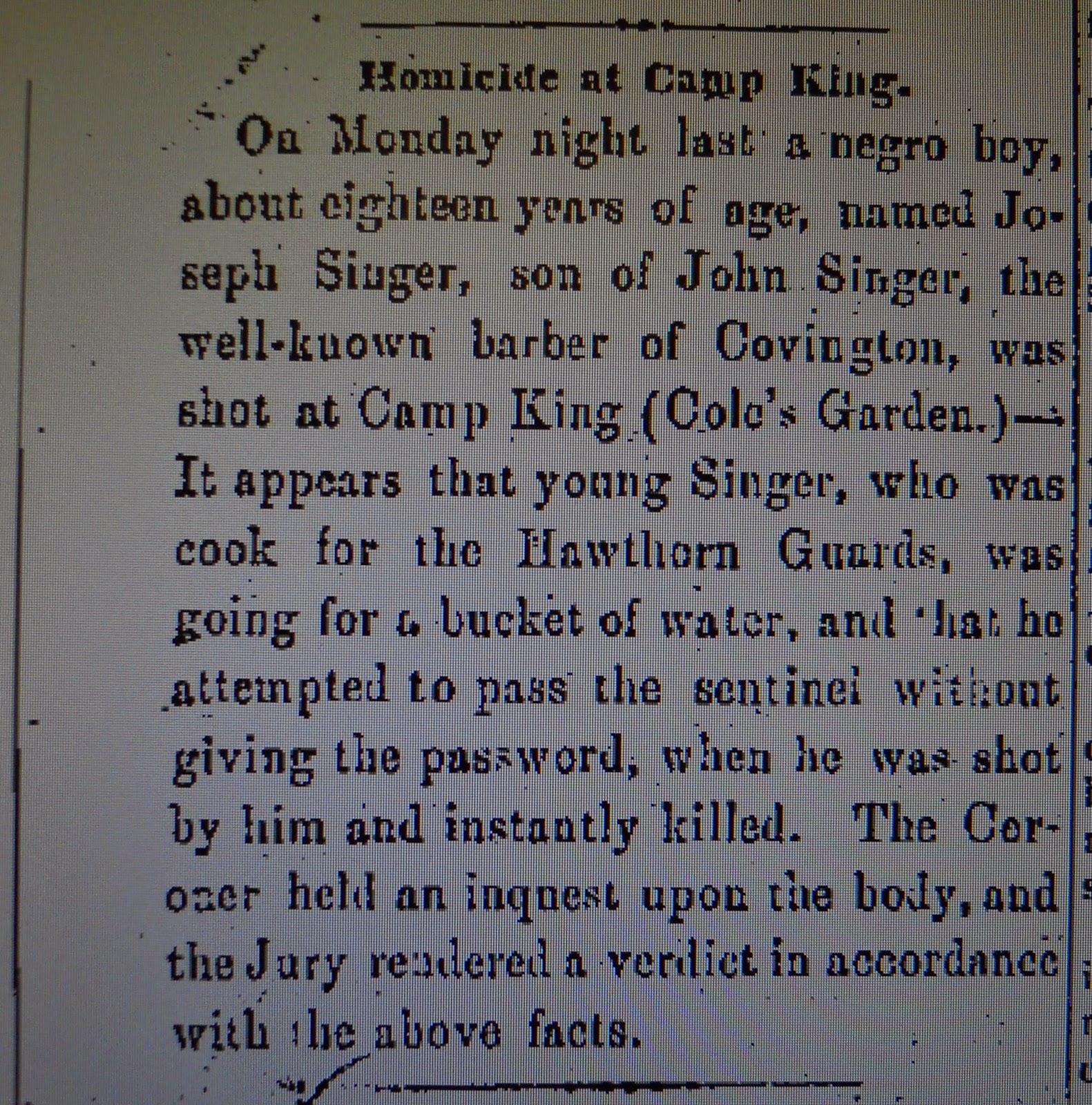
A Singer Family Tragedy


Yesterday I posted about Covington, Kentucky, African American barber John Singer. Singer utilized his skills as a barber to become an important part of his community although most free people of this era experienced racial prejudice at almost every turn. By entrepreneurship, thrift, and hard work Singer was able to provide well for his family. However, despite his many successes, Singer, like many other free blacks saw their fair share of tragedy, too.

I located this newspaper article in the September 28, 1861 edition of the Covington Journal, while searching for more information on John Singer for yesterday's post. This tragic incident occurred shorty after Kentucky declared their allegiance to the Union through their elected representatives in the state legislature.

Of course, at this time African Americans (whether slave or free) were unable to serve as soldiers in the Union army. Despite this fact, Kentucky blacks, again, both free and enslaved, served in forming Union units in various labor capacities. We do not know if  John Singer was proud of his son Joseph in helping the Union cause as a cook, or if John Singer would have preferred his son stay away from the soldiers' encampment to prevent potential harassment or worse. Regardless, one can only image the heartbreak the "well-known barber" felt when he learned of his son's death at such a young age while only attempting to help.

Monday, March 30, 2015

John Singer - Covington Black Barber


Last week I was happy to be contacted by a good friend and colleague who is currently working on the Kentucky Civil War Governors Papers project. While doing transcriptions he came across a document that he knew would intrigue me.

The letter was written to Gov. Beriah Magoffin, and although it was undated, it had to have been written between the governor's election in 1859 and resignation in 1862. The missive was written by Samuel H. Cambron, a Covington, Kentucky, attorney, and was likely a customer of the subject of the letter, one John Singer, free man of color and noted barber.

I had come across Singer's name some time back in my research through the 1850 and 1860 censuses. In addition, I also had located an advertisement (above) that he ran for a time in the mid-1840s in the Licking Valley Register. Other than one of Singer's sons, Charles, he was the only black barber in Covington listed in those censuses. However, he competed for business with several immigrant barbers, mainly German, but also Irish and Italian. Singer though must have built up quite a large clientele, as he is listed as owning $4000 in real estate in 1860.

Singer had moved to Covington from western Virginia in 1836. Although it is not certain, he may have come from another river town like Wheeling. In an article that ran in the Covington Daily Commonwealth in the 1870s, he explained that his settlement as a free black man in Covington was first met with resistance, but he soon gained acceptance through his pleasant disposition and quality work.

In fact, Singer became such as asset to the community that he garnered enough support to get a legislative act passed that allowed him to stay in the state (see below) being that he was a free black man.  


But back the the letter "To his Excellency" Governor Magoffin. In it the attorney Cambron explained that Singer and his wife Ann, and daughter, Rachel, and son, Charles, had been indicted for crossing the Ohio River, probably to Cincinnati, and then returning to Covington. Of course, the fear at this time in this activity would be that Singer might help runaways to freedom if allowed to do such. 

However, Cambron explained to the governor that "John Singer & his family have [been] in the community for a long series of years say since 1836, [and] supported a good character. [He is] Industrious honest prudent and Saving. [He] Has made some money by his business (Barber) and so far as I know without reproach or suspicion of any citizen." Quite the endorsement.

Cambron went on to explain that Singer had come to Covington from Virginia in 1836 and that the state legislature had made an act authorizing the barber to live in Kentucky as a free man of color, and also that Singer had been accustomed to traveling across the Ohio River regularly before a recent law was passed disallowing free blacks to do so. Cambron claimed that "the violations which have occurred were not the result of design but of Mistake as the Extent of the rights conferred by the act for his benefit referred to above." Cambron requested that if the governor found it within his ability he "should deem it proper to pardon him and his wife and two children," and that if done "would meet with the approval of most citizens of this city who know the facts and know Singer & his said family."

Singer continued to work as a barber and apparently a number of this other sons also entered the trade. Free man of color John Singer died on December 6, 1886, and was buried in Highland Cemetery. His wife Ann followed in him death in 1893.

Sunday, March 29, 2015

Just Finished Reading - Moonshiners and Prohibitionists

I apologize again for my delays in making posts. I was in St. Augustine, Florida, last week for the National Council on History Education conference where I presented a couple of sessions. And unfortunately, I came back home with spring allergy symptoms that have made me not feel up to posting until today. I realize that I many of my recent posts have been book reviews, but I have some interesting things in the works and will be getting them up soon.

A few weeks ago a friend loaned me the movie Lawless, which chronicles a moonshine war that occurred in Franklin County, Virginia, in the 1930s. I had seen the previews for the film when it originally came out, but hadn't taken the time or effort to see it at the theater, find it online, or rent it. I have to say though, I really enjoyed it. Watching it made me curious to learn more about the struggle in the southern Appalachian Mountains between the moral, political, and economic implications that came with illegal alcohol.

I located Moonshiners and Prohibitionists: The Battle over Alcohol in Southern Appalachia (University Press of Kentucky, 2011) at my local library. Its author, Bruce E. Stewart, is a history professor at Appalachian State University, but was not there when I received my education.

Stewart focuses his research on this topic specifically to western North Carolina, but his finding could likely be generalized to most of the southern Appalachian region. I appreciated that Stewart took a long approach to his research into moonshining in that he showed that the practice has roots that go back to the first white settlers into the area in the late-eighteenth century. Steward claims that early distillers were not viewed so much as criminals as much as they were seen as entrepreneurs by their fellow citizens.

However, as alcohol manufacture in the southern Appalachians progressed into the antebellum era, and with its rise in demand, and thus its production, the backlash of temperance movements also emerged. The demands for food during the Civil War also impacted impressions of moonshiners. Corn, a favored and necessary ingredient in whiskey production, grew scarce during the war years. Citizens came to see moonshiners as using the grain for gain rather than helping feed mountain residents, thus causing some resentment.

When federal taxation began to be more strictly enforced during the Reconstruction era, a significant amount of violence emerged among revenue agents and mountain distillers intent on evading the taxes. Examining this particular subject allowed Stewart the opportunity to delve into the "Creation of the Myth of Violent Appalachia and its Consequences, 1878-1890," in chapter six. Industrialization and social dislocation had more to do the violence that emerged in the southern mountains during this era, but many, even some of those who lived there, saw alcohol as main contributor to the violence and started making pushes for its prohibition.

By 1908, North Carolina approved a referendum outlawing the sale and manufacture of alcohol within the state. However, like in other parts of the Union, the demand for illegal alcohol remained, and thus the profitability obtained through it production continued it manufacture - even after prohibition ended. The western North Carolina mountains proved especially advantageous to concealing production and hiding the product's movement to markets.

While Stewart ends the Moonshiners and Prohibitionists story in the 1920s, I think it would have made for an interesting epilogue to show how moonshining and bootlegging influenced the sport of stock car racing in the mid-twentieth century.

I really enjoyed reading Mooshiners and Prohibitionists and learned a lot about the conflict between rural and urban mountain areas over distilling and temperance during this period. I high recommend it for those who are also curious about the subject. On a scale of one to five, I give the book a 4.75.

Tuesday, March 17, 2015

Park Day is Coming Soon - Help History, Help Out

DON’T TAKE HISTORY FOR GRANTED: JOIN CIVIL WAR TRUST FOR NATIONAL PARK DAY EVENT 

Now in its 19th year, Park Day is a hands-on preservation event to clean up and restore America’s hallowed Civil War and Revolutionary War sites. 

(Washington, D.C.) You can give back to your country, get out of the house, and honor your heritage all at once on by joining the Civil War Trust on Saturday, March 28, for Park Day 2015. Park Day is an annual hands-on preservation event to help maintain Civil War — and now Revolutionary War — battlefields and historic sites across the nation. 

For the 19th straight year, history buffs, community leaders, preservationists and other volunteers will fan out across 108 historic sites in 29 states for a spring cleanup at America’s battlefields and historic sites. Armed with trash bags, rakes, weed whackers and paint brushes, this corps of community-minded citizens can use your help in sprucing up these national treasures. 

This year, for the first time, the Trust adds Revolutionary War battlefields to Park Day as part of the Trust’s new “Campaign 1776” initiative to save the battlefields of the American Revolution and War of 1812. From Gettysburg to Guilford Court House, and Saratoga to Shiloh, Park Day participants will tackle maintenance tasks large and small.

“Park Day volunteers are critically important to historic sites that must balance basic maintenance needs with limited budgets and small staffs,” said Civil War Trust President James Lighthizer. “Neglect and deferred repairs can be as much a threat to historic sites as development. Visitors really do notice the difference after our legions of volunteers pitch in and clean up!” 

Since 1996, thousands of volunteers of all ages and abilities, including Boy Scouts, Rotarians, Lions Club members, church groups, ROTC units, youth groups and many others, have taken part in Park Day. 

Besides picking up trash, activities can include building trails, raking leaves, painting signs, putting up fences and other tasks. In addition to the satisfaction that volunteer work brings, participants receive official Park Day t-shirts and have an opportunity to hear local historians describe the significance of the participating site. 

In 2014, nearly 9,000 volunteers converged on 104 sites across the country, where they donated more than 35,000 service hours. With your help, we can do even more this year. Every trash bag that goes to the dump, every fence that is painted and every tree that is planted, leaves each site that much better prepared for the tourists who will visit this year to experience their heritage where it happened. 

Keeping America’s hallowed grounds pristine is a fitting tribute not only to those who served in the early conflicts of American history, but to all soldiers who serve and protect our country. These preserved historic sites are outdoor classrooms, teaching young and old alike about the sacrifices made to forge this nation. For a complete list of participating Park Day sites, visitwww.civilwar.org/parkday. 

The Civil War Trust is the largest and most effective nonprofit organization devoted to the preservation of America’s hallowed battlegrounds. Although primarily focused on the protection of Civil War battlefields, through its Campaign 1776 initiative, the Trust also seeks to save the battlefields connected to the Revolutionary War and War of 1812. To date, the Trust has preserved more than 40,800 acres of battlefield land in 20 states. Learn more atwww.civilwar.org. 

### 

(To learn more about the 108 participating Park Day sites, visit www.civilwar.org/parkday).

Monday, March 9, 2015

Just Finished Reading - War Upon the Land

As you can see I have been on quite the reading spree. I guess that is one positive from all the snow and cold weather. However, I will be happy to see all of this white stuff melt away.

My latest read was published a couple of years ago, and was another selection I had on my "Wish List." War Upon the Land: Military Strategy and the Transformation of Southern Landscapes during the American Civil War, by Lisa M. Brady (UGA Press, 2012) examines yet another fascinating aspect of the war (as an environmental study) that has not received much attention before it appeared, but is now producing more works.

To show how the Union army used and attempted to change nature and the southern environment, Brady focused on three campaigns: the Vicksburg campaign, Sherman's march through Georgia and the Carolinas, and the 1864 Shenandoah Valley campaign. By looking at these campaigns Brady shows how war was made, not only on the various Confederate forces that the Union army encountered, but also on the "agroecological" environments where these campaigns played out.

In the Vicksburg campaign Grant determined to "use every means to weaken the enemy, by destroying their means of subsistence, withdrawing their means of cultivating their fields, and in every other way possible." To do so the Union army embraced a mode of destroying crops and the ability to grown more crops, encouraged slaves to come into Union lines in order to have them supply additional labor and deprive that labor from the Confederates, which in turn undermined "the local residents' (and, by association, the Confederate government's) control over the natural environment." Grant even attempted an enormous canal project that tried to alter the landscape in order to help the Union army achieve victory. And although the canal project failed, a invaluable Union victory was realized at Vicksburg through Grant's method of warfare.

Similarly, and again with Grant's vision, first Gen. Hunter and then Gen. Sheridan reeked havoc in the Shenandoah Valley during the summer and fall of 1864. The Valley was a granary for the Confederacy, its wheat, oats, and other grains fed the soldiers, their animals, and those on the home front. The Union forces in the Valley did tremendous damage to its landscape. And although it was not literally turned into a desert and wasteland as many of the residents described it, its damage and loss proved costly economically, militarily, and politically. Nineteenth century Valley dwellers had worked hard (along with their slaves) to turn the region from an unmitigated "wilderness" into an agricultural paradise, but the Union army's burning and damaging ways reversed those efforts, for at least a time.

Finally, what is fact and what is fiction of Sherman's March to the Sea and beyond has been the subject of debate since those events happened, but it cannot be doubted that some the most significant damage of the war was taken out on Georgia and South Carolina in 1864 and 1865. Again, under the direction of Grant, Sherman carried out the work. Thousands and thousand of slaves, whose labor had brought wealth and prosperity to southern citizens, were liberated, which made recovering from Sherman's bummers a true task. In addition, Sherman's severing of his force from his lines of supply caused his men to live off the land, taking subsistence from those who had it and leaving them with little to nothing. Those in the way simply got washed over like a tsunami. Homes, towns, and crops were burned breaking the will of the people to oppose him and thus helped speed the end of the war.

While this mode of warfare proved successful, it obviously brought an enormous amount of physical and psychological damage to those who suffered through it. One of the things I appreciated about War Upon the Land, was Brady's inclusion of the accounts  of those not only doing the damage to the South's environment, but also those whose worlds were damaged. For many, perceived antebellum  order was turned to wartime chaos and confusion.

War Upon the Land is a significant addition to Civil War studies. And as mentioned, its groundbreaking look at the environmental aspect of the war is already producing more scholarship. Explaining the details of the various methods of warfare and its impact on the South's people and environment are valuable contributions to the field. On a scale of one to five, I give War Upon the Land a 4.5.  

Friday, March 6, 2015

Just Finished Reading - Milliken's Bend

All of the snow and cold weather we have been experiencing here in Kentucky has really cut down on my walking regimen, but conversely it has increased my reading time.

In an attempt to knock out some of my own books on my "to be read shelf" I had not been to my local public library in quite a while. A couple of weeks ago I decided to take a few minutes to browse through their online catalog and I saw a couple of selections that they had recently added that piqued my interest.

One of those books was Milliken's Bend: A Civil War Battle in History and Memory, by Linda Barnickel (LSU Press, 2012). I had had this book on my Amazon.com "wish list" since it came out, so I was happy to get to check it out for free.

Barnickel provides a full treatment on this Louisiana battle which was part of the Vicksburg Campaign. In the engagement a recently recruited Union force made up primarily of former slaves was attacked by Texas Confederates under the command of Gen. Henry McCulloch on June 7, 1863.

This was one of the first battles in which black troops engaged in combat. Milliken's Bend along with the previously fought Port Hudson, also in Louisiana, and Battery Wagner in South Carolina, were used by the northern press to help convince those that were skeptical that former slaves would indeed prove effective in combat.

After the black troops had participated in a brief reconnaissance toward Richmond, Louisiana, on June 6, they returned to their Milliken's Bend camp. In the battle the Texans surprised the black troops by attacking and drove them back to the edge of the Mississippi River. The fighting turned desperate and resulted in terrific losses for the black troops who had just joined the Union army only a few weeks before. The African Americans and part of the white 23rd Iowa finally held with the help of levee defenses constructed partly of cotton bales,and the aid of Union gunboats on the river. The battle featured deadly hand-to-hand combat where muskets battered skulls and bayonets were wielded freely on both sides.

Due largely to the Union gunboats' assistance, the southerners retreated, taking a number of captured black troops and their white officers. Rumors of the murder of black troops and some of the white officers made headlines in the press. Although it is difficult to determine the veracity of these reports it does appear that some the African American solders were executed after surrender (as happened in several other engagements in the war) and that at least two of the white officers were later killed for leading the black troops at Milliken's Bend.

Barnickel shows the importance of reconsidering this largely forgotten battle and how it influenced northern opinion on the use of former slaves as soldiers. In the battle's aftermath, the rumors of mistreatment of the black soldiers helped lead to a breakdown in prisoner exchanges, and the example of the Milliken's Bend soldiers steeled other black recruits and units to join in and continue their fight for freedom.

Of particular interest to me was book's first chapter "The Dark Pall of Barbarism: Emancipation as a War Crime." This chapter examined the prewar perceptions of slaves by whites in the northern Louisiana, eastern Texas region. It really fit in well with much of what Woodward had explained in my previous read, Marching Masters. The Texans especially saw blacks as somewhat similar to the Native Americans they had to contend with on what was still then the frontier border. Slaves were viewed as merely tempered savages that had been tamed under by the influence of the institution and the guidance of their owners. The Texans and Louisianans, like most other southerner, believed that if their slaves were emancipated ruin would come to the white agricultural world, their way of life would be gone forever, and eventually they would be forced to relocated or exterminate the blacks as they had the Indians.

On a scale of one to five, I give Milliken's Bend a 4.75. It is a well researched and written work that helps shed new light on a largely forgotten but yet important engagement.

Tuesday, March 3, 2015

Just Finished Reading - Marching Masters

Upon reading a new take on an old subject, I have often asked myself, "Why hasn't someone looked at this before?" It all seems so clear once it has been presented, but, of course, that's after the fact. It takes someone with foresight to break new ground.

Slavery, and thus race, have been examined in many studies, but Marching Masters: Slavery, Race, and the Confederate Army during the Civil War (Univ. Virginia Press, 2014), by Colin Edward Woodward, is the first book I can remember that offers such a solid and clear argument on how the institution influenced not only soldiers' motivations, but also the Confederate government's policies.

Woodward puts forth the fact that while the majority of Confederate soldiers did not own slaves, they lived in a society and economy that derived its lifeblood from the labor of human property. The book's first chapter "The Question of Slavery - Confederate Soldiers and the Southern Cause, 1861-1862," spells this out. Southerners believed that the election of Abraham Lincoln and the Republican Party, which was wedded to the idea of the non-extension of slavery meant an eventual and certain death to the institution. And, whether soldiers claimed they went off to fight for adventure, defense of their homes, and "states' rights," all those ideas were upheld by a new country that made clear in its constitution that slavery would be at its foundation.

Marching Masters also looks into the relationship between enlisted men and officers, and thus how class divisions often played out in the Confederate army. Woodward contends that slavery was a bond that held an otherwise socially divided army together. Many of the officers were either slaveholders or came from slaveholding families and solders aspired to be like their officers inside the army and out.

One of the most interesting subjects covered in the book was the role of blacks in the Confederate army. Whether they were used to build fortifications, roads, and railroads, or labored as cooks, teamsters, and body servants in the army camps, slaves provided vital labor for the southern cause. And whether impressed by the government or brought by owners to the front, challenges arose that made civilian masters and soldiers think in news ways about the institution. African American labor allowed an enormous amount of white southerners to fight in the ranks. But when blacks ran off to nearby Union units or found ways around doing their required work, it tested antebellum conventions. Until very late in the war many Confederates believed that slavery could be saved and abolitionist gains since the Emancipation Proclamation could be overturned.

Encounters in combat between Confederate soldiers and black Union soldiers also figures into this study. This unpleasant reality meant that many southern soldiers would massacre black troops rather than see them taken captive. Much in these tragic episodes have roots that go back to antebellum fears of slave insurrections. In several battles black troops proved to be viewed as severe threats and received no quarter along with their white officers. Certainly not all captured USCT soldiers were killed nor their officers, but it was Confederate policy to turn over captured blacks to states to be dealt with as their laws prescribed. Some were returned to their former owners, while others were turned over to work for the Confederate army, and some were held in Confederate prisoner of war camps.

Of course, late in the war slaves became the topic of extensive discussions as to whether they could be made into Confederate soldiers and help fight for their continued enslavement. After debate the Confederate government decided they could, but they would not receive their freedom for their enlistment, and the policy went into effect so late tin the war that their impact was virtually nonexistent. And while some white soldiers supported the idea, just as many if not more were reviled by the idea.

Marching Masters is an important book that is changing what we thought we knew about Confederate soldiers. Woodward sums things up nicely by explaining the confusing nature of southerners' thoughts on blacks: "In the nineteenth century, white Southerners created a racial world-view that contained paradoxical tenets: blacks were lazy, but they formed the foundation of a social and economic 'mud sill' class; slaves were 'savages,' but the rarely revolted and were malleable to discipline; they were not intelligent enough to raise above  being field hands, but they were clever enough to make laws that subjugated the South during Reconstruction. Black people were faithful hiders of silverware, yet they were prone to resistance and running away. They were both human and property, beloved family members and 'aliens,' Africans and Americans, heathens and Christians." Such misunderstandings have unfortunately been passed from generation to generation and although much has changed, much still remains to be done in the present to ensure a better future.

On a five point scale, I give Marching Masters a 4.75. I highly recommend this important new study and the perspective it shares.


Friday, February 27, 2015

Miss Civil War 2015


This year's winner of Random Thought's Miss Civil War was not actually a miss. Well, she might have been when these wonderful photographs were taken, as I am not exactly sure when they were made. Regardless, 
Emilie Todd was a true Kentucky beauty. Emilie was born in 1836 in Lexington and was the half-sister of Mary Todd Lincoln (18 years difference in age).

In 1856, Emilie married Benjamin Hardin Helm, who went on to lead Kentucky's famed Confederate Orphan Brigade and was killed at the Battle of Chickamauga. If you have seen pictures of Gen. Helm, you can see that he clearly married up.


After Gen. Helm's death, Emilie went to live with Mary and Abraham Lincoln in the White House for a time. One can only image the gossip and rumors that spread by having the wife of a Confederate general in the White House. Emilie remained true to her departed husband, never remarrying and wearing mourning clothes for much of the remainder of her life. In addition, Emilie remained loyal to the memory of the Confederacy. She became active in memorial organizations and was known as the "Mother of the Orphan Brigade," as she was a faithful attendee to their reunions.

Despite Emilie's loss of her husband and her nation, she lived a long full life, dying at age 93 in 1930. She was buried in the Todd family plot of the Lexington Cemetery.

For a great longform essay on Emilie, you can download my friend and colleague Stuart Sanders' Kindle read "Lincoln's Confederate 'Little Sister:' Emilie Todd Helm" for only $2.99.

Images courtesy of the University of Kentucky.

Tuesday, February 24, 2015

All Facial Hair Team - Army of Tennessee Squad

Following up on my Army of the Potomac all facial hair team post, and wanting to give equal time to the major Confederate army in the Western Theater, I thought I would share my picks for its squad. All of these officers spent at least some time in the Army of Tennessee.


Lt. General Braxton Bragg; a monobrow technically counts as facial hair doesn't it?


Major General John C. Breckinridge; best rope-like mustache


Lt. Gen. John Bell Hood; best beard on the saddest-looking face


Maj. Gen. Lafayette McLaws, best imitation of Harry Potter's Hagrid


Brig. Gen. Otho F. Strahl; fullest goatee

Monday, February 23, 2015

Just Finished Reading - The Smell of Battle, The Taste of Siege

While it has been some time now since I last posted a "Just Finished Reading" selection, I hope I am getting back into the swing of things and can share more in the near future.

Ten years after the end of the Civil War Walt Whitman told us that "the real war will never get in the books." Whitman went on to explain what the war was not. "It was not a quadrille in a ballroom. Its interior history will not only never be written=its practicality, minutiae of deeds and passions will never be even suggested. The actual soldier of 1862-'65, North and South, with all of his ways, his incredible dauntlessness, habits, practices, tastes, language, his fierce friendships, his appetite, rankness, his superb strength and animality, lawless gait, and a hundred unnamed lights and shades of camp, I say, will never be written=perhaps must not and should not be."

With the thousands of books written on the war since he wrote those words, I might argue with Whitman's assessment. Each and every year gives us more and more studies on various aspects of the men and women that lived those tragic four years.

Mark M. Smith's The Smell of Battle, the Taste of Siege: A Sensory History of the Civil War (Oxford Univ. Press, 2014) makes a great addition to the war's scholarship and gives us a better understanding by looking a how the war was sensed. In doing so Smith gets us closer to those things that Whitman thought would never make it into the history books.

I suppose one of the reasons I first tried my hand at reenacting so many years ago was to get a better idea of of how the war smelled, looked, tasted, felt, and sounded to those that fought it. My experiences were never as accurate as the original events=it never could be=but at times it surely must have been close=if just for a few minutes or hours. Reading The Smell of Battle, the Taste of Siege made that fact all the more evident. Smith's method for covering this particular topic is quite interesting. To give us a better idea of the Civil War's sensory history he looks at specific events and uses them to illustrate each sense.

To examine the sense of hearing he talks about the "Sounds of Secession." All of the hub-bub in Charleston during South Carolina's withdrawal from the Union must have been something to hear. When it came time for pushing and shoving, the cacophony of Fort Sumter was deafening for those unaccustomed to such sounds, especially at night.

For the ocular sense, Smith uses the sights at First Manassas. "Eyeing First Bull Run," lets us see the grand panorama of the war's first big fight. Washington dignitaries came out to view the battle and the panic of the Union retreat back to the capital provided many with a view of the havoc that was to come in so many battles that followed.

What I think would be one of war's worst sensory experiences gets covered with Smith's chapter "Cornelia Hancock's Sense of Smell." Smith uses the accounts of this New Jersey woman turned nurse's time helping the wounded after the Battle of Gettysburg. Her descriptions of the smells of death and dying in the July heat really get to the heart of sensory experience.

The terrible siege at Vicksburg provides Smith the opportunity to discuss taste. In the Mississippi River town of refined palates before the war, citizens and soldiers had to adjust to eating rats and mule meat to survive. Grant's grip on Vicksburg had the people living in caves carved from the hillsides and scrounging for the littlest bits of scraps they could find to eat.

For the sense of touch, Smith describes the cramped conditions that the Confederate sailors of the submarine Hunley endured. In a world and time that prized personal space, the close confines of the prototype underwater vessel tried men's mental patience as well as their physical endurance.

Along with the main sense examined with each event, Smith also weaves into the narrative other senses that came into play with each event, which provided a fuller picture. And while I enjoyed reading and thinking about the sensory experience of the Civil War and found the events that Smith chose as examples insightful, I could not help wanting more. The 150-page book was just not enough once my curiosity on this topic was stirred. Hopefully this is just the beginning of scholars' looks at the Civil War's sensory history. There is so much more we can learn by examining this largely overlooked perspective.

One a scale of one to five, I give The Smell of Battle, the Taste of Siege a 4.25.  

Saturday, February 21, 2015

A Proud Widow


I came across this image in the Library of Congress collection tonight and thought I'd share it. It really seemed to grab my attention at first glance, but upon closer inspection more details became apparent.

This unidentified woman, obviously a widow in mourning attire, holds what appears to be her son, who wears a soldier's cap. The woman proudly wears a photograph necklace of what I assume is her deceased husband and the child's father.

This single image summarizes so much of what the Civil War meant to those that experienced it. Despite not knowing which side this woman sympathized with, and her husband fought for, it vividly reminds us of the loss that the war meant for so many families. She first lost her husband to the army, and then she lost him to death. The first separation hoped to be temporary, the second was realized to be permanent. However, this photograph also shows us that people, both North and South, were proud of their families' service and sacrifice and wished to immortalize it for posterity.

Friday, February 20, 2015

Humor in Combat?


I don't know about you, but when thinking of the most humorless of environments, combat quickly comes to my mind. Now, fortunately, I have never been in combat, but I have read enough about it, often written by those who have experienced it first-hand, to know that for most it is nothing but sheer terror. Not knowing whether the next fired bullet will be the one that strikes you, or if the next shell fragment has your name on it scared the wits out of many an otherwise brave man. Maybe even more terrifying than being hit was having a close call; like your hat being ventilated or your rifle stock being shattered, or being hit by a spent ball. However, when some soldiers looked back on a battle they are able to somehow find something that struck them as funny, while amid all the horror.

Published about twenty-three years after the war, Millett S. Thompson's diary of life in the Thirteenth New Hampshire Infantry, told of what he saw as a humorous event in the heat of a fight. Thompson's regiment was connected to the XVIII Corps when they attacked the Petersburg defenses on June 15, 1864 (pictured above).

During the attack some of the Thirteenth New Hampshire came upon some Confederates that were serving as forward pickets. The small band of southerners were firing in earnest at Thompson and his fellow attackers. Thompson wrote:

"We were quickly safe behind trees, and they hit no one, excepting a little, wiry Irishman in the Thirteenth; a rebel bullet just glanced across the top of his thumb, a little back of the first joint. The affair is a mere bruise. For a moment the thumb is numb, and Paddy stands still, contemplating it most studiously; and then he suddenly belches out a most distinguished mixture of groan, scream and yell combined and loud enough to raise the dead, throws his gun as far as he can, shoots about six feet into the air, throws his roll of blankets a couple of rods away; and for fully a minute turns himself into a perfect little spinning gyration of sprawling, flying legs and arms, flopping haversack, banging canteen, and rattling tin-cup and cartridge box, all the time yelling as a man never yelled before--in our hearing. He jumped, whirled, laid down, rolled, kicked, struck out, screamed, swore and bawled all at once. Meanwhile the little squad of rebel pickets--either thinking that we have invented a new yell, and are going to charge, or else we have with us the veritable 'Yankee Devil' himself, horns and all--cease firing instantly upon the Irishman's first compound scream, seize their loose clothing and blankets in the hands, and make off towards Petersburg, running as for dear life. A most amusing scene to all of the Union troops--excepting Paddy."

Tuesday, February 17, 2015

All Facial Hair Team - The Army of the Potomac Squad

Even those that don't know much about the Civil War know that that period was an era of facial hair high fashion. Like all fashion, the interest in having and maintaining beards, mustaches, and goatees change often. The television show Duck Dynasty, along with the hipster trend, have brought back a certain level of facial hair popularity. However, even the Robertson family would be envious of some of the facial hair from the Civil War era.

Below are five of the top facial hair talents of the Union's Army of the Potomac.


Brigadier General Romeyn Ayres; best beard with receding hairline


Major General Ambrose Burnside; most creative facial hair, best sideburns.


Brigadier General David Gregg; bushiest beard; extra credit for length


Major General Charles Griffin; best mustache, trendsetter for future Western icons such as Wyatt Earp


Major General Winfield Scott Hancock; best goatee design


Brigadier General Francis Barlow; (disqualified for lack of talent)

Monday, February 16, 2015

How a Black Correspondent Exercised His Rights in the Confederate Capitol Building


I'm staying off the roads on a snowy Kentucky Monday, so I thought I would share an interesting eye-witness account of how quickly images of race could be turned upside down for some as the Civil War wrapped up.

I remember coming across this story while reading Thomas Morris Chester: Black Civil War Correspondent, His Dispatches from the Virginia Front, which was edited by R.J.M. Blackett. Chester was born a freeman in Harrisburg, Pennsylvania in 1834. During the Civil War he was employed as a correspondent for the Philadelphia Press and worked as an embedded reporter with several United States Colored Troops regiments. Chester saw some amazing things during his time as a correspondent and occasionally risked his life to let the Union homefront better understand the sacrifices and bravery of its African American troops.

One of the most fascinating things that Chester witnessed was the capture of Richmond and subsequent entrance of the capital city of the Confederacy by the Army of the Potomac's black XXV Corps. Soon after joining the troops in Richmond, Chester made the Virginia state capitol building (which also served as the Confederacy's capitol) his temporary office and utilized the Speaker of the Senate's desk for writing his reports.

As one might imagine, Chester's commandeering of the Speaker's desk was viewed as a great affront to some of Richmond's whites. Charles Carelton Coffin, a correspondent for the Boston Journal, told of one man's attempt to unseat Chester in his book Four Years of Fighting.

"Among the correspondents accompanying the army was a gentleman connected with the Philadelphia Press, a Mr. Chester, tall, stout, and muscular. God had given him a colored skin, but beneath it lay a courageous heart. Visiting the Capitol, he entered the Senate chamber and sat down in the Speaker's chair to write a letter. A paroled Rebel officer entered the room.

'Come out of there you black cuss!' shouted the officer with a clinching his fist.

Mr. Chester raised his eyes, calmly surveyed the intruder, and went on with his writing.

'Get out of there, or I'll knock your brains out!' the officer bellowed, pouring out a torrent of oaths; and rushing up the steps to execute his threat, found himself tumbling over chairs and benches, knocked down by one well-planted blow between his eyes.

Mr. Chester sat down as if nothing had happened. The Rebel sprang to his feet and called upon Captain Hutchins of General Devens's staff for a sword.

'I'll cut the fellow's heart out,' said he.

'O no, I guess not. I can't let you have my sword for any such purpose. If you want to fight, I will clear a space here and see that you have fair play, but let me tell you that you will get a tremendous thrashing,' said Captain Hutchins.

The [Rebel] officer left the hall in disgust. 'I thought I'd exercise my rights as a belligerent,' said Mr. Chester."

Image courtesy of the Library of Congress.