Sunday, March 4, 2012

Union Camp Servants in Kentucky, Part II: The Curious Case of Adam

In the Library of Congress is a series of correspondence that involved a Kentucky runaway slave that became a camp servant for a Wisconsin regiment. While there were thousands of instances of runaways fleeing to the approaching Union armies during the Civil War, this particular instance involved a distinguished owner and ended up on President Abraham Lincoln's desk.

When Kentucky's neutrality ended in September 1861 and Union regiments descended from Indiana, Illinois and Ohio, one unit that was included was the 22nd Wisconsin. The 22nd was led by Colonel William Utley. Utley was born in Massachusetts and moved to Racine, Wisconsin in the 1840s. Utley dabbled in local politics, supported the Free Soil Party and then the Republican Party, due largely to its insistence on the non-extension of slavery. Utley was elected a state senator in 1861, and in 1862 he was commissioned colonel of the 22nd Wisconsin. While the 22nd was stationed in northern Kentucky in the fall of 1862 four runaways made their way to their camp. Utley was commanded by General Quincy Gilmore to return the slaves, named John, Abe, George, and Dock, as they were apparently owned by Kentucky Unionists (see letter above).

Utley wrote back to Gilmore that same day and explained that while he recognized Gilmore's authority in military matters, Utley did not think this instance pertained. He flatly refused to handover the contrabands and Gilmore surprisingly did not insist (see letter above). With this instance as precedence, Utley's stance against slavery was certainly strengthened.


Later that fall, Utley and the 22nd Wisconsin encamped in central Kentucky near Nicholasville. While there a small enslaved man, some said a mulatto "dwarf," with an iron collar with spikes, made his way into the regiment's camp. The slave's collar was removed and he was given a job with one of the regiment's orderly sergeants. The slave's name was Adam and we was owned by Lexington, Kentucky resident George Robertson (pictured above). Utley naturally did not know who Robertson was, but most Kentuckians did. Robertson had had a distinguished career in Kentucky politics. He was a former chief justice of Kentucky, professor of law at Transylvania University and long time Whig member to the U.S. House of Representatives. Robertson had also served as the personal attorney for Abraham and Mary Todd Lincoln when Mary's father Robert Todd passed away and his estate was settled.

Robertson had hired Adam out to an Irishman who had abused the slave. Adam had informed Robertson of this abuse, but Robertson apparently demanded he return to the Irishman leaser. Adam, fearing for his life, fled and landed in the 22nd Wisconsin's camp after spending a significant time hiding in the woods and living off of acorns. Robertson was a solid Whig Unionist, a personal friend of the late Henry Clay, but he, like Clay, believed that the constitution guaranteed him the right to his property. When Robertson learned of Adam's whereabouts, he attempted to recover the slave. Robertson rode out to the 22nd Wisconsin's camp in his carriage, with his slave coachman, and was flatly refused by Utley. Utley suggested that if Robertson wanted to try to take Adam he could; but at risk to his own personal safety. Robertson was told to leave and he was banned from the camp.

Robertson demanded satisfaction and believed the surest way was to contact President Lincoln. Robertson wrote Lincoln on November 19 and demanded the return of fugitive slaves of Kentucky Unionist owners, but he did not reference the Adam incident specifically. However, Lincoln knew Robertson was referring to Adam as Utley had also contacted the president a couple days earlier on November 17. Lincoln amazingly wrote back to Robertson on November 26 and offered him up to $500 for Adam and asked transfer of ownership to Utley, who could then free the slave to settle the matter once and for all (see letter above). Robertson had already filed civil and criminal complaints against Utley before contacting Lincoln, but nothing brought the return of his slave. On December 1, Robertson wrote in answer to the president and refused Lincoln's offer, as he believed he could get at least $1000 by suit.

Robertson would have to wait for his collection as the 22nd was soon ordered into Tennessee where Utley and a number of his command were captured by Confederates. Utley was eventually exchanged and in 1864 resigned his commission and returned to Wisconsin. Robertson doggedly continued the suit although slavery was outlawed at the end of 1865 with passage of the 13th amendment. Finally in 1871, through the courts, Robertson collected a little over $900 for his slave Adam who had fled almost a decade before. In 1874 Robertson died from complications due to an earlier stroke. Utley was able to laugh last as he was indemnified by the U.S. Treasury through the help of his personal attorney, Lincoln's former attorney general, and Kentuckian, James Speed.

For a fuller and excellently written article on the curious case of Adam see:

Saturday, March 3, 2012

Just Finished Reading

One of the first Civil War books that I obtained was Bell I. Wiley's The Life of Johnny Reb. I received it as a gift my senior year of college and I think I read it through in almost a day. This classic led me to look for and find other books on the Civil War's common soldiers. Fortunately there were books such as Gerald Linderman's Embattled Courage, Reid Mitchell's Civil War Soldiers: Their Expectations and Their Experiences and James I. Robertson's Soldiers Blue and Gray available to feed my interest. The View from the Ground provides good company for those that blazed the trail.

This book, which contains an introduction, nine individual essays and an afterword adds much to the ongoing scholarship that is informing us on numerous aspects of the soldier experience.

There were several of the essays that I particularly enjoyed. Editor Aaron Sheehan-Dean's "The Blue and the Gray in Black and White: Assessing the Scholarship on Civil War Soldiers" provided a nice historiography on the topic and reminded me how much I have enjoyed a number of the books and articles he mentions.

Chandra Manning's essay, "A Vexed Question: White Union Soldiers on Slavery and Race," was also intriguing. Manning examined the evolution of white Union soldiers' thoughts (as expressed in their letters and camp newspapers) on slavery and race as they came into contact with the institution and African Americans during the war. She explains that many of the soldiers became "abolitionized" and "radicalized" by what they saw and experienced while fighting in the South.

Jason Phillips' essay, "A Brother's War? Exploring Confederate Perceptions of the Enemy" and Lisa Laskin's, "The Army Is Not Near So Much Demoralized as the Country Is: The Army of Northern Virginia and the Confederate Home Front," both provided thought provoking insights into the feelings of the Southern soldiers and those they were fighting for.

The other essays cover religion and soldiers, soldiers and antiwar movements in the North, soldiers and command leadership and how Confederate soldiers from different states tried to claim the glory in remembering the Battle of the Crater. Joseph T. Glatthaar ends the book with a nice "Afterword" where he explains that, due to the efforts of scholars such as the contributors to this book, Walt Whitman's claim that the "real war" would never make it into the history books, is being proven false.

On a scale of 1 to 5, I give A View from the Ground a 4.5

Friday, March 2, 2012

Union Camp Servants in Kentucky, Part I


When Union troops moved into Kentucky and joined their Bluegrass state comrades in arms one of things they observed first-hand and commented on was slavery. For most of these soldiers, mainly from Illinois, Ohio, Wisconsin, and Michigan, their first experience with the institution came in this key border state.

As the Kentucky state legislature officially ended neutrality in September 1861, politicians and army officials made sure soldiers took a hands-off approach in relation to slaves, so as not to offend slaveholding Kentuckians, and potentially drive them into the Confederacy. The hand bill above, from Harrison County, Kentucky and dated September 28, 1861, bears evidence of this early war stance. It noted, "My soldiers will not interfere with peaceable and law abiding citizens. They will hold no conversation with your negroes, or suffer them to come within the lines of our encampment."

However, after the Emancipation Proclamation went into effect, things changed significantly. Although Kentucky was not officially subject to Lincoln's edict, Union soldiers, especially those from other states, took in large numbers of runaways and employed them for various camp duties.

In the letter above, from soldier James Magie of the 78th Illinois to his wife, wrote about a runaway in their camp. "We have a contraband in camp who makes us a great deal of fun. He is the greatest dancer I ever saw. He joins in our debates, and makes a right down [damn?] good speech. He is employed by the Colonel and works makes fires, works &c. He means to stay with us until the war is over and then go off to Illinois with us. He is a slave and ran away from Spencer County about 50 miles distant."

Historians have shown that many Union soldiers' attitudes toward slavery changed after making contact with the institution. Soldiers' letters bear out the fact that they hadn't really thought about slavery or what it did to a society in which it existed until they saw it first-hand. That is not to mean that the soldiers' attitudes toward African Americans always changed too. Most soldiers were for whatever would help end the war sooner, but that didn't necessarily mean they wanted African Americans to have the same social standing and political opportunities that whites enjoyed.

Images courtesy Kentucky Historical Society and Gilder Lehrman Institute of American History.

Thursday, March 1, 2012

Just Finished Reading

It happens to me all too often. I see a book title that I think looks super, I buy the book while I am in the middle of reading something else and I put it on the bookshelf and there it sits and sits and sits. I bought this book at the Harper's Ferry NPS bookstore when I visited there to do some research about a year and a half ago.

Well, I finally got to it, and I am pleased to say, it was a good read. The book was much more of a self described "folk history" than your typical scholarly history text; although, I suppose I would consider it a type of social history.

The author made heavy use of the 1930s Federal Writer's Project Slave Narratives to construct the book and its individual chapter focuses. The author made sure to explain that using the Slave Narratives have certain advantages and drawbacks; the biggest drawback being that these interviews occurred sometimes 70 years after slavery ended. And we all know how faulty memories can be. While she did use some limited runaway slave advertisements for clothing descriptions, I thought that particular primary source was seriously underutilized. Another potential primary source that the author rarely mentioned are period photographs.

After what I thought was a too long first chapter (50+ pages) that explored historical accounts of clothing in West Africa to help set up the later American South accounts, the author finally jumped into some intriguing chapters. The second chapter was particularly informative. It covered accounts of how slaves creating cloth and clothing. The third chapter covered accounts of how slaves wore their clothes, which was very often in much different styles than the whites in their immediate environments. Chapter four covered footwear; mainly the heavy slave brogans that slave most often wore. In chapter 5, "Embellishing the Head," I believe the author unnecessarily covered slave hairstyles. I certainly thought it was interesting chapter, but to me hair styles do not equal clothing. Chapter 6, "Crowning the Person," looked at African American head wraps and why this form of clothing was both practical and stylish for slaves. Again, I enjoyed historical accounts (from the Antebellum South as the title of the book suggests), but too much time was spent examining modern head wraps (from WWII to present).

It might sound as if I didn't enjoy the book. Well, I did, but I don't believe that this "folk history" style is personally my cup of tea. However, I do recommend it if this topic peaks your interest.

On a scale of 1 to 5, I give New Raiments of Self, a 3.75

Wednesday, February 29, 2012

Aunt Harriet Becha Stowe

Aunt Harriet Becha Stowe

John H. Hewitt, 1853


I went to New York City a month or two ago,

A huntin’ for that lady, Aunt Harriet Becha Stowe.

I see’d de Aboltions, they said she’d gone away,

Dey told me in dat city it was no use to stay.

She take away de dollars and put em in her pocket,

She laid her hand upon it and dar she safely lock it.

Dey said if massa come for me, den dey would quickly meet,

Dey’d make a lion of me and give me ‘nuf to eat.


(Chorus) Oh!Oh! Aunt Harriet Becha Stowe!

How could you leave de country, and serve dis poor nigga so.


De treated dis her chile as doe I was a Turk,

Den tale me for to leave dem and go away to work.

I couldn’t get no work, I couldn’t get no dinner.

And den I wish dis’ fugitive was back in old Virginny.

Oh when I was a picinin’, Ole Uncle Tom would say,

Be true unto your Massa and neber runs away.

He tales me dis at home, and he tells me dis at partin’,

Ned, don’t you trust the white folks for dey am quite unsartin’.


(Chorus) Oh !Oh! Aunt Harriet Becha Stowe!

How could you leave de country, and serve dis poor nigga so.


Ole Massa's very kind, Ole Missu's gentle too,

And much I love my Dinah in ole Virginny too.
Now I'll go back and stay dar, and never more to roam,
Lor bless de Southern Ladies, and my old Virginny home,
But don't come back Aunt Harriet, in England make a fuss,
Go talk against your country, put money in your puss [purse],
And when us happy niggers, you pity in your prayer,
Oh! Don't forget de White slave, dat starving ober dare.


(Chorus) Oh! Oh! Aunt Harriet Becha Stowe, How
could you leave de country, and serve poor nigga so."

Source title: Aunt Harriet Becha Stowe
Repository: Library of Congress. Music Division.
Date: 1853
Digital ID: sm1853 550190

Tuesday, February 28, 2012

Slavery is a Hard Foe to Battle

Slavery is a Hard Foe to Battle

(sung to Jordan is a Hard Road to Travel)


I looked to the South and I looked to the West,

And I saw old slavery a comin’.

With four Northern doughfaces hitched up in front,

Driving freedom to the other side of Jordan.


Chorus:


Then take off coats and roll up sleeves,

Slavery is a hard foe to battle.

Then take off coats and roll up sleeves,

Oh, Slavery is a hard foe to battle, I believe.

Slavery and freedom they both had a fight,

And the whole North came up behind ‘em.

Hit slavery with a few knocks with a free ballot box,

Sent it staggering to the other side of Jordan.


(Chorus)


If I was in the Legislature of these United States,

I settle this great question accordin’.

I’d let every slave go free over land and over sea,

And let them have a little hope this side of Jordan.


(Chorus)

The South have their school where the masters learn to rule,
And they lord it over the free states accordin’.
But sure they better quit e’re they raise the yankee grit,
And we tumble them over the other side of Jordan.

(Chorus)

But the day is drawing nigh when slavery must die,
And every one must do his part accordin’.
Then let us unite to give every man his right,
And we’ll get our pay the other side of Jordan.

(Chorus)

Source title: Slavery is a Hard Foe to Battle
Repository: Library of Congress. Music Division.
Date: 1855
Digital ID: sm1855 751680

Monday, February 27, 2012

A Visit to Fort Donelson

I had the good fortune to be able to share my research on Kentuckians' reactions to John Brown's raid with a Teaching American History grant group in western Kentucky last Thursday evening. Since I was in that part of the state I took the opportunity to make a short drive down to Fort Donelson National Battlefield to look around.

My first stop was at the visitor center where I watched a short video that summarized the battle and highlighted the friendship between Ulysses S. Grant and Simon Bolivar Buckner. Also in the visitor center is a small museum that has a number of displays with artifacts from the battle. Many of the displays were outdated in their design (probably from the 1960s) but some new signage has been added for the Sesquicentennial, which I missed by only about a week as the battle happened on February 14 and 15, and surrender was on February 16, 1862.

This map from the Civil War Trust provides a great view of how the opposing troops were positioned and how the battle unfolded.

A cannon and earthworks near the park entrance and visitor center (Union left). Many of the earthworks throughout the park are very well preserved.

The Confederate Monument at Fort Donelson was erected by the United Daughters of the Confederacy in 1933. The Confederate soldiers killed in the battle were hastily buried in unmarked graves in unknown locations, so the monument is dedicated to their memory.

A close up of the Confederate soldier on the monument.


An interpretive sign and artist's depiction shows a bird's eye view of the Confederate encampment at Fort Donelson. The fort was named for Daniel Donelson, a native Tennessean, nephew of Andrew Jackson and Confederate general. The 15-acre earthen fort was constructed by Confederate soldiers and slaves and took about seven months to build.

The purpose of the fort was to protect the important Cumberland River and the capital of Tennessee, Nashville, further upstream. When the nearby fort on the Tennessee River, Fort Henry, was bombed into submission on February 6 by Union gunboats, the Confederates there fled to Fort Donelson, only about 15 miles away. Bad weather slowed Grant's pursuit to Fort Donelson, but his force arrived there on February 13. The step earthen walls and deep ditch shown above are on the south side of Fort Donelson proper and reminded me of many of the earthworks at Petersburg, Virginia.

In the park is a reconstructed soldier's hut that provides visitors a better understanding of the conditions that Confederates faced during the winter of 1862. I was there on a cool and windy day, but I could only imagine the sharpness of the wind coming off the snow covered ground and nearly frozen Cumberland River 150 years ago. Over 400 of these huts dotted the interior of the garrison. The huts were burned by the Union troops after the battle due to a measles outbreak.

This view of the lower river battery shows the excellent position that the Confederates had as they battled the Union gunboats. Fort Donelson was in much better position to fight off the gunboats than Fort Henry, which has a much lower elevation. Union Flag Officer Andrew Foote's flotilla was defeated on February 14 through the efficient work of these guns.


Another look at the lower river battery. It was called the lower battery because it was slightly down river from the upper battery. However, the upper battery had a lower elevation position than the lower battery. Confused yet?


An artist's depiction of the lower battery (left) and upper battery (right) as it engaged the Union gunboats on the Cumberland River on February 14.

This view provides an artilleryman's eye view of the river. The Union gunboat's smokestacks were first visible over the trees in the far bend of the river and then they steamed upstream toward this position.

One of the big guns that defeated the Union gunboats on February 14.

The upper river battery.

After the Union gunboats were beaten back on February 14, Grant attacked the Confederate right with Gen. Charles F. Smith's troops on February 15 and captured the outer Confederate earthworks. Earlier on the 15th the Confederates had attacked the Union right and opened up an escape route out of the fort, but Gen. Pillow withdrew back into the fort's defenses. Now basically surrounded, the Confederates decided it would be best to surrender. While Col. Nathan Bedford Forrest's troops made their way out of the fort and escaped, commanding general John Floyd and Pillow transferred command to subordinate general Simon Bolivar Buckner, who surrendered to his pre-war friend Grant on February 16. Floyd and Pillow escaped capture by cowardly fleeing on a steamboat.


Buckner's surrender happened at the Dover Hotel. It was built between 1851 and 1853 and originally accommodated riverboat travelers before the war. Buckner used it during the battle as his headquarters, and after the battle it served as a hospital for Union soldiers.

An estimated 13,000 Confederate soldiers were surrendered at Fort Donelson. Most waited here on the riverbank below the Dover Hotel as they were loaded on steamboats for transfer to Union prison camps in Illinois, Indiana, Ohio and Boston, Massachusetts. Most of the Fort Donelson prisoners were exchanged in the fall of 1862. The Dover Hotel was one of the few structures in town that survived a Confederate attack a year later. The hotel remained in operation until the 1930s.

Also in Dover is the Fort Donelson National Cemetery, where over 650 Union soldiers were reinterred. Today the cemetery also contains veterans that have served in the U.S. military since the Civil War. In the cemetery I spotted several United States Colored Troops graves.

Over 500 of the Union soldiers are unknown. This is largely due to the hurry to clean up the battlefield, the reinterrment of remains from other cemeteries and the fact that Civil War soldiers were not issued government identifications.

For more information on check out the Civil War Trust's Fort Donelson page at:

Sunday, February 26, 2012

Just Finished Reading

When I saw that Tony Horwitz, author of Confederates in the Attic, had written a book on John Brown and the Harpers Ferry Raid, I knew I had to get a copy. I suppose I was looking for a book in the style of Confederates in the Attic, but this book is much more traditional history rather than his previous observatory-type history.

Midnight Rising is a basic retelling (in short version-290 pages) of earlier John Brown and Harpers Ferry books such as Stephen B. Oates, To Purge this Land with Blood and Robert McGlone's, John Brown's War Against Slavery. In my reading, I did not see much new insight provided in this book other than a closer look at some of the individual raiders.

I have often wondered why someone has not written a book that focused solely on the men that joined Brown in his raid. A book has been written on the men that helped fund Brown's raid (Edward J. Renehan's, The Secret Six) so it would seem that the men, many of which lived extraordinary lives, although most of them were young men, deserve a detailed telling too. I think it would make a great read.

The part of Midnight Rising that I enjoyed the most was the epilogue, "Immortal Raiders." In this chapter Horwitz argues convincingly that Brown's raid was the indeed the spark that set off the keg of powder that was the Civil War, and thus the end of slavery in America. Frederick Douglass probably said it best when giving a speech at Harpers Ferry's Storer College on the school's fourteenth anniversary, "If John Brown did not end the war that ended slavery, he did at least begin the war that ended slavery."

One last gripe is the footnote/endnote style that Horwitz employed. Rather than the traditional number format, he used a quotation mark style that I found difficult to follow and find in the endnotes.

On a scale of 1 to 5, I give Midnight Rising a 3.5

Saturday, February 25, 2012

Andrew Jackson Smith: From Camp Servant to Medal of Honor Winner

Not all African American camp servants remained so. A perfect example is Kentuckian Andrew Jackson Smith. Smith was born in Lyon County the son of a slave mother and white owner father. When Lyon learned that his owner-father had enlisted in the Confederate army and intended to take him along as a servant, Smith ran away. He along with another slave absconded to the nearest Union camp, which happened to be in Smithland, Kentucky and offered his services to Major John Warner of the 41st Illinois regiment. When the 41st received their marching orders, Smith went along.

Smith witnessed the battles of Fort Donelson in February 1862 and Shiloh two months later. At Shiloh Smith was in the heat of the action bringing horses to Warner as one and then another was shot out from under the major. During the battle Smith was hit in the temple with a spent bullet which coursed under the skin to the middle of his forehead. The bullet was removed and Smith was not terribly hurt, although I am sure it was not a pleasant experience.

In the fall of 1862 Smith went to Illinois with Warner on leave where he learned about President Abraham Lincoln's Emancipation Proclamation and the opportunity to join the Union army as a fighting soldier. He first tried to enlist in the famous 54th Massachusetts, which had been recruited largely from free American Americans across the north. But, the 54th filled before he was able to enlist, so he signed up with the 55th Massachusetts, the sister unit of the 54th and the same unit in which Frederick Douglass' sons served. Smith traveled to Reidville, Massachusetts and joined up.

Recruited later than the 54th, the 55th trained while the 54th earned their glory at Battery Wagner, South Carolina. The 55th participated in the operations at Olustee, Florida in February 1864, but were not engaged. In July, 1864 they participated in the fight at Fort Lamar, on James Island, South Carolina. Although they did not capture the fort they did seize two Confederate cannons in a related action.

At the Battle of Honey Hill, South Carolina on November 30, 1864, the 55th fought desperately. During the action the color bearer was hit by an exploding artillery shell and Smith caught the flag and carried it through the battle although he received a wound himself. For his gallantry Smith was promoted to color sergeant. The commander of the 55th was wounded early in the Honey Hill fight and subsequently did not include Smith's heroism in the battle in his official report. But fortunately that was not the end of Smith's story.

Smith mustered out of the army in August 1865 and initially stayed in Illinois, but he soon purchased land and moved to Eddyville, Kentucky. The regimental surgeon of the 55th, Burt Wilder, attempted to nominate Smith for the Medal of Honor, but due to inaccuracies and the omission of Smith's efforts in the battle's official report, his efforts were turned down in 1916. Smith passed away in 1932 and was buried in the cemetery at Mt. Pleasant Baptist Church in Grand Rivers, Livingston County, Kentucky. Thankfully, and finally in 2001, Smith was awarded the Medal of Honor posthumously, which was received by his descendants.


Friday, February 24, 2012

African American Camp Servants, Part II


Cockfighting in camp

Courtesy Library of Congress

Thursday, February 23, 2012

African American Camp Servants, Part I

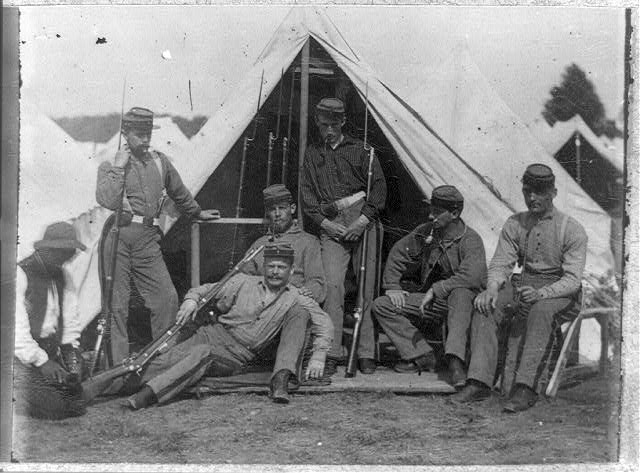
If you have spent any significant amount of time perusing Civil War photographs - especially Union soldier camp photographs - you have probably noticed the ubiquity of African American camp servants. These individuals, the majority of which were runaway slaves that flocked to the Union army as it marched into the Confederate states, are proof positive that a great number of these people were willing to take the risk of fleeing. They were men, women, boys, and girls all looking for freedom and the opportunity to finally receive payment for their labor. And, to think, so many slaveholders thought the wouldn't work without force. Among other myriad duties they shined shoes, groomed horses, cleaned officers' tents, cooked meals, and drove wagons and cattle herds.

Here are only a few:


Don't see him? Look in the tree.


Photographs courtesy Library of Congress

Wednesday, February 22, 2012

The Cost of War

Lest we forget...

Courtesy Library of Congress