Friday, July 29, 2011

Civil Rights Bus Tour - Day 4, July 14, 2011

Our first stop on day four was to Selma, Alabama. Selma, like Montgomery to the east, is on the Alabama River and based its economy on cotton for decades. We first visited the National Voting Rights Museum, which recently moved to its current location. The museum is a good example of how a local community is taking control and preserving its history without waiting for funds or outside help. Their aim is to honor the "foot soldiers" of the movement; those that didn't necessarily gain notoriety but stood up for their rights and what was right.


The museum has an amazing set of photos of the three marches that were planned to go from Selma to Montgomery. On February 18, 1965 Jimmie Lee Jackson was killed by an Alabama state trooper while trying to protect his mother during a voting rights protest. The first march was led by Hosea Williams and attempted on March 7, 1965 in protest of Jackson's death. The marchers were met by Sheriff Jim Clark's deputized citizens and when the marchers stopped to talk to the police they started being shoved and beaten. Seventeen of the marchers were hospitalized and the day went down in history as "Bloody Sunday."

The second march was organized by Dr. King and took place on March 9, 1965. 2500 people participated but it was stopped by a federal court order. King didn't want to disobey the federal order since he knew that federal authorities were his only possible protection.

On March 16, a federal judge ruled in the protesters favor and the third march went off on March 21. The marches made it to the steps of the state capitol in Montgomery on March 25. That night Viola Liuzzo, a white woman from Detroit who came to Alabama to help the voting rights effort was shot by members of the Ku Klux Klan while driving African American marchers back to Selma.

In the above photo Sheriff Clark's police patrol outside of Brown Chapel African Methodist Episcopal Church, which we next visited.

Brown Chapel AME Church is a unique place, as it can make the rare claim of having both Dr. King and Malcolm X speak there during the movement. Malcolm X spoke there on February 4, 1965, only weeks before he was killed in New York City on February 21, 1965. Brown Chapel is situated in a neat kept housing project neighborhood.


A monument to Dr. King, James Reeb, Jimmie Lee Jackson and Viola Liuzzo at Brown Chapel.


Our group on the historic steps of Brown Chapel


At the National Voting Rights Museum was a political election card for Sheriff Jim Clark (pictured above) with nightstick and cattle prod. It included a poem of sorts that stated:

Jim Clark Says
"NEVER"
Never be afraid to do what's right
Always be willing to stand and fight
Never be overcome by Socialism
For the next thing that follows is Communism
Never be overcome by Federal Control
Stand for States Rights true and bold
Never let true justice be forgotten or
Overrun in our Dixie Land of Cotton
Never be afraid of the Leftist Block
Stand true and firm like Gibralter's rock
Never dim the glow of bright true light
Always lead us through the restless night.


Making the walk across the bridge was a moving experience for me; much like being on a Civil War battlefield.

This historic photo shows marchers crossing over the Edmund Pettus Bridge.


A historic photo of "Bloody Sunday." The bridge can be seen in the background with clouds of tear gas.


Near the site of "Bloody Sunday" three monuments have been placed to honor some of those that fought for voting rights: Hosea Williams, John Lewis, Amelia Boyton Robinson and Marie Foster.


I couldn't resist snapping a picture of a genuine Alabama cane brake. This one was across Highway 80 from Essie's Place, where we ate a wonderful down home lunch.

Much of the rest of the day was spent traveling through west Alabama and into east Mississippi. We went through tornado ravaged Tuscaloosa. The damage was beyond belief where the twister touched down.


We finally found our way to Oxford, Mississippi, home of the University of Mississippi (Ole Miss) and William Faulkner. The courthouse square is your ideal southern setting. There are at least three bookstores in the numerous businesses around the courthouse so obviously I was in heaven. After having supper at City Grocery we headed on to Memphis.


This plaque on the Lafayette County, Mississippi Courthouse is a great Faulkner quote...a sentence that runs on forever.


A southern courthouse square would not be complete without the ubiquitous Confederate monument.

Tuesday, July 26, 2011

Civil Rights Bus Tour - Day 3, July 13, 2011


We arrived in steamy Montgomery, the capital city of Alabama, on Tuesday evening. We had amazing accommodations at the Renaissance Hotel in downtown Montgomery that made our two night stay very comfortable. My room window provided a great view of the Alabama River (above). The Alabama River is one big reason Montgomery grew in the 1820s and 1830s and became the capital of the state in the 1840s. Cotton grown in the interior of the state was often brought to Montgomery where it was traded and transported down this waterway to Mobile (Cotton City), which was probably only second to New Orleans as a port of export for the fluffy fiber that fed the state's economy.


The first stop in our site-packed Wednesday was not originally on our agenda, but our lead scholar, Dr. Gerald Smith suggested adding it due its great historical significance to the city and the Civil Rights Movement.

Holt Street Baptist Church was where the Montgomery Bus Boycott was organized and where a young Dr. King was chosen as the leader of the Montgomery Improvement Association. On December 5, 1955, Dr. King made his debut in the movement. That night the church was filled to overflowing as he addressed the crown with a short speech in what was originally intended to be a one day boycott. It ended up lasting 381 days.


Today Holt Street Baptist Church is empty and is quickly decaying. The congregation has moved into a different and more commodious location, but fortunately, does have intentions on preserving this historic landmark.


Our second stop was a view of the King parsonage on South Jackson St. It was here on January 31, 1956, that a bomb exploded that did not injury King's wife Coretta and young daughter Yolanda. Montgomery blacks rallied to the house and vowed revenge, but King advised to continue in their pursuit of a nonviolent strategy. The house was damaged again over a year later when a another bomb was planted near the front porch. Again, fortunately, no one was physically harmed.


Our next stop, the Civil Rights Memorial, commemorates 40 men and women who died advocating for civil rights between the years 1954 and 1968. The memorial, pictured above, was designed by Mya Lin, who also designed the Vietnam Memorial in Washington, D.C. The 40 names are carved on a beautiful black granite table as water constantly flows over them. The symbolism is fascinating. On the wall behind the memorial is carved words from one of Dr. King's speeches, "Until justice rolls down like water and righteousness like a mighty stream."


Of course a Civil Rights tour of Montgomery would not be complete without a visit to Dr. King's church, Dexter Avenue Baptist. The significance of the black churches in the Civil Rights Movement can not be overlooked was fully evident in our week long tour. As one black man during the Jim Crow Era said, "He turns to it [church] not only for his spiritual wants, but looks toward it as the center of his civilization. Here he learns the price of cotton or the date of the next circus; here is given the latest fashion plates or the announcement for candidates for justice of the peace."


After a lunch on our own we next reconvened at the Alabama state capitol building for a tour. The temperature was pushing 100 degrees at this point in the day, so I was happy to be in the air conditioned building. Our guide, an African American gentlemen who participated in the famous march from Selma to Montgomery as a young man mentioned that we were in the perfect place when I told him we had teachers that were studying "From Civil War to Civil Rights." He also explained that in his opinion there would never be a monument to the famous march on the capitol grounds because then governor George Wallace didn't allow the marchers to touch the capitol property. As the historic picture above shows the marchers made it right up to the capitol steps.


On the grounds are several tributes to the Confederacy. A huge monument to southern soldiers was erected on the grounds as well as the above monument to Jefferson Davis. Montgomery is often called the "Cradle of the Confederacy" as it was here that the Confederate government was formed, Jefferson Davis was inaugurated as its president, and this building served as the first capital of the Confederacy, before it was moved to Richmond, Virginia in May of 1861.


This star marks the location on the steps of the capitol building where Jefferson Davis was inaugurated on February 18, 1861.


In the above photo our tour guide tells us why the Alabama state capitol building is the most historically significant state capitol building in the United States. I think he has a good argument!


After our visit to the capitol, we went a few blocks back west to the Montgomery Greyhound Bus Station. Now, thanks to the efforts of the Alabama Historical Commission, this building is restored and protected to interpret the significant events of May 20, 1961 when the Freedom Riders attempted to integrate the public facility. Here the black and white riders were mobbed after their police protection disappeared and they were left to the mercy of their attackers who saw them as being "outside agitators."


A historic photo of Freedom Riders waiting to restart their trip.


It was at the Montgomery fountain square where seamstress Rosa Parks worked in a department store called Montgomery Fair, and outside of which, on December 1, 1955, she got on the bus and went into history. Parks, who had previously studied civil disobedience at the Highlander School in Tennessee, became the test case that civil rights lawyers were looking for. After Parks was warned to give her seat to a white person she refused and when warned that she would be arrested if she didn't move, she said, "You may do so."


A historic photo of 42 year old Rosa Parks being booked in Montgomery for refusing to give up her seat on the bus.


Parks's police finger prints are on display at the Rosa Parks Museum. It was at the museum's present location that the bus stopped and where Parks was arrested. The museum features the story of how the African American community of Montgomery worked to bring about social change. Men and women of all walks of life contributed, and even though the museum features the name of one person, it really honors all the "unsung heroes."

The Rosa Parks Museum also features a children's wing, which offers a magic time traveling bus where one goes back into time to learn where the word Jim Crow originated, as well as meet historic figures such as Homer Plessy, Harriet Tubman, Henry "Box" Brown, among others.


Sunday, July 24, 2011

Civil Rights Bus Tour - Day 2, July 12, 2011


We didn't finish out day one of our bus trip in Tennessee. We actually traveled on into Alabama and our first stop in the "Heart of Dixie" was not at a historic site, but at a travel rest stop.

I saw the above monument while at the rest stop and thought that it was an interesting marker due to its various possible interpretations across Alabama's history. In 1860-61 Alabamians would not have hesitated to declare their intention to defend their "southern rights," while one hundred years later African Americans would state their desire to defend their rights to integrate public facilities and to vote.

We spent our first traveling night in downtown Birmingham. Unfortunately, I had forgotten to pack one of my bags (it was at home on my bed) that had my toiletries, so I had to catch a cab to take me to a drugstore to purchase my necessaries. The cab ride was quite educational. My cabby was an African American man who did not hesitate to express this disdain that downtown had become a virtual ghost town after dark. He explained that it was busy enough during the day with all the businesses, but people for the past 10 to 15 years sought their evening entertainment out of the downtown area which had severely hurt his business. He complained that the University of Alabama no longer played any games at Legion Field in Birmingham and Saturdays in the fall that used to hum with activity were now dead.


Our first stop Tuesday morning was to Kelly Ingram Park. This park, named in 1932 for a local firefighter who the first U.S. sailor killed in World War I, served as a center for civil rights activism during the 1960s.

Prominently displayed in the park are a number of statues and sculptured artwork designed to commemorate Birmingham's role in the Civil Rights Movement. The statue of Dr. King was placed in 1986 and looks across the intersection at 16th Street Baptist Church.


One of the many impressive pieces of sculpture is the one above. It depicts the use of police dogs by the authorities to try to break up demonstrations in Birmingham. Many of the protesters were mere children.


Another piece of artwork gives the visitor the feeling of walking through a gauntlet of police dogs.


Yet another, shows the police tactic of using high pressure water hoses to discourage protesters.


And, yet another shows children jailed for their civil disobedience. The words on it say "I AIN'T AFRAID OF YOUR JAIL."


After spending some time in the park we walked across the intersection to the historic 16th Street Baptist Church. This church was one of the first established in Birmingham by African Americans and the building there now was built in 1911. The events that happened outside the church building, on 16th Avenue, on May 2-3, 1963, are depicted in the previously mentioned sculptures in Kelly Ingram Park.


The above photo is a historic image of the events of May 2-3, 1963 with the church in the background and police forces in the foreground. Notice the wet pavement from the fire hoses and wet clothing on the protesters.


This present-day shot of the church sign can be seen in the top right of the historic photo above and in the photo below.


On September 15, 1963 at 10:22 a.m. a planted bomb exploded outside a side entrance of the 16th Street Baptist Church.


The explosion killed four young ladies; Addie Mae Collins, Cynthia Wesley, and Carole Robertson, all 14 years old, and 11 year old Denise McNair. The above tablet was placed in their memory near where the bomb exploded. Another girl was injured in the blast, losing an eye and being terribly scarred, she survived. Robert Chambliss was convicted in 1977 for his role in the bombing and died in prison in 1985. Thomas Blanton Jr. and Bobby Frank Cherry were convicted in 2001 and 2002 for their roles in the bombing; all three men were affiliated with the Ku Klux Klan.


Another monument in memory of the four young ladies.

We next toured the museum at the Birmingham Civil Rights Institute which was just across the street from church and Kelly Ingram Park. The museum had some amazing artifacts including the cell where Dr. King wrote his famous "Letter from a Birmingham Jail" letter.


Our next stop after a number of miles of driving south and east was to Tuskegee University. Founded in the early 1880s, with help from recent graduate of Hampton Institute in Virginia Booker T. Washington, Tuskegee became known far and wide for it training programs in agriculture, veterinary and engineering programs for African American students. Washington was born a mixed race slave in 1856 in Franklin County, Virginia. After the Civil war Washington moved with his mother and step father to Kanawha County, West Virginia where he worked making salt and in local coal mines before being admitted to Hampton Institute.

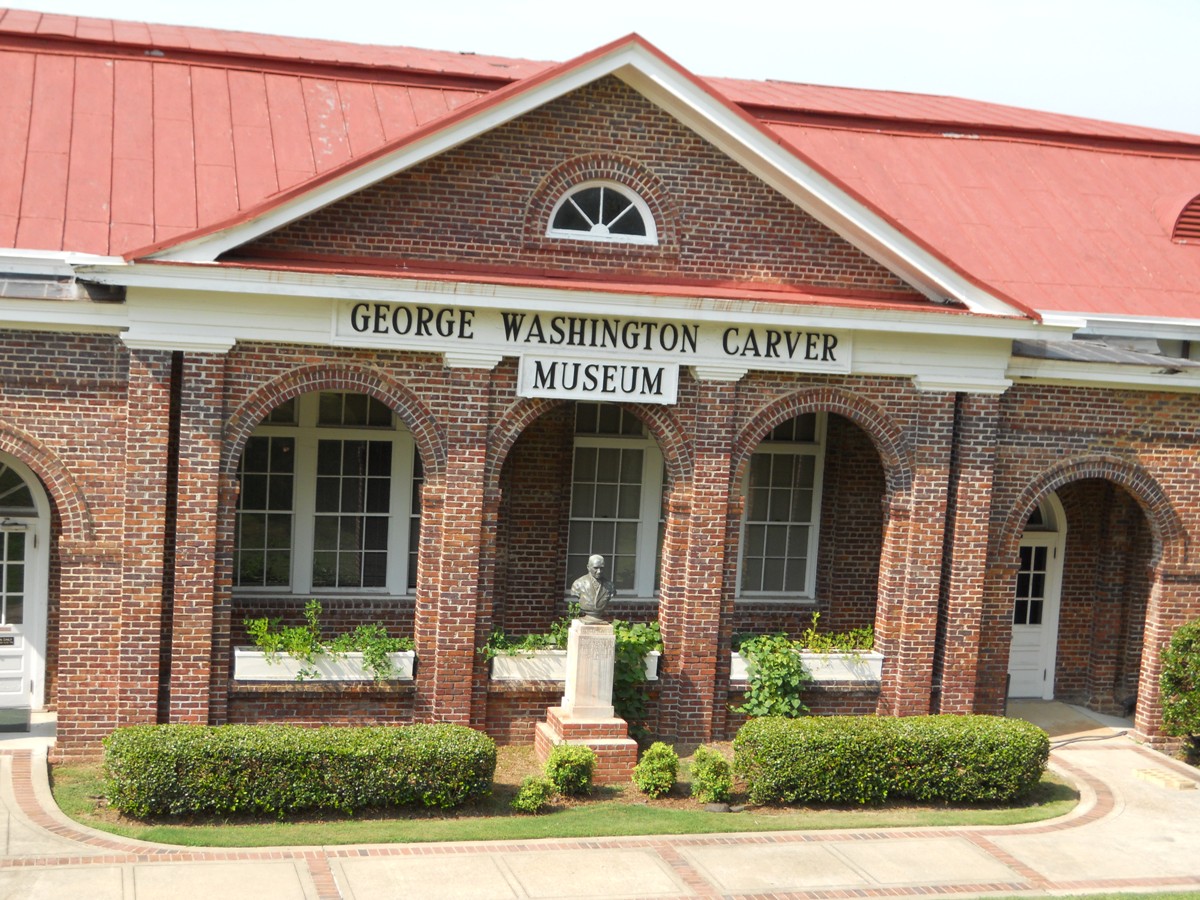
Tuskegee still thrives to this day and the National Park Service has established the George Washington Carver museum (pictured above) and maintains Booker T. Washington's former home, "The Oaks."


George Washington Carver was Tuskegee's most famous faculty member. The George Washington Carver Museum is a tribute to the man and his many inventions and discoveries. Carver was born a slave in Missouri during the Civil War (probably 1864) and received his high school education in Kansas and attended college at Iowa State University.


The Booker T. Washington monument on Tuskegee's campus is impressive. It depicts Washington lifting the veil of ignorance from African Americans. The black man holds a book and sits on an anvil and plow. Washington's accommodationist ideas were not appreciated by all African Americans, but he felt that was the most practical manner for blacks to achieve in the "Jim Crow" South.


Booker T. Washington's tombstone. Washington died in 1915.

George Washington Carver's grave at Tuskegee. Carver died in 1943.

"The Oaks," Booker T. Washington's home at Tuskegee was built in 1900 by Tuskegee students and he lived there until his death. Washington became sick while in New York on a speaking tour, but explained that "I was born in the South, I have lived and labored in the South and I expect to be buried in the South." He made it back to his beloved Tuskegee and passed away at his home on November 14, 1915.

Tuesday, July 19, 2011

Civil Rights Bus Tour - Day 1, July 11, 2011


It was a real pleasure to join 19 Kentucky teachers on a bus tour of Civil Rights Movement sites through the states of Tennessee, Alabama and Mississippi. Over the next several posts I will try to highlight some of these sights with images I took along the way and include some historic images as well.

After meeting in Lexington, Kentucky and getting on the bus our first stop after lunch at Neely's BBQ was to Fisk University in Nashville, Tennessee. I have been to Nashville many times, but I had never been on the campus of Fisk. Fisk has a long history that dates back to the Reconstruction era (1867). It was founded by the American Missionary Association and was named for Gen. Clinton B. Fisk, the Freedmen's Bureau commissioner for Tennessee and Kentucky.


A few short years after the founding of the institution it was in serious debt and was threatened with closing when school treasurer George White assembled a group of student singers, all but two of whom were former slaves and named them the Jubilee Singers. Going on the road they raised funds and helped keep Fisk's doors open to offer a rare chance at education to African American students. The humble monument above is dedicated to the Jubilee Singers and our tour guide explained that it was placed upon a stone foundation that formerly served as a slave auction block in Nashville.

The first building on what would eventually become the established campus was named Jubilee Hall (pictured above), which was built in 1876.


Our tour guide, an Iraq War veteran and graduate of Tennessee State University, told us that the Jubilee Singers not only toured around the United States, but also went to England and sang before Queen Victoria in 1873. It is believed that Nashville's name "Music City" came about when the queen heard the singers and said that they must be from a "musical city."


This beautiful portrait of the Jubilee Singers is proudly displayed in Jubilee Hall.


The architecture of Jubilee Hall is fantastic and the building is now listed as a National Historic Landmark.

One of Fisk's most famous alumni is historian (and one of my heroes) John Hope Franklin. Franklin passed away in 2009, but his legacy is memorialized in the name of the university's library; a very fitting tribute to the scholar. We were told that Dr. Franklin would only accept naming the library in his honor if his wife's name was included as well.


In the Franklin library is this portrait of a young John Hope and Aurelia Franklin on the Fisk campus. A large case in the library's lobby is dedicated to Dr. Franklin and his accomplishments during his long life. If you haven't read his autobiography Mirror to America, please do. I highly recommend it.

Probably the most famous alumni of Fisk is W.E.B. Du Bois. Du Bois graduated from Fisk in 1888 and entered Harvard that fall. He earned a bachelor's degree at Harvard and then studied in Germany before returning and becoming the first African American Ph.D. from Harvard in 1895. In 1909, he along with a group of like minded activists formed the NAACP.

While at Fisk we also visited the "Knowledge Tree." It was here that students came to study before their big tests and where student activists such as Dianne Nash planned civil disobedience actions like the Nashville lunch counter sit-ins and the Freedom Rides.

History abounds at Fisk University. In fact the school is known as the "brain trust" of the Civil Rights Movement. Unfortunately, Fisk's history that is not well known, but it should be. The university is a story of perseverance and accomplishment; overcoming long odds and making a way for future generations to experience and enjoy the benefits of a good education.

Monday, July 18, 2011

Civil Rights Movement Touring with Teachers

From Lexington Herald Leader; by Merlene Davis


Hope Brown, a teacher at Rowan County High School, has a passion for the civil rights movement.

"That passion made me want to be a teacher," she said.


It's also the reason she is accompanying other Kentucky teachers on a road trip through history, stopping at several sites in the South where significant events took place that thrust racial equality to the forefront of America's psyche during the 1950s and 1960s.


There are 19 Kentucky elementary, middle and high school teachers traveling as a part of "Democratic Visions: From Civil War to Civil Rights," a three-year professional development program for fifth-, eighth- and 11th-grade history teachers in Bath, Carter, Estill, Fleming, Menifee, Montgomery, Morgan, Powell, Pulaski, Rockcastle and Rowan counties.


Democratic Visions, in its final year, is a partnership among school districts, the Kentucky Historical Society, professors at the University of Kentucky and Berea College, and the Kentucky Heritage Council. The program is funded by a grant to Powell County Schools from the U.S. Department of Education's Teaching American History initiative. Similar grants, which are targeted at rural communities, have been awarded to Harlan and Letcher counties in recent years.


Twenty-seven people are on the trip, including UK history professor Gerald Smith; Kathi Kern, director of the UK Center for the Enhancement of Learning and Teaching, who wrote the grant; and Chad Berry, director of the Loyal Jones Appalachian Center at Berea College.


Smith, the lead scholar for this year's program, which is focusing on civil rights, said the group had just left Holt Street Baptist Church in Montgomery, Ala., when I called Wednesday. On Dec. 5, 1955, the church was the site of the first mass meeting of the Montgomery Improvement Association, led by the Rev. Martin Luther King Jr., which directed the Montgomery bus boycott.

"When I was given the opportunity to join three years ago, I looked forward to having the ability to see these sites and share in our shared history," said Chip Manley, a teacher at Montgomery County High School. "Even for me it is like walking on holy ground. You can feel the ghosts of history around you and imagine the struggle."


Holt Street Baptist Church has been abandoned and is in serious disrepair, Kern said. "There is no stewardship," she said. "That congregation has moved on."


Still, she said, "This trip is what we have been looking forward to."


Wednesday's tour also included the Dexter Avenue King Memorial Baptist Church & Parsonage, where King was pastor from 1954 to 1960 and where he began his civil rights odyssey, and the Southern Poverty Law Center, where the group learned more about Rosa Parks and Jo Ann Gibson Robinson, who worked with Parks to help the bus boycott succeed.


The tour began Monday with a stop in Nashville at Fisk University, where the second wave of Freedom Riders originated. The visit to Birmingham on Tuesday included 16th Street Baptist Church, where a bomb exploded Sept. 15, 1963, killing four little girls who were attending Sunday school, and a trip to Tuskegee University to learn more about Booker T. Washington and George Washington Carver.


In the coming days, the bus tour will travel to Selma, Ala.; Oxford, Miss.; and finally to Memphis, where they will tour the National Civil Rights Museum and talk with the Rev. Samuel "Billy" Kyles, who was with King when he was assassinated.

Teachers in Democratic Visions receive a $1,000 stipend or three hours graduate credit for full participation; are taught new teaching techniques; and are given books and teaching materials, in-class assistance and travel opportunities.


Smith is the only African-American on the tour. Rebecca Hanly, Teaching American History project director at the Kentucky Historical Society, said she has worked with the grants in Eastern Kentucky since 2002, and of the 150 teachers who have participated, only one was black.


There simply aren't that many African-American students or teachers in that area of Kentucky, she said. "It's just an interesting side effect," she said.


Manley agreed. "Seeing the experience, the stories and the photos are resources beneficial to not only African-American students, but also white students. This is something for everyone: the fight for justice and to overcome inequality."

The teachers who are participating are an enthusiastic group, Smith said. "You can hear that in their conversations."

It is definitely evident when talking with Rowan County's Brown.


"I'm trying to bring as much passion to the classroom as possible," she said, and nothing brings that home better than a visit to the sites students study in history and social studies classes.


A friend of mine is fond of quoting a Spanish proverb that says, "What the eyes don't see, the heart doesn't feel."

Because 19 teachers have seen for themselves some of the historic sites of the civil rights movements, hundreds of Kentucky students will have a better feel for and tolerance of the struggle for equality.