Monday, July 4, 2011

Of Webster and Whittier

I don't know how many blog posts that I have started with, "I recently finished reading," but it happens...a lot. Sorry for that, it's just that when I find things interesting I want to share my newly acquired knowledge. So, here goes...

I recently finished reading, At the Edge of the Precipice: Henry Clay and the Compromise that Saved the Nation, by Robert V. Remini, and I am currently reading Shadrach Minkins: From Fugitive Slave to Citizen, by Gary Collison. In these books the authors explained that after Henry Clay had proposed his packaged 1850 compromise, Daniel Webster (who along with Clay and John C. Calhoun made up the "Great Triumvirate") realized the significant importance of the compromise and thew his support behind Clay. Webster made a dramatic oration on the floor of the senate in attempt to assure its passage.

Webster (pictured above) started his March 7, 1850 speech by stating that he came that day, not as "a Massachusetts man, nor as a Northern man, but as an American." During the speech Webster explained his support for Clay's compromise and that in particular he approved of a strengthened fugitive slave law. Webster said that he saw that Southerners had a real grievance in that northern states were not holding up their constitutional obligations by returning fugitive slaves to their southern masters. He saw that if this was not remedied this issue could lead to continued strained relations between the sections and that the issue might bring on the worst thing possible...civil war.

Webster's Senate declarations were not well received by northern abolitionists, who, though small in percentage of the northern population, were quite vocal and had excellent access to the press and publications.

One of those disturbed by Webster's remarks was poet John Greenleaf Whittier. Soon after hearing about Webster's speech Whittier wrote "Ichabod," by which he meant "inglorious," or "the glory has departed."

Whittier gave the following explanation for writing the poem:

"This poem was the outcome of the surprise and grief and forecast of evil consequences which I felt on reading the seventh of March speech of Daniel Webster in support of the `compromise,' and the Fugitive Slave Law. No partisan or personal enmity dictated it. On the contrary my admiration of the splendid personality and intellectual power of the great Senator was never stronger than when I laid down his speech, and, in one of the saddest moments of my life, penned my protest. I saw, as I wrote, with painful clearness its sure results, -- the Slave Power arrogant and defiant, strengthened and encouraged to carry out its scheme for the extension of its baleful system, or the dissolution of the Union, the guaranties of personal liberty in the free States broken down, and the whole country made the hunting-ground of slave-catchers. In the horror of such a vision, so soon fearfully fulfilled, if one spoke at all, he could only speak in tones of stern and sorrowful rebuke.

But death softens all resentments, and the consciousness of a common inheritance of frailty and weakness modifies the severity of judgment. Years after, in The Lost Occasion, I gave utterance to an almost universal regret that the great statesman did not live to see the flag which he loved trampled under the feet of Slavery, and, in view of this desecration, make his last days glorious in defence of "Liberty and Union, one and inseparable."

Ichabod

So fallen! so lost! the light withdrawn
Which once he wore!
The glory from his gray hairs gone
Forevermore!
Revile him not, the Tempter hath
A snare for all;
And pitying tears, not scorn and wrath,
Befit his fall!
Oh, dumb be passion's stormy rage,
When he who might
Have lighted up and led his age,
Falls back in night.
Scorn! would the angels laugh, to mark
A bright soul driven,
Fiend-goaded, down the endless dark,
From hope and heaven!
Let not the land once proud of him
Insult him now,
Nor brand with deeper shame his dim,
Dishonored brow.
But let its humbled sons, instead,
From sea to lake,
A long lament, as for the dead,
In sadness make.
Of all we loved and honored, naught
Save power remains;
A fallen angel's pride of thought,
Still strong in chains.
All else is gone; from those great eyes
The soul has fled:
When faith is lost, when honor dies,
The man is dead!
Then, pay the reverence of old days
To his dead fame;
Walk backward, with averted gaze,
And hide the shame!


Friday, June 24, 2011

Franklin & Armfield Slave Office


While in Alexandria, Virginia last weekend I saw listed on a tourist map outside the Metro station a place marked as the "Freedom House." This building is actually the former office of Franklin and Armfield, antebellum slave dealers. It now houses the Freedom House Museum, which was developed by the Northern Virginia Urban League, "to preserve the story of thousands of men, women and children who passed through this place on a harrowing journey to lives of bondage and hard labor in the Deep South." Unfortunately, the museum was closed when we visited.

In the tourist handbook "A Remarkable and Courageous Journey: A Guide to Alexandria's African American History" the following interpretation of the building is provided: "This building served as the headquarters for the slave trade operations of Isaac Franklin and John Armfield, a partnership formed in 1828. Exporting thousands of blacks south, this was one of the largest intrastate slavetrading companies in the country. Enslaved African Americans were housed in 'pens' - walled areas with males to the west and females to the east. In January 1834, J. Leavitt, editor of the New York Evangelist, visited the slave pens. As recounted by Leavitt:
'We were first taken out into a paved yard 40 or 50 feet square, with a very high brick wall and about half of it covered with a roof...He (Armfield) ordered the men to be called out of the cellar where they sleep...they soon came up...50 or 60. While they were standing, he ordered the girls to be called out...About 50 women and small children came in...and I thought I saw in the faces of these mothers some indication of irrepressible feeling. It seemed to me that they hugged their little ones more closely, and that a cold perspiration stood on their foreheads.' During the Federal occupation of Alexandria, the building became a jail for captured Confederate soldiers and errant Union soldiers, as well as housing 'contrabands,' blacks seeking freedom behind Union lines."


Wednesday, June 8, 2011

Glendy Burke

Glendy Burk(e) was not only the name of one of Stephen C. Foster's most popular songs, it was also the name of a real steamboat that plied the waters of the Mississippi and Ohio Rivers.

The side-wheel packet steamer weighed 425 tons and was built by Howard Shipyards in Jeffersonville, Indiana and owned by the firm of Cobb and Nanlove in Vicksburg, Mississippi. It was first launched in 1851, but the Glendy Burke lived a short life. It sank in 1855 near Cairo, Illinois.

The boat was named for Glen D. Burke who was a wealthy merchant, banker, and later, mayor of New Orleans.

The song, published in 1860, is a lively air written in blackface dialect with what are (like many of Foster's songs) somewhat nonsensical lyrics.


De Glendy Burk is a mighty fast boat,
Wid a mighty fast captain too;
He sits up dah on de hurricane roof
And he keeps his eye on de crew.
I cant stay here, for dey work too hard;
I'm bound to leave dis town;
I'll take my duds and tote 'em on my back
When de Glendy Burk comes down.
Chorus:
Ho! for Lou'siana!
I'm bound to leave dis town;
I'll take my duds and tote 'em on my back
When de Glendy Burk comes down.

De Glendy Burk has a funny old crew
And dey sing de boatman's song,
Dey burn de pitch and de pine knot too,
For to shove de boat along.
De smoke goes up and de ingine roars
And de wheel goes round and round,
So fair you well! for I'll take a little ride
When de Glendy Burk comes down.

I'll work all night in de wind and storm,
I'll work all day in de rain,
Till I find myself on de levy dock
In New Orleans again.
Dey make me mow in de hay field here
And knock my head wid de flail,
I'll go wha dey work wid de sugar
And de cane And roll on de cotton bale.
My lady love is as pretty as a pink,
I'll meet her on de way
I'll take her back to de sunny old south
And dah I'll make her stay.
So dont you fret my honey dear,
Oh! dont you fret Miss Brown
I'll take you back 'fore de middle of de week
When de Glendy Burk comes down.

Image courtesy of Dave Thomson and located at www.steamboats.com

Tuesday, June 7, 2011

The Bivouac of the Dead

There are a number of famous people buried in the Frankfort Cemetery. Daniel and Rebecca Boone are there. Vice President Richard M. Johnson is too. Simon B. Buckner and John J. Crittenden are just two of the many Kentucky governors who are there. Although only famous because of his father, Henry Clay, Jr's final resting place is there as well.

Frankfort Cemetery too, is the location of Theodore O'Hara's gave. Who? Theodore O'Hara. You know the guy that wrote the poem "The Bivouac of the Dead;" the poem which graces almost every military cemetery in America. Many people think that particular poem is from the Civil War, but it is actually from the Mexican American War. O'Hara wrote it to commemorate a monument in the Frankfort cemetery to his fellow Mexican American War veterans from the commonwealth.

O'Hara was born in Danville, Kentucky in 1820, but as a youngster his family moved to Frankfort. He was educated at Centre College and St. Joseph's Academy. He briefly studied law but worked in Washington D.C. at the Treasury department before the outbreak of the Mexican American War.

Apparently O'Hara was a firm believer in America's "manifest destiny," as during the war he held officer positions, and in 1850, joined in an expedition to remove Spanish rule from Cuba, where he was wounded in the leg. After his military adventures O'Hara went to writing, as the editor for newspapers in Louisville, Frankfort, and Mobile, Alabama.

Martial spirit must have been in O'Hara's blood, because when the Civil War broke out he joined the Confederate cause and became the lieutenant colonel of the 12th Alabama infantry regiment. He participated in epic Western Theater battles such as Shiloh and Murfreesboro.

After the war O'Hara tried the cotton business but a fire ruined that prospect. His short life ended in 1867, at at age 47, when he died of fever (probably malaria) at Guerrytown, Alabama. He was first buried in Columbus, Georgia, but his remains were eventually reinterred in Frankfort in the 1870s.

The Bivouac of the Dead

The muffled drum's sad roll has beat
The soldier's last tattoo;
No more on Life's parade shall meet
That brave and fallen few.
On fame's eternal camping ground
Their silent tents to spread,
And glory guards, with solemn round
The bivouac of the dead.

No rumor of the foe's advance
Now swells upon the wind;
Nor troubled thought at midnight haunts
Of loved ones left behind;
No vision of the morrow's strife
The warrior's dreams alarms;
No braying horn or screaming fife
At dawn shall call to arms.

Their shriveled swords are red with rust,
Their plumed heads are bowed,
Their haughty banner, trailed in dust,
Is now their martial shroud.
And plenteous funeral tears have washed
The red stains from each brow,
And the proud forms, by battle gashed
Are free from anguish now.

The neighing troop, the flashing blade,
The bugle's stirring blast,
The charge, the dreadful cannonade,
The din and shout, are past;
Nor war's wild note, nor glory's peal
Shall thrill with fierce delight
Those breasts that nevermore may feel
The rapture of the fight.

Like the fierce Northern hurricane
That sweeps the great plateau,
Flushed with triumph, yet to gain,
Come down the serried foe,
Who heard the thunder of the fray
Break o'er the field beneath,
Knew the watchword of the day
Was "Victory or death!"

Long had the doubtful conflict raged
O'er all that stricken plain,
For never fiercer fight had waged
The vengeful blood of Spain;
And still the storm of battle blew,
Still swelled the glory tide;
Not long, our stout old Chieftain knew,
Such odds his strength could bide.

Twas in that hour his stern command
Called to a martyr's grave
The flower of his beloved land,
The nation's flag to save.
By rivers of their father's gore
His first-born laurels grew,
And well he deemed the sons would pour
Their lives for glory too.

For many a mother's breath has swept
O'er Angostura's plain --
And long the pitying sky has wept
Above its moldered slain.
The raven's scream, or eagle's flight,
Or shepherd's pensive lay,
Alone awakes each sullen height
That frowned o'er that dread fray.

Sons of the Dark and Bloody Ground
Ye must not slumber there,
Where stranger steps and tongues resound
Along the heedless air.
Your own proud land's heroic soil
Shall be your fitter grave;
She claims from war his richest spoil --
The ashes of her brave.

Thus 'neath their parent turf they rest,
Far from the gory field,
Borne to a Spartan mother's breast
On many a bloody shield;
The sunshine of their native sky
Smiles sadly on them here,
And kindred eyes and hearts watch by
The heroes sepulcher.

Rest on embalmed and sainted dead!
Dear as the blood ye gave;
No impious footstep here shall tread
The herbage of your grave;
Nor shall your glory be forgot
While Fame her record keeps,
For honor points the hallowed spot
Where valor proudly sleeps.

Yon marble minstrel's voiceless stone
In deathless song shall tell,
When many a vanquished ago has flown,
The story how ye fell;
Nor wreck, nor change, nor winter's blight,
Nor time's remorseless doom,
Can dim one ray of glory's light
That gilds your deathless tomb.

Thursday, June 2, 2011

Kingdom Coming

No matter what President Lincoln claimed in his first inaugural address, some people, both North and South, realized that the Civil War would eventually bring emancipation to the almost four million African Americans held in bondage.

One person that apparently saw the handwriting on the wall was Henry Clay Work. In 1862 Clay published "Kingdom Coming." Work was born in Middletown, Connecticut in 1832, and his father was an antislavery man and apparently passed on his sentiments to the son.

"Kingdom Coming," written in the then popular blackface dialect, now viewed as offensive to many people, is regardless a skillfully written tune that showed that the mere presence of the Union army would aid slaves in their search for freedom.

The lyrics:

Say, darkeys, hab you seen de massa,
Wid de muffstash on his face,
Go long de road some time dis mornin',
Like he gwine to leag de place?
He seen a smoke, way up de ribber,
Whar de Linkum gumboats lay;
He took his hat, an' lef berry sudden,
An' I spec he's run away!

De massa run? ha, ha!
De darkey stay? ho, ho!
It mus' be now de kingdom comin',
An' de year of Jubilo!

He six foot one way, two foot tudder,
An' he weigh tree hundred pound,
His coat so big, he couldn't pay de tailor,
An' it won't go half way round.
He drill so much they call him Cap'an,
An' he get so drefful tann'd,
I spec he try an' fool dem Yankees
For to tink he's contraband.

De darkey's feel so lonesome libing
in de loghouse on de lawn,
Dey move dar things to massa's parlor
For to keep it while he's gone.
Dar's wine an' cider in de kitchen,
An' de darkey's dey'll hab some;
I spose dey'll all be cornfiscated
When de Linkum sojers come.

De oberseer he make us trouble,
An' he dribe us round a spell;
We lock him up in de smokehouse cellar,
Wid de key trown in de well.
De whip is lost, de han'cuff broken,
But de massa'll hab his pay;
He's ole enough, big enough, ought to known better
Dan to went an' run away.

Reading the words does not do the song justice...it truly has to be heard to do it justice. Here's a version by the 2nd South Carolina String Band - http://www.youtube.com/watch?v=7wgpJDGy4Bo

Work wrote a number of other Civil War standards, including "Babylon is Fallen," "Come Home Father," and probably his most well known tune, "Marching Through Georgia." He continued to pen songs long after the war was over passing away in Hartford, Connecticut in 1884.

Monday, May 30, 2011


In reading Ernest B. Furguson's Ashes of Glory: Richmond at War I ran across quite an interesting quote from Confederate Congressman Warren Akin. Akin wrote to his wife Mary in Georgia about the possibility of enlisting blacks to join the Confederate army. This was in the fall of 1862, way before most people, especially politicians, seriously considered this extreme measure.

Akin fully understood that, "It is a question of fearful magnitude." He wrote, "To call forth the negroes in the army with the promise of freedom, will it not be giving up the great question involved by doing the very thing Lincoln is now doing?" However, if it assured Confederate success and ultimately independence Akin was for it.

But the thoughts related to this important matter troubled Akin's mind. The logic of it did not seem to make sense to him. Warren asked Mary, 'Have you ever noticed the strange conduct of our people during this war?" How people of the Confederacy could oppose a measure that could help win the war seemed to have a hypocritical twist. Akin continued, "They give up their sons, husbands, brothers & friends, and often without murmuring, to the army; but let one of their negroes be taken, and what a howl you will hear. The love of money had been the greatest difficulty in our way to independence - it is now our chief obstacle...."

Of course, the Confederacy would eventually enlist African Americans. But, not until it was a last resort measure, and not until the last weeks of the war. And, not with much success in numbers or effectiveness. Undoubtedly, more slaves ran away from Richmond homes and farms and served in the Union army than ever were armed and enlisted for the Confederacy.

Thursday, May 26, 2011

Kentuckian Richard T. Jacob at Cooper Union

Most students of the Civil War are aware of Lincoln's emergence as a viable Republican candidate for the presidential nomination after his appearance and speech at New York City's Cooper Union Institute in February 1860. But, I am sure fewer people are cognizant of the irony in that a fervid call was made for a change in administrations in the same building just four years later.

In March 1864 several men spoke at Cooper Union in effort to support former commander of the Army of the Potomac George B. McClellan as a Democratic presidential nominee. Septuagenarian and former Andrew Jackson "kitchen cabinet" member Amos Kendall spoke first and wished that his former boss was still around to correct matters between the North and South. "If the Old Chief was alive he would say to the men of the North, mind your own business [slavery agitation]; to the men of the South, submit to the Constitution and the laws [no secession]."

After Kendall spoke, resolutions were announced, which included one that called the Lincoln administration "imbecile" and ended with the following: "Resolved, That we recognize in Gen. George B. McClellan, qualifications which eminently fit him to be the the deliverer and savior of our country [McClellan's big head must have loved reading this], and we hold it to be the paramount duty of all patriotic citizens and organizations to abandon all disturbing questions [slavery], and rally around him as the destined preserver of our constitutional liberties."

Next up to speak was Kentucky Lt. Governor Richard Taylor Jacob. Jacob was from an influential Kentucky family that had strong political connections. He was a second cousin of former president Zachary Taylor and his sister had married a son of the famous Henry Clay. Jacob himself married a daughter of noted Missouri Senator Thomas Hart Benton, which also made him a brother-in-law to John C. Fremont, who was the first Republican presidential candidate back in 1856. Jacob had served as colonel of the 9th Kentucky Cavalry (U.S.) until he was elected to his public office in 1863.

The following is what was printed in the New York Times on March 18, 1864:
"Hon. R.T. Jacobs [sic], of Kentucky, was next introduced. He said [Andrew] Jackson once declared that the Union must and should be preserved. If he were present there, he would add the Constitution must and shall be preserved. The speaker alluded to the 'miserable Abolitionists,' which the audience construed to be a reflection on the North, and greeted Mr. Jacobs with groans and hisses, making it difficult for him to proceed with his remarks. After quiet was restored, the speaker commented at length on the affairs of the nation. He said Southern traitors had broken up the Democratic party to destroy the Union. He was willing to wait until Mr. Lincoln committed some overt act, and then he would appeal to the people to sustain the Constitution. He believed the Union was indestructible, and he would stand by it. He was willing to receive the rebels as citizens, with all their former rights, when they came under the banner of the country, but not before. Upon the head of the [Lincoln] Administration rested the misery of the Union men of the South. They had been deceived by false promises. He didn't care anything about the negro. If he [the Negro] went down incidentally with the rebellion, let him go. All he cared for was the preservation of the Constitution. He would not give an inch to the rebellion, neither would be allow a violation of the Constitution. He would appeal to the flag - to his country, to stand by the Constitution. If that was treason, make the most of it. The speaker concluded by saying that he looked forward to the next November election with great hope."

Anthony Banning Norton, an editor of a Texas Unionist newspaper and who had been exiled from the state earlier in the war spoke next. "He thanked God he was reared in the old Whig school, the school of Henry Clay (cheers), in which he was taught the value of the Union, and to stand by it in every difficulty and every emergency, and it was for this reason that while the mad waves of secession rolled about Texas he stood true to the old Union." Norton too praised "Little Mac."

Last to speak was Colonel Max Langenschwartz who claimed, "We had in four years, run up a national debt double what our citizens had in seventy-two years. George B. McClellan must be our next President; and if Lincoln were to ask him why, he would reply, 'Because it is a military necessity.'" Langenschwartz's rhetoric was well practiced, in a different speech at a different time he called on the Republican party to add to polygamy to their emancipation, confiscation and miscegenation so "a man could have a yellow wife from China, a brown wife from India, a black wife from Africa, and a white wife from his own county, and so have a variegated family..."

The meeting ended with cheers for Amos Kendall, McClellan and others.

Obviously Cooper Union did not hold the same good fortune for McClellan as it did for Lincoln four year earlier. But, that didn't mean there wasn't a significant and strong concerted effort in the North to induce a change in administrations prior to the 1864 elections.

Sunday, May 22, 2011

A Sunday Stroll in Frankfort's Greenhill Cemetery


With the upcoming Memorial Day on my mind, I decided to take a rather short walk down Versailles Road to the Greenhill Cemetery here in Frankfort.

Several years ago, before I began studying history seriously, I never thought much about segregation and that in the past people felt the need to separate the white and black races on everything from eating and entertainment facilities to where their bodily remains would rest for time immemorial. Of all things segregated, cemeteries to me seem the most ridiculous. But, nonetheless, custom and tradition determined that Greenhill would be the historically African American cemetery here in Kentucky's capital city.

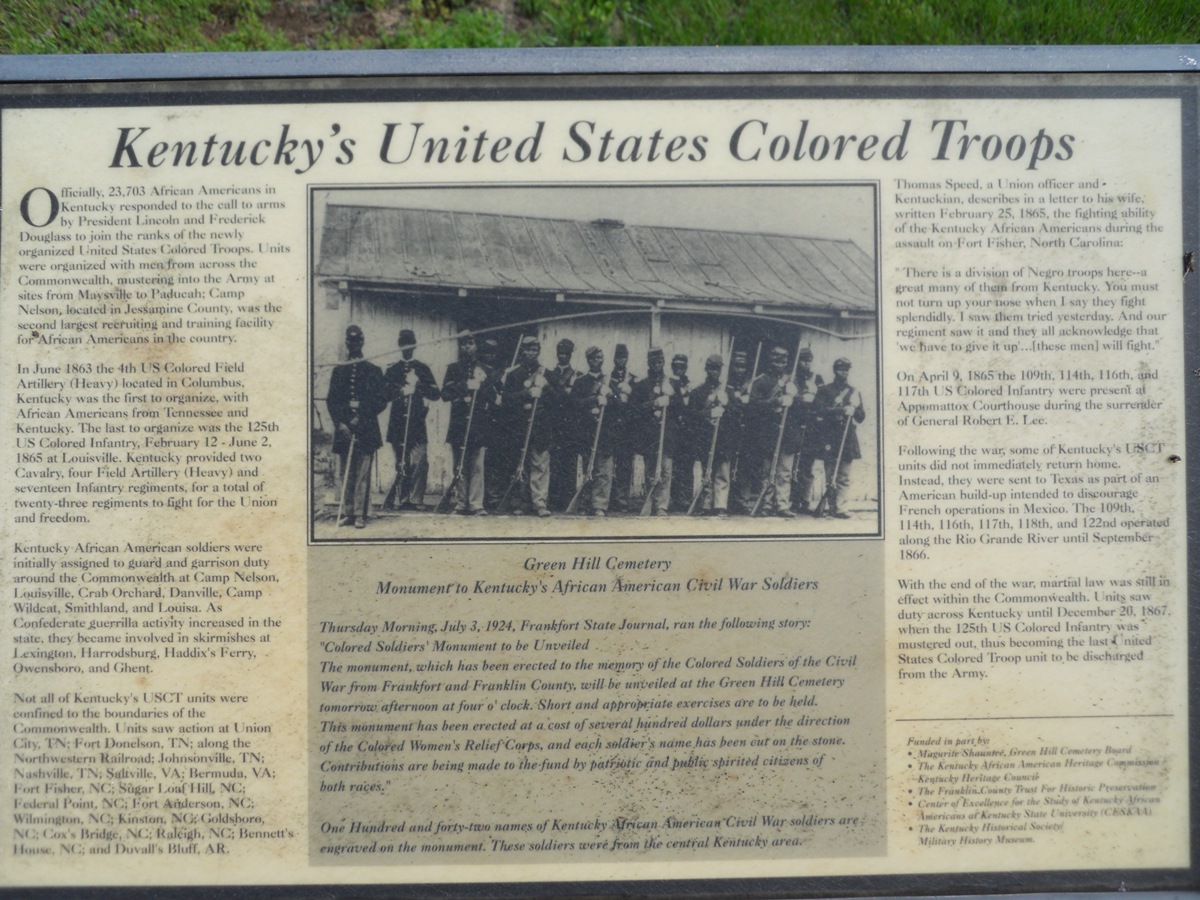
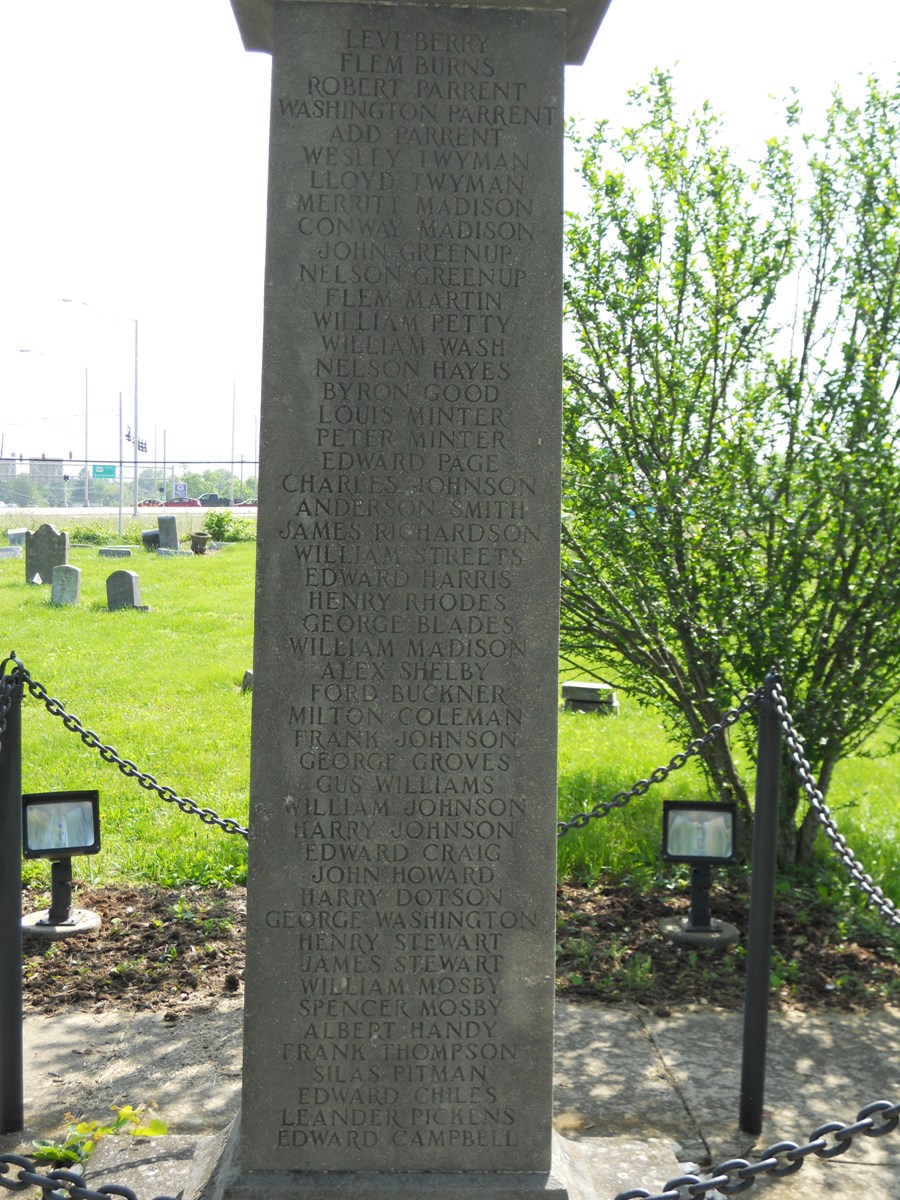
I had previously posted about the Colored Soldiers Monument at Greenhill back on June 8, 2010, and I drive past it twice everyday on my way to and from work, but ashamedly I had never taken the time to make a personal visit. I suppose I should not have been surprised to see the memorialization that vividly shows the local African American population's contributions the United States military over the years, but I was. I saw headstones for African American soldiers that were involved in every major US combat endeavor from Korea back to the Civil War while I was in Greenhill, but the number of Civil War soldiers stood out to me in particular.

A wayside interpretive marker in Greenhill Cemetery


A memorial marker dedicated by Kentucky State University

The Colored Soldiers Monument - erected 1924 (north elevation)

The Colored Soldiers Monument (west elevation)

The Colored Soldiers Monument (south elevation)

The Colored Soldiers Monument (east elevation)

Howard Anderson, Co. E, 119th United States Colored Infantry

Corporal Alexander Rennick, Co. F., 5th United States Colored Cavalry, Born March 4, 1841

Newton Bush, Co. E., 5th United States Colored Cavalry

James Butler, Co. I, 114th United States Colored Infantry

Corporal Morrison Butcher, Co. H, 114th United States Colored Infantry

Lewis Page, Co. F, 5th United States Colored Cavalry

Corporal Lewis A. Smith, Co. G, 117th United States Colored Infantry

Guy Owens, Co. I, 115th United States Colored Infantry

Corporal Frank Johnson, Co. K, 12th United States Colored Heavy Artillery

Corporal Benjamin Brightwell, Co. G, 114th United States Colored Infantry

John Roward, Co. I, 114th United States Colored Infantry

Jason Payne, Co. H, 119th United States Colored Infantry

Henry Starks, Co. G, 114th United States Colored Infantry

George Washington, Co. I, 114th United States Colored Infantry

William Pedrick, Co. F, 113th United States Colored Infantry

Sergeant Conway Madison, Co. D, 116th United States Colored Infantry

Merritt Madison, Co. D, 116th United States Colored Infantry

Isaac Frank, Co. F, 116th United States Colored Infantry

Levi Berry, Co. I, 107th United States Colored Infantry

William Streets, Co. K, 12th United States Colored Heavy Artillery

Harry Johnson, Co. K, 6th United States Colored Cavalry

Henry Rhodes, Co. C, 114th United States Colored Infantry

Edward Mitchell, Co. H, 8th Regiment, United States Volunteer Infantry, Spanish American War
Willie A. Queen, Kentucky Private First Class, US Army, World War I

Kenneth Childs, US Army, World War II

Howard R. Caldwell, Kentucky Private First Class, US Army, Korea

Saturday, May 21, 2011

Shouldn't an Editor Catch These?

Reading as much as I do I often come across references in books that I know are incorrect. It is a pet peeve of mine to see errors, especially when they are in books published by some of the most reputable printers of scholarly works.

For example, I recently just finished reading A Savage Conflict: The Decisive Role of Guerrillas in the American Civil War by Daniel Sutherland, a professor at the University of Arkansas. I had read a number of other works by Sutherland and had heard great reviews on this new book, so I was excited to get started.

The book did not disappoint. It is one of the best books that I have read this year. And, the author makes a great case for his thesis that guerrilla warfare severely weakened support for the Confederate cause by showing that the southern government could not protect its citizens from retaliations by Unionist guerrillas and the Union army.

But, something that also caught my attention, was the couple of errors that I discovered in my reading. The first, one which I found glaring was on page 81. I quote: "Colonel John A. Garfield, future president of the United States, believed Unionists in parts of eastern Kentucky were determined enough by March 1862 to resist the 'small bands of reckless men' who still endangered them." Whaaaaa? I thought it was James A. Garfield. Surely, this must have been a typographical error! Well, maybe it was, but when I checked the index it too listed, "Garfield, John A., 81." Sure, it is only a difference of a few little letters, but isn't this something that an editor should catch before the book is printed?; especially when it is being published by probably the best publisher of scholarly Civil War works around, the University of North Carolina Press?

I found another small error later, toward the end of book. On page 267, it mentions Robert E. Lee's effort to combine forces with Joseph E. Johnston after the fall of Petersburg and Richmond, but in the next paragraph it stated, "Only the combined forces of Lee and Johnson, not scattered partisan bands, could halt the enemy's advance." Uh, it's Johnston, you just said it was Johnston; why now say Johnson?

Not too long ago I came across a reference that was clearly intended to be about Braxton Bragg, one time commander of the Army of Tennessee, but incorrectly named him as Thomas Bragg. Thomas was Braxton's older brother, and for a short time Attorney General of the Confedearcy, but was not a Confederate general.

It is not only names that are often printed incorrectly. Another book I recently read stated in error that the Battle of Perryville, Kentucky occurred on October 16 and 17, 1862. The battle actually occurred on October 8, 1862. Who is proofreading these books?

I am sure that I make my fair share of typos and grammatical errors in writing my blog posts, but I hope that if I do ever find myself fortunate enough to get an article or book published, my editor catches those little mistakes that can prove to be so embarrassing, because, after all, a blog post can be edited once published online, but once something's in print, it's there forever.

Monday, May 16, 2011

A Kentucky Union Soldier in January 1863

Writing to his sister Jennie on January 15, 1863, while aboard the steamboat War Eagle, on the Mississippi River, Kentucky Union soldier John T. Harrington provided some interesting opinions on the Confederates that were his supposed enemies and his service in Mr. Lincoln's army.

Harrington opened his missive with a description of the horrors of a recent battle, where "one poor fellow received a ball full in the forehead which was right in front of me[.] he turned over, gave a rattling groan and expired." He saw this as fateful providential intervention, "for had he not been perfectly in front of me my head would have received the fatal shot." He continued, "I have seen war in all its horrors." He explained that he had been part of the victorious forces during his service and he had been routed by the enemy because of political generals that should not have been in command.

Harrington's thoughts on combat give us a small glimpse of what combat must have been like, and surely his sentiments were shared by almost all of his comrades, but his comments in the next paragraph caught me off guard and probably caught his sister off guard too. And, they make me wonder if others in the 22nd Kentucky Infantry felt likewise.

"At Arkansas Post I witnessed another kind of fight in which our side triumphed in every particular and finally planted the colors on the works of the vanquished foe, amidst the deafening shouts of a victorious army. Jennie bear in mind these men [Confederates] were overpowered but not conquered. I spent over an hour among them that night and on the word of a soldier they are men and men of the of the days of [17]76 men who have their hearts enlisted in their cause who believe God is with them and even willing to favor and defend them from the hand of oppression."

Some interesting compliments to give to the enemy who just tried to kill him, right? Well, possibly the next paragraph gives some insight into why he bestowed the favors on his foes and considered them patriots similar to those of the Revolutionary War.

"Sister you may think the above a singular expression for a Federal soldier but it is true. I enlisted to fight for the Union and the Constitution but Lincoln puts a different construction on things and and now has us Union men fighting for his Abolition Platform and thus making us a hord of Subjugators, house burners, negro thieves and devestators of private property." Harrington closed with a declaration of faith. "The Lord is with those who love him and I doubt not he will protect in the hour of danger and in time make a breech by which I will escape this thralldom [servitude]."

This letter, as previously mentioned, was written on January 15, 1863. President Lincoln's Emancipation Proclamation went into effect on January 1. Could Harrington's views on race and slavery have changed his opinion of his enemies. Did he now find more similarity between his own beliefs ant that of the Confederates rather than those commanding his army? Did the Emancipation Proclamation cause him to reconsider not only what he was fighting for, but what he thought his enemies were fighting for? And, in writinging "in time make a breech by which I will escape this thralldom" did he mean he wished to exit the service now that the Union aims included abolition?

Saturday, May 14, 2011

One Woman's Take


It doesn't surprise me anymore to find letters from Civil War era people to their elected officials. I think that people back then thought that their sentiments would be listened to more than we do today.

Writing from Logan County in southern Kentucky Sue H. Burbridge wanted President Lincoln to hear her concerns even before he officially took office. On January 20, 1861 she wrote:

Dear Sir

The negros have taken up the notion, or rather it has been taught them by beggers and Gipsies, that as soon as you were elected they would all be free. They have commence their work of poisining and Incendiaryism. Now all I want to know is make them know it, so that they may go to work and wait until the next presidential Election to cut up again. I wish you would ask your Estimable Lady how she would like, "just as she gets a good cook for some stragling begger, peddler or fortune teller to come along and pursuade her that some one would give her higher wages on the other side of town. For God sake Dear Sir give us women some assurance that you will protect us, for we are the greatest Slaves in the South.

Respectfully

Sue H Burbridge

It is not known if Abraham Lincoln responded to this woman's fears or even if he read her letter. Knowing Lincoln I would not be surprised if he did both. Letters like this might be one of several reasons he treated the border slave states with kid gloves early in the war.

Her mention of gypsies and peddlers as the cause of trouble with slaves was a common concern among citizens of the slave states. Whether these traveling salesmen and wandering performers were responsible or not, they often drew the wrath of community members concerned with personal safety and maintaining their slaves as property. Peddlers were particularly targeted for vigilante harassment. Treatments of tar and feathers or a ride out of town on a rail were not rare. For the citizens of the slave states the law of self preservation remained primary to any rights bestowed by government and written laws.